Knowledge How do quartz crucibles and quartz cover plates protect the substrate? Optimize TiO2 Nanowire Growth
Author avatar

Tech Team · Kintek Furnace

Updated 1 day ago

How do quartz crucibles and quartz cover plates protect the substrate? Optimize TiO2 Nanowire Growth


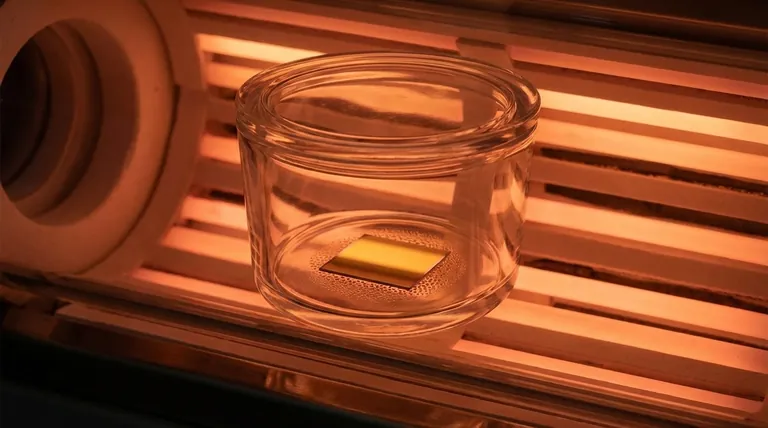
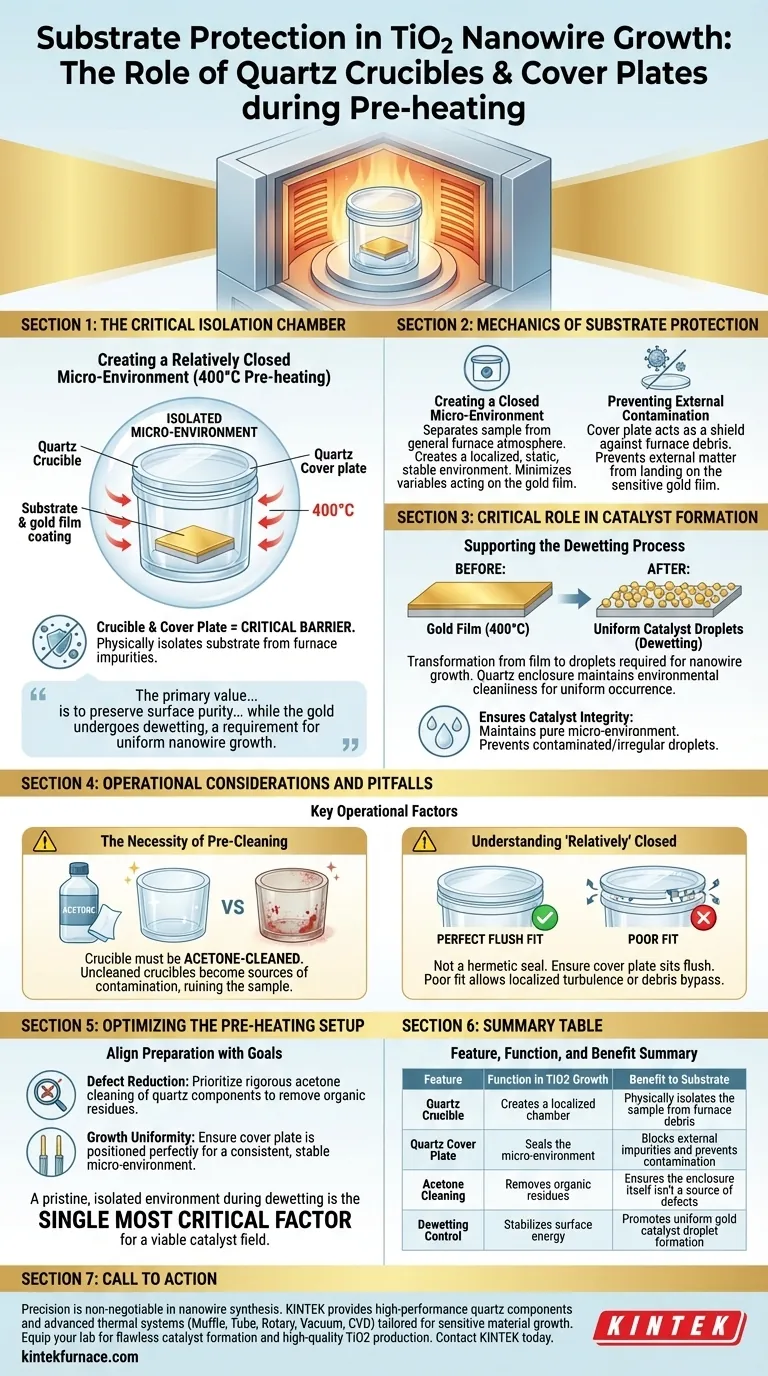
The combination of a quartz crucible and cover plate functions as a critical isolation chamber during the 400°C pre-heating phase. By sealing the gold-deposited substrate inside this assembly, you create a "relatively closed micro-environment" that physically blocks external impurities from contacting the sensitive gold film.

The primary value of the quartz assembly is to preserve surface purity during the transition from solid film to liquid catalyst. It ensures the environment remains contaminant-free while the gold undergoes dewetting, a requirement for uniform nanowire growth.
How do quartz crucibles and quartz cover plates protect the substrate? Optimize TiO2 Nanowire Growth

The Mechanics of Substrate Protection

Creating a Closed Micro-Environment

The fundamental role of the quartz crucible and cover plate is isolation. By placing the substrate inside and covering it, you effectively separate the sample from the general atmosphere of the furnace.

This configuration creates a localized, static environment. It minimizes the variables acting on the substrate, ensuring that the conditions immediately surrounding the gold film are controlled and stable.

Preventing External Contamination

Furnace environments can contain microscopic particulates or impurities. Without a physical barrier, these contaminants can settle on the substrate surface.

The quartz cover plate acts as a shield against this debris. It prevents external matter from physically landing on or interacting with the gold film during the sensitive heating ramp.

The Critical Role in Catalyst Formation

Supporting the Dewetting Process

At 400°C, the gold film on the substrate undergoes a process called dewetting. This is where the continuous film breaks apart to form the distinct catalyst droplets required for nanowire growth.

This transformation is highly sensitive to surface energy and chemistry. The quartz enclosure maintains the specific environmental cleanliness required for this physical change to occur uniformly.

Ensuring Catalyst Integrity

If impurities were to contact the gold film during dewetting, the resulting droplets could be contaminated or irregular. This would lead to poor nanowire growth or structural defects.

By maintaining a clean micro-environment, the quartz assembly ensures the gold remains pure. This allows the catalyst droplets to form correctly, setting the stage for high-quality nanowire synthesis.

Operational Considerations and Pitfalls

The Necessity of Pre-Cleaning

The protection offered by the quartz is only as good as the condition of the quartz itself. The primary reference explicitly notes that the crucible must be acetone-cleaned.

If the crucible is not rigorously cleaned before use, it becomes a source of contamination rather than a shield. Residue inside the "closed" environment will be trapped with the substrate, potentially ruining the sample.

Understanding "Relatively" Closed

The system creates a "relatively closed" environment, not a hermetic seal. While it blocks particulates, it allows for the necessary thermal equilibrium.

Operators should ensure the cover plate sits flush against the crucible. A poor fit compromises the micro-environment, allowing localized turbulence or external debris to bypass the protective barrier.

Optimizing the Pre-Heating Setup

To ensure the highest quality Titanium Dioxide nanowire growth, align your preparation with these specific goals:

  • If your primary focus is Defect Reduction: Prioritize the rigorous acetone cleaning of the quartz crucible and cover plate to remove any organic residues before loading the substrate.
  • If your primary focus is Growth Uniformity: Ensure the cover plate is positioned perfectly to create a consistent, stable micro-environment for the duration of the 400°C pre-heating phase.

A pristine, isolated environment during the dewetting phase is the single most critical factor for establishing a viable catalyst field.

Summary Table:

Feature Function in TiO2 Growth Benefit to Substrate
Quartz Crucible Creates a localized chamber Physically isolates the sample from furnace debris
Quartz Cover Plate Seals the micro-environment Blocks external impurities and prevents contamination
Acetone Cleaning Removes organic residues Ensures the enclosure itself isn't a source of defects
Dewetting Control Stabilizes surface energy Promotes uniform gold catalyst droplet formation

Precision is non-negotiable in nanowire synthesis. KINTEK provides high-performance quartz components and advanced thermal systems tailored for sensitive material growth. Backed by expert R&D and manufacturing, we offer Muffle, Tube, Rotary, Vacuum, and CVD systems—all fully customizable to meet your unique lab requirements. Contact KINTEK today to equip your lab with the tools needed for flawless catalyst formation and high-quality TiO2 production.

Visual Guide
How do quartz crucibles and quartz cover plates protect the substrate? Optimize TiO2 Nanowire Growth Visual Guide

References

  1. Zhina Razaghi, Guo‐zhen Zhu. Ni‐Assisted Endotaxial Growth of Au Nanoparticles Within TiO<sub>2</sub> Nanowires. DOI: 10.1002/admi.202500490

This article is also based on technical information from Kintek Furnace Knowledge Base .

Related Products

People Also Ask

Related Products

1400℃ High Temperature Laboratory Tube Furnace with Quartz and Alumina Tube

1400℃ High Temperature Laboratory Tube Furnace with Quartz and Alumina Tube

KINTEK's Tube Furnace with Alumina Tube: Precision high-temperature processing up to 2000°C for labs. Ideal for material synthesis, CVD, and sintering. Customizable options available.

1200℃ Split Tube Furnace Laboratory Quartz Tube Furnace with Quartz Tube

1200℃ Split Tube Furnace Laboratory Quartz Tube Furnace with Quartz Tube

Discover KINTEK's 1200℃ Split Tube Furnace with quartz tube for precise high-temperature lab applications. Customizable, durable, and efficient. Get yours now!

1700℃ High Temperature Laboratory Tube Furnace with Quartz or Alumina Tube

1700℃ High Temperature Laboratory Tube Furnace with Quartz or Alumina Tube

KINTEK's Tube Furnace with Alumina Tube: Precision heating up to 1700°C for material synthesis, CVD, and sintering. Compact, customizable, and vacuum-ready. Explore now!

1400℃ Muffle Oven Furnace for Laboratory

1400℃ Muffle Oven Furnace for Laboratory

KT-14M Muffle Furnace: Precision 1400°C heating with SiC elements, PID control, and energy-efficient design. Ideal for labs.

High Pressure Laboratory Vacuum Tube Furnace Quartz Tubular Furnace

High Pressure Laboratory Vacuum Tube Furnace Quartz Tubular Furnace

KINTEK High Pressure Tube Furnace: Precision heating up to 1100°C with 15Mpa pressure control. Ideal for sintering, crystal growth, and lab research. Customizable solutions available.

1700℃ High Temperature Muffle Oven Furnace for Laboratory

1700℃ High Temperature Muffle Oven Furnace for Laboratory

KT-17M Muffle Furnace: High-precision 1700°C lab furnace with PID control, energy efficiency, and customizable sizes for industrial & research applications.

Laboratory Muffle Oven Furnace with Bottom Lifting

Laboratory Muffle Oven Furnace with Bottom Lifting

Boost lab efficiency with KT-BL Bottom Lifting Furnace: precise 1600℃ control, superior uniformity, and enhanced productivity for material science and R&D.

High Temperature Muffle Oven Furnace for Laboratory Debinding and Pre Sintering

High Temperature Muffle Oven Furnace for Laboratory Debinding and Pre Sintering

KT-MD Debinding & Pre-Sintering Furnace for ceramics - precise temperature control, energy-efficient design, customizable sizes. Boost your lab efficiency today!

Multi Zone Laboratory Quartz Tube Furnace Tubular Furnace

Multi Zone Laboratory Quartz Tube Furnace Tubular Furnace

KINTEK Multi-Zone Tube Furnace: Precise 1700℃ heating with 1-10 zones for advanced material research. Customizable, vacuum-ready, and safety-certified.

Silicon Carbide SiC Thermal Heating Elements for Electric Furnace

Silicon Carbide SiC Thermal Heating Elements for Electric Furnace

High-performance SiC heating elements for labs, offering 600-1600°C precision, energy efficiency, and long lifespan. Customizable solutions available.

Molybdenum Disilicide MoSi2 Thermal Heating Elements for Electric Furnace

Molybdenum Disilicide MoSi2 Thermal Heating Elements for Electric Furnace

High-performance MoSi2 heating elements for labs, reaching 1800°C with superior oxidation resistance. Customizable, durable, and reliable for high-temperature applications.

Vacuum Heat Treat Furnace with Ceramic Fiber Liner

Vacuum Heat Treat Furnace with Ceramic Fiber Liner

KINTEK's Vacuum Furnace with Ceramic Fiber Lining offers precise high-temperature processing up to 1700°C, ensuring uniform heat distribution and energy efficiency. Ideal for labs and production.

Vacuum Hot Press Furnace Machine Heated Vacuum Press Tube Furnace

Vacuum Hot Press Furnace Machine Heated Vacuum Press Tube Furnace

Discover KINTEK's advanced Vacuum Tube Hot Press Furnace for precise high-temperature sintering, hot pressing, and material bonding. Customizable solutions for labs.

Laboratory Vacuum Tilt Rotary Tube Furnace Rotating Tube Furnace

Laboratory Vacuum Tilt Rotary Tube Furnace Rotating Tube Furnace

KINTEK Laboratory Rotary Furnace: Precision heating for calcination, drying, sintering. Customizable solutions with vacuum & controlled atmosphere. Enhance research now!

Ultra High Vacuum Stainless Steel KF ISO CF Flange Pipe Straight Pipe Tee Cross Fitting

Ultra High Vacuum Stainless Steel KF ISO CF Flange Pipe Straight Pipe Tee Cross Fitting

KF/ISO/CF ultra-high vacuum stainless steel flange pipe systems for precision applications. Customizable, durable, and leak-tight. Get expert solutions now!

CF KF Flange Vacuum Electrode Feedthrough Lead Sealing Assembly for Vacuum Systems

CF KF Flange Vacuum Electrode Feedthrough Lead Sealing Assembly for Vacuum Systems

Reliable CF/KF flange vacuum electrode feedthrough for high-performance vacuum systems. Ensures superior sealing, conductivity & durability. Customizable options available.

1700℃ Controlled Inert Nitrogen Atmosphere Furnace

1700℃ Controlled Inert Nitrogen Atmosphere Furnace

KT-17A Controlled Atmosphere Furnace: Precise 1700°C heating with vacuum & gas control. Ideal for sintering, research & material processing. Explore now!

1400℃ Controlled Inert Nitrogen Atmosphere Furnace

1400℃ Controlled Inert Nitrogen Atmosphere Furnace

KT-14A Controlled Atmosphere Furnace for labs & industry. 1400°C max temp, vacuum sealing, inert gas control. Customizable solutions available.

1200℃ Controlled Inert Nitrogen Atmosphere Furnace

1200℃ Controlled Inert Nitrogen Atmosphere Furnace

KINTEK 1200℃ Controlled Atmosphere Furnace: Precision heating with gas control for labs. Ideal for sintering, annealing, and material research. Customizable sizes available.

Chairside Dental Porcelain Zirconia Sintering Furnace with Transformer for Ceramic Restorations

Chairside Dental Porcelain Zirconia Sintering Furnace with Transformer for Ceramic Restorations

Dental Porcelain Speedy Sintering Furnace: Fast 9-minute zirconia sintering, 1530°C precision, SiC heaters for dental labs. Boost productivity today!


Leave Your Message
