
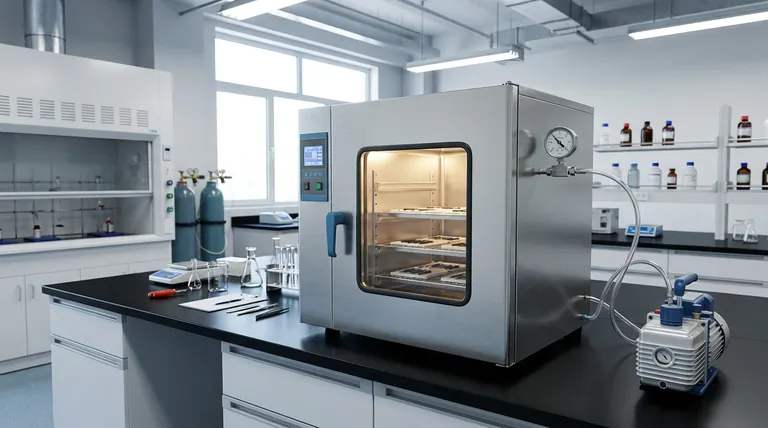
The use of a vacuum drying oven is mandatory for MXene-coated electrodes to ensure the material's chemical stability and physical adhesion. This process creates a low-pressure, oxygen-deprived environment that prevents the thermal oxidative degradation of sensitive MXene nanosheets while accelerating the evaporation of solvents at controlled temperatures.
Core Takeaway MXene is a highly reactive two-dimensional material that is prone to losing its conductive properties when exposed to heat and oxygen. Vacuum drying circumvents this issue by removing oxygen and lowering the boiling point of solvents, ensuring the electrode dries completely without chemically degrading or physically detaching from the substrate.
Preventing Chemical Degradation
The Threat of Thermal Oxidation
MXene nanosheets possess high surface activity, making them extremely susceptible to oxidation. When heated in a standard environment containing air, these nanosheets undergo thermal oxidative degradation, effectively destroying their utility as electrode materials.
Eliminating the Oxygen Variable
The vacuum drying oven addresses this by physically removing oxygen from the drying chamber. By conducting the process in a vacuum, you prevent oxygen from reacting with the MXene layers, preserving the material's electrochemical activity and essential surface functional groups.
Optimizing Solvent Removal
Accelerating Evaporation via Pressure Reduction
The vacuum environment significantly reduces the ambient pressure within the oven. This lowers the boiling point of solvents, allowing them to evaporate much faster than they would at atmospheric pressure.
Effective Removal at Safe Temperatures
Because the boiling point is lowered, stubborn solvents like N-methyl-pyrrolidone (NMP) and residual moisture can be removed at relatively low temperatures (often between 60°C and 100°C). This ensures thorough drying without subjecting the electrode components to excessive heat that could damage biomass cellulose or other additives.
Preventing Electrolyte Decomposition
Thoroughly removing residual moisture and organic solvents is critical for battery safety. If these residues remain, they can cause side reactions, electrolyte decomposition, or corrosion during battery cycling, severely impacting performance.
Ensuring Structural Integrity
Promoting Uniform Adhesion
The vacuum drying process facilitates a controlled setting of the coating. It allows the MXene layers to adhere firmly and uniformly to the substrate surfaces, such as carbon fibers or carbon cloth.
Protecting the Conductive Network
By ensuring firm adhesion and preventing the physical collapse of the nanosheets, the vacuum process protects the electrode's conductive network. This establishes a stable physical foundation necessary for subsequent processing steps, such as high-temperature cyclization.
Understanding the Trade-offs
Temperature Sensitivity Even in Vacuum
While vacuum drying allows for lower temperatures, the specific temperature setting must still be precise. Operating at temperatures that are too high (e.g., significantly above 120°C for certain binders) can still cause thermal degradation of specific functional groups, even in the absence of oxygen.
The Necessity of Time
Vacuum drying is efficient, but it is not instant. The process requires sufficient time to ensure deep removal of trace moisture adsorbed within the electrode sheets. Rushing this process by breaking the vacuum too early can leave trapped solvents that compromise initial coulombic efficiency.
Making the Right Choice for Your Goal
To maximize the performance of your MXene electrodes, align your drying parameters with your specific structural needs:
- If your primary focus is maximizing conductivity: Prioritize a strict vacuum level to eliminate all oxygen traces, preventing the oxidation that destroys the metallic conductivity of MXene.
- If your primary focus is long-term cycle stability: Ensure an extended drying duration to completely remove residual NMP and moisture, which prevents side reactions and corrosion inside the assembled battery.
By controlling pressure and temperature simultaneously, you transform a destructive drying phase into a critical step for structural reinforcement.
Summary Table:
| Feature | Vacuum Drying Benefit | Impact on MXene Performance |
|---|---|---|
| Environment | Oxygen-deprived (low pressure) | Prevents thermal oxidative degradation of nanosheets |
| Solvent Removal | Lowered boiling points | Efficient removal of NMP/moisture at safe, low temperatures |
| Structural Integrity | Controlled layer setting | Ensures uniform adhesion and protects conductive networks |
| Safety | Eliminates residual volatiles | Prevents electrolyte decomposition and side reactions |
Elevate Your MXene Research with Precision Thermal Solutions
Maximize the electrochemical performance of your advanced materials with KINTEK’s specialized laboratory equipment. Backed by expert R&D and world-class manufacturing, we provide high-performance Vacuum Drying Ovens, Muffle, Tube, and CVD systems tailored for sensitive materials like MXenes and 2D nanosheets.
Whether you require precise temperature control to prevent oxidation or custom vacuum parameters for complex solvent removal, KINTEK offers customizable solutions to meet your unique research needs. Contact us today to find the perfect furnace for your lab and ensure the structural integrity of your next-generation electrodes.
References
- Kavin Teenakul, Amirreza Khataee. Treatment of carbon electrodes with Ti<sub>3</sub>C<sub>2</sub>T<sub><i>x</i></sub> MXene coating and thermal method for vanadium redox flow batteries: a comparative study. DOI: 10.1039/d4ra01380h
This article is also based on technical information from Kintek Furnace Knowledge Base .
Related Products
- Vacuum Heat Treat Sintering and Brazing Furnace
- Vacuum Heat Treat Sintering Furnace Molybdenum Wire Vacuum Sintering Furnace
- Dental Porcelain Zirconia Sintering Ceramic Vacuum Press Furnace
- Vacuum Hot Press Furnace Machine for Lamination and Heating
- Vacuum Hot Press Furnace Machine Heated Vacuum Press
People Also Ask
- What are the benefits of using vacuum heat treating furnaces for metal alloys? Achieve Superior Metal Properties and Performance
- What is one of the most important uses of vacuum heat treating furnaces in aerospace? Achieve Superior Strength in Aircraft Alloys
- How does vacuum heat treating affect the grain structure of metal alloys? Achieve Precise Microstructure Control
- What is the temperature of a vacuum furnace brazing? Optimize Your Joint Strength and Cleanliness
- What are the steps involved in a typical vacuum brazing treatment? Master the Process for Strong, Clean Joints







