
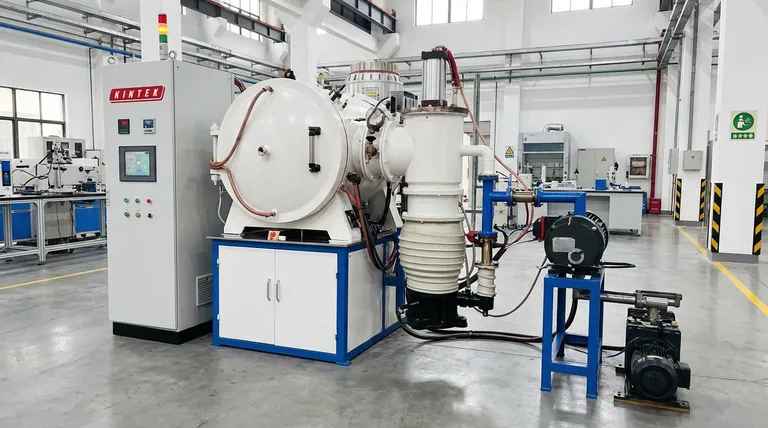
The use of a vacuum oven is the final, non-negotiable safeguard in the production of graphite anodes. It serves two distinct purposes: the complete evaporation of organic solvents (typically NMP) used during the mixing process, and the rigorous elimination of trace moisture. If these elements remain in the electrode sheet, they trigger chemical reactions that compromise the battery's safety and drastically shorten its lifespan.
The Core Takeaway While drying removes solvents, the critical function of the vacuum oven is to eliminate trace moisture that standard drying cannot reach. Without this step, residual water molecules react with the battery's electrolyte to form Hydrofluoric acid (HF), a corrosive compound that degrades internal components and destroys cycling stability.
The Critical Threat: Moisture and Chemical Stability
Preventing Acid Formation
The most significant danger to a lithium-ion battery is water. Even microscopic amounts of residual moisture can react with electrolyte salts, specifically Lithium Hexafluorophosphate ($LiPF_6$).
The Corrosive Result
This reaction produces Hydrofluoric acid (HF). HF is highly corrosive and attacks the cathode materials and the solid electrolyte interphase (SEI) on the anode, leading to rapid capacity fade.
Ensuring Electrochemical Inertness
By utilizing a vacuum oven, manufacturers ensure the electrode sheet is chemically inert before assembly. This prevents the side reactions that lead to gas generation (bloating) and thermal instability.
Optimizing Physical Integrity
Complete Solvent Removal
Graphite slurries are often mixed using N-methyl-2-pyrrolidone (NMP). A vacuum oven operates at elevated temperatures (typically between 80°C and 120°C) to ensure NMP is fully evaporated from the coated electrode.
Strengthening Adhesion
Thorough drying does more than clean the chemistry; it improves mechanics. Removing solvents and moisture strengthens the adhesion between the active graphite layer and the copper current collector.
preventing Delamination
Better adhesion ensures the active material does not delaminate or peel off during the expansion and contraction of battery cycling. This maintains the electrical pathways necessary for consistent performance.
The Physics of Vacuum Drying
Lowering the Boiling Point
A vacuum environment significantly lowers the boiling point of solvents. This allows for rapid, thorough drying without requiring excessive temperatures that might otherwise damage the binder or active materials.
Penetrating the Microstructure
Standard thermal drying often traps moisture deep within the porous graphite structure. The negative pressure of a vacuum effectively "pulls" these trapped volatiles out from the core of the electrode sheet.
Common Pitfalls to Avoid
Incomplete Drying Cycles
A common error is shortening the drying duration to save time. References indicate that effective drying often requires extended periods (e.g., 20 hours) to reach the necessary parts-per-million (PPM) moisture levels.
Temperature Mismanagement
While vacuum allows for lower temperatures, the process still requires heat (80°C–120°C). Setting the temperature too low will leave residual NMP; setting it too high runs the risk of degrading the polymer binders that hold the graphite together.
Making the Right Choice for Your Goal
To optimize your anode preparation process, align your drying parameters with your specific performance targets:
- If your primary focus is Cycle Life: Prioritize maximum vacuum duration and depth to eliminate every trace of moisture, preventing HF formation.
- If your primary focus is Mechanical Stability: Ensure the temperature ramp is controlled to prevent solvent "popping," which secures a dense, uniform interface between the coating and the foil.
Ultimately, the vacuum oven transforms a chemically reactive slurry into a stable, durable electrode ready for high-performance cycling.
Summary Table:
| Feature | Purpose in Anode Preparation | Impact on Battery Performance |
|---|---|---|
| Moisture Removal | Eliminates trace water molecules | Prevents Hydrofluoric Acid (HF) formation and bloating |
| Solvent Evaporation | Removes residual NMP solvents | Ensures chemical inertness and electrochemical stability |
| Vacuum Pressure | Lowers boiling points of volatiles | Enables deep penetration of porous graphite structures |
| Controlled Heating | Strengthens binder-to-foil bond | Prevents delamination and improves cycling stability |
Maximize Your Battery Performance with KINTEK
Don't let residual moisture compromise your lithium-ion battery safety and cycle life. KINTEK provides high-precision vacuum ovens and thermal systems engineered specifically for the rigorous demands of battery research and manufacturing.
Backed by expert R&D and manufacturing, KINTEK offers Muffle, Tube, Rotary, Vacuum, and CVD systems, all fully customizable to meet your unique laboratory or production needs. Whether you are optimizing slurry drying or scaling up electrode production, our team is ready to provide the technical support and high-performance equipment you deserve.
Contact KINTEK Today for a Specialized Solution
References
- Anna Lähde, Jorma Jokiniemi. Effect of high temperature thermal treatment on the electrochemical performance of natural flake graphite. DOI: 10.1557/s43578-024-01282-z
This article is also based on technical information from Kintek Furnace Knowledge Base .
Related Products
- Vacuum Heat Treat Sintering and Brazing Furnace
- Vacuum Heat Treat Sintering Furnace Molybdenum Wire Vacuum Sintering Furnace
- Dental Porcelain Zirconia Sintering Ceramic Vacuum Press Furnace
- Vacuum Hot Press Furnace Machine for Lamination and Heating
- Vacuum Hot Press Furnace Machine Heated Vacuum Press
People Also Ask
- What is one of the most important uses of vacuum heat treating furnaces in aerospace? Achieve Superior Strength in Aircraft Alloys
- What are the benefits of using vacuum heat treating furnaces for metal alloys? Achieve Superior Metal Properties and Performance
- How does vacuum heat treating affect the grain structure of metal alloys? Achieve Precise Microstructure Control
- What is the temperature of a vacuum furnace brazing? Optimize Your Joint Strength and Cleanliness
- What are the steps involved in a typical vacuum brazing treatment? Master the Process for Strong, Clean Joints



















