
Electrode design acts as a critical variable in thermal uniformity, serving as both a power source and a potential heat sink. While electrodes are essential for introducing current, their physical structure and insertion points create localized "voids" where heat dissipates more rapidly than in the rest of the chamber. This results in lower temperatures near electrode holes, leading to thermal decay that can compromise the symmetry of the sintering process.
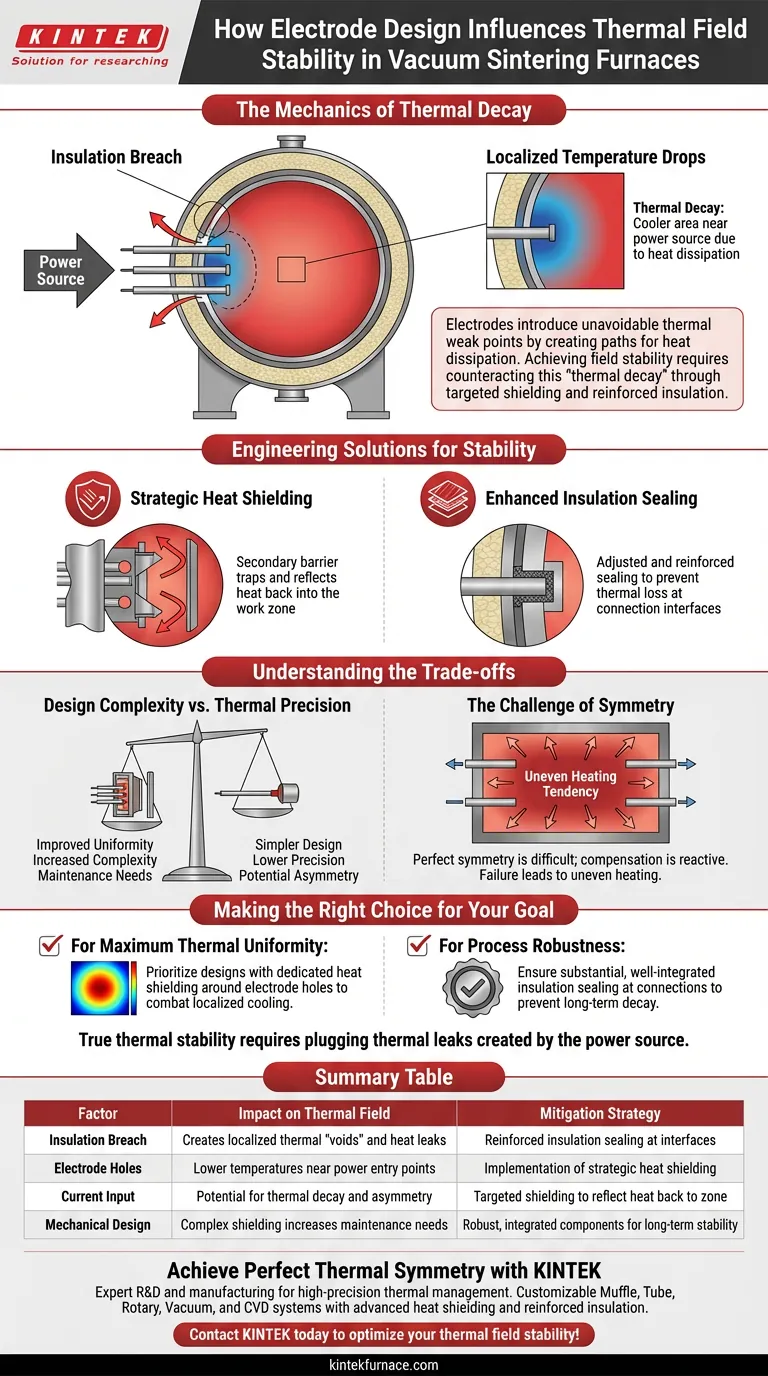
Electrodes introduce unavoidable thermal weak points by creating paths for heat dissipation. Achieving field stability requires counteracting this "thermal decay" through targeted shielding and reinforced insulation at connection interfaces.
The Mechanics of Thermal Decay
The Disruption of the Insulation Envelope
Electrodes serve as the interface for current input, but they physically breach the furnace's insulation layer.
This structural necessity creates a localized void. Instead of a continuous thermal barrier, the furnace has specific points where the insulation is interrupted to allow power delivery.
Localized Temperature Drops
Because of these voids, heat escapes more easily at the connection points than in the rest of the hot zone.
The temperatures near electrode holes are frequently lower than the surrounding environment. This phenomenon creates thermal decay, effectively cooling the area immediately adjacent to the power source.
Engineering Solutions for Stability
To maintain a symmetric thermal field, engineers must actively compensate for the losses caused by electrode placement.
Strategic Heat Shielding
Furnace designs often incorporate specific heat shielding structures directly around the electrode holes.
These shields act as a secondary barrier, trapping heat that would otherwise escape through the electrode void and reflecting it back into the work zone.
Enhanced Insulation Sealing
Standard insulation is often insufficient at these high-risk junction points.
To maintain overall stability, the insulation sealing at electrode connections is adjusted and reinforced. This ensures that the interface between the electrode and the furnace wall does not become a major avenue for thermal loss.
Understanding the Trade-offs
Design Complexity vs. Thermal Precision
Implementing advanced shielding around electrodes improves thermal uniformity but increases mechanical complexity.
More complex shielding structures introduce additional components inside the vacuum chamber. These components must be maintained and aligned correctly to remain effective over time.
The Challenge of Symmetry
Achieving perfect symmetry is difficult because the electrodes themselves are rarely distributed perfectly evenly across the entire surface area of the hot zone.
Compensation measures (like shielding and sealing) are reactive solutions. If these measures fail or degrade, the natural tendency of the furnace will revert to uneven heating near the power inputs.
Making the Right Choice for Your Goal
When evaluating vacuum sintering furnace designs, look closely at how the manufacturer mitigates heat loss at the power feed-throughs.
- If your primary focus is maximum thermal uniformity: Prioritize designs that explicitly feature dedicated heat shielding structures around the electrode holes to actively combat localized cooling.
- If your primary focus is process robustness: Ensure the insulation sealing at the electrode connections is substantial and well-integrated to prevent long-term thermal decay.
True thermal stability requires not just generating heat, but effectively plugging the thermal leaks created by the power source itself.
Summary Table:
| Factor | Impact on Thermal Field | Mitigation Strategy |
|---|---|---|
| Insulation Breach | Creates localized thermal "voids" and heat leaks | Reinforced insulation sealing at interfaces |
| Electrode Holes | Lower temperatures near power entry points | Implementation of strategic heat shielding |
| Current Input | Potential for thermal decay and asymmetry | Targeted shielding to reflect heat back to zone |
| Mechanical Design | Complex shielding increases maintenance needs | Robust, integrated components for long-term stability |
Achieve Perfect Thermal Symmetry with KINTEK
Thermal decay at electrode points can compromise your entire sintering process. At KINTEK, our expert R&D and manufacturing teams specialize in high-precision thermal management. We offer customizable Muffle, Tube, Rotary, Vacuum, and CVD systems designed with advanced heat shielding and reinforced insulation to eliminate localized cooling.
Whether you need maximum thermal uniformity or process robustness, KINTEK provides the laboratory furnace solutions tailored to your unique high-temperature needs.
Contact KINTEK today to optimize your thermal field stability!
Visual Guide
References
- Mao Li, Hesong Li. Numerical simulation of the heating process in a vacuum sintering electric furnace and structural optimization. DOI: 10.1038/s41598-024-81843-8
This article is also based on technical information from Kintek Furnace Knowledge Base .
Related Products
- Vacuum Heat Treat Sintering Furnace Molybdenum Wire Vacuum Sintering Furnace
- Small Vacuum Heat Treat and Tungsten Wire Sintering Furnace
- 9MPa Air Pressure Vacuum Heat Treat and Sintering Furnace
- Vacuum Heat Treat Sintering Furnace with Pressure for Vacuum Sintering
- 2200 ℃ Tungsten Vacuum Heat Treat and Sintering Furnace
People Also Ask
- What are the main structural components of a vacuum sintering furnace? Unlock Precision in High-Temperature Processing
- What is the purpose of setting a mid-temperature dwell stage? Eliminate Defects in Vacuum Sintering
- What are the key components of a vacuum sintering furnace? Essential Parts for Precision Material Processing
- How does vacuum sintering improve dimensional tolerances? Achieve Uniform Shrinkage and Precision
- How does vacuum sintering contribute to cost reduction in material processing? Lower Expenses with Superior Parts



















