
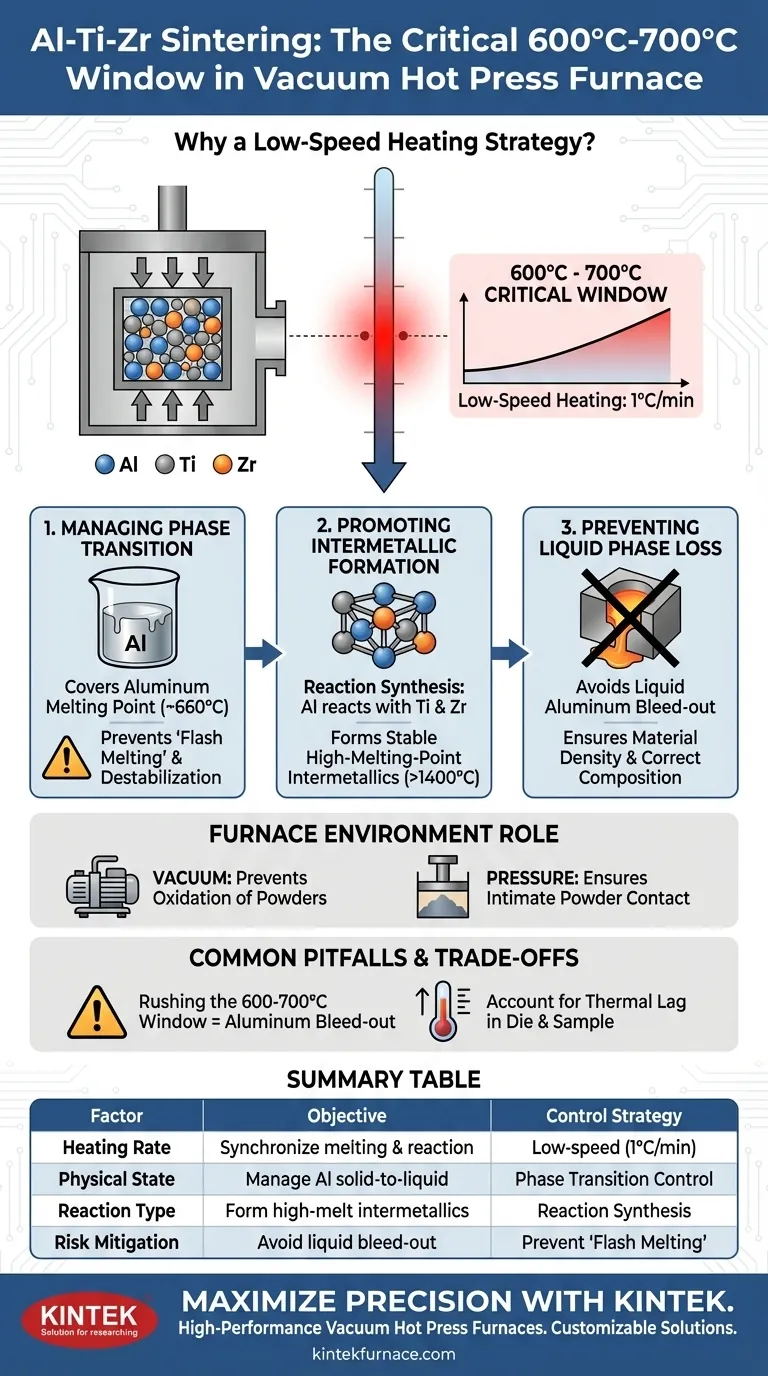
The critical 600°C to 700°C window in your heating profile corresponds directly to the melting point of aluminum. A low-speed heating strategy is implemented here to strictly manage the transition of aluminum from solid to liquid. By reducing the heating rate (typically to 1°C/min), you ensure that melting aluminum reacts immediately with titanium and zirconium powders to form stable, high-melting-point intermetallics, rather than flowing out of the matrix as a liquid.
The core objective is to synchronize the melting of aluminum with its chemical consumption. Slow heating allows the liquid aluminum to be captured via reaction synthesis, transforming it into heat-resistant compounds (>1400°C) and preventing the structural collapse that occurs if the liquid phase escapes.
The Mechanics of Reactive Sintering
Managing the Phase Transition
The temperature range of 600°C to 700°C covers the melting point of aluminum (approx. 660°C). In a mixed powder system (Al-Ti-Zr), this is the most volatile stage of the process.
If the furnace passes through this range too quickly, a large volume of liquid aluminum forms simultaneously. This "flash melting" can destabilize the powder compact before the chemical reactions can occur.
Promoting Intermetallic Formation
The goal of this specific heating stage is reaction synthesis. You want the aluminum to react with the Titanium and Zirconium to form new intermetallic compounds.
These resulting compounds have significantly higher melting points (exceeding 1400°C) than pure aluminum. By heating slowly, you allow the aluminum to melt locally and immediately react, effectively "locking" the aluminum into a solid, heat-resistant structure.
Preventing Liquid Phase Loss
If the heating rate is too aggressive, the reaction kinetics cannot keep up with the melting process. This results in an excess of unreacted liquid aluminum.
In a Vacuum Hot Press environment, this unreacted liquid is liable to flow out of the die or squeeze into pores improperly. This leads to a loss of material, deviated chemical composition, and ultimately, a failed sintering run.
The Role of the Furnace Environment
Program Control Precision
The Vacuum Hot Press Furnace is essential because it allows for programmable heating rates. This is not a linear blast of heat; it requires a specific "hold" or "slow ramp" instruction in the controller.
Maintaining a strict 1°C/min rate (or similar) ensures the thermal energy provided matches the reaction rate of the powders, rather than overwhelming them.
Vacuum and Pressure Synergy
While the temperature control manages the melting, the vacuum and pressure play supporting roles. The vacuum atmosphere prevents the oxidation of the sensitive metal powders (particularly aluminum and titanium).
Simultaneously, the mechanical pressure (e.g., 40.8 MPa) ensures the powders remain in intimate contact. This physical contact is crucial for the liquid aluminum to find and react with the Ti/Zr particles instantly upon melting.
Common Pitfalls and Trade-offs
The Risk of Rushing
It is tempting to increase the heating rate to reduce total cycle time. However, skipping or rushing the 600-700°C window is the primary cause of aluminum bleed-out.
If you see resolidified aluminum on your die or furnace floor, or if your final part has low density and poor stoichiometry, your ramp rate in this specific zone was likely too high.
Thermal Lag Considerations
Operators must account for the thermal mass of the die and the sample. The thermocouple reading may differ slightly from the core temperature of the sample.
A slow ramp rate helps minimize the thermal gradient between the outside and the inside of the sample, ensuring the reaction happens uniformly throughout the material, not just on the surface.
Making the Right Choice for Your Goal
When designing your sintering profile for Al-Ti-Zr composites, consider the following:
- If your primary focus is Compositional Accuracy: strictly adhere to the low-speed ramp (1°C/min) through the melting point to prevent any loss of the aluminum phase.
- If your primary focus is Material Density: ensure high mechanical pressure is applied effectively during this reaction phase to eliminate porosity as the phases transform.
- If your primary focus is Cycle Efficiency: optimize the ramp rates before 600°C (e.g., after the 400°C degassing stage) or after 700°C, but never compromise the speed within the critical melting window.
Success in this process relies on treating the aluminum melting point not just as a temperature to pass, but as a chemical reaction to manage.
Summary Table:
| Factor | 600°C - 700°C Control Strategy | Key Objective |
|---|---|---|
| Heating Rate | Low-speed (typically 1°C/min) | Synchronize melting with reaction kinetics |
| Physical State | Aluminum Phase Transition | Manage solid-to-liquid transformation |
| Reaction Type | Reaction Synthesis | Form high-melting-point (>1400°C) intermetallics |
| Risk Mitigation | Prevent "Flash Melting" | Avoid liquid aluminum bleed-out and material loss |
| Atmosphere | Vacuum & Pressure | Prevent oxidation and ensure intimate powder contact |
Maximize Your Sintering Precision with KINTEK
Don't let "aluminum bleed-out" ruin your complex material compositions. Success in Al-Ti-Zr sintering requires equipment that offers unmatched thermal control and precision programming.
Backed by expert R&D and manufacturing, KINTEK provides high-performance Vacuum Hot Press Furnaces, Muffle, Tube, Rotary, and CVD systems. Our lab high-temperature furnaces are fully customizable to meet your unique sintering profiles and research needs.
Ready to elevate your material synthesis? Contact our technical experts today to find the perfect furnace solution for your laboratory.
Visual Guide
Related Products
- Vacuum Hot Press Furnace Machine for Lamination and Heating
- 600T Vacuum Induction Hot Press Vacuum Heat Treat and Sintering Furnace
- Vacuum Hot Press Furnace Machine Heated Vacuum Press Tube Furnace
- Vacuum Hot Press Furnace Machine Heated Vacuum Press
- High Pressure Laboratory Vacuum Tube Furnace
People Also Ask
- What are the primary components of a vacuum hot press furnace? Master the Core Systems for Precise Material Processing
- What safety features are incorporated in vacuum hot press furnaces? Ensure Operator and Equipment Protection
- What are the benefits of the vacuum environment system in a vacuum hot press furnace? Unlock High-Density Sintering
- What industries benefit from the use of vacuum hot press furnaces? Unlock High-Performance Materials for Your Industry
- What is a vacuum hot press furnace? Unlock Superior Material Performance



















