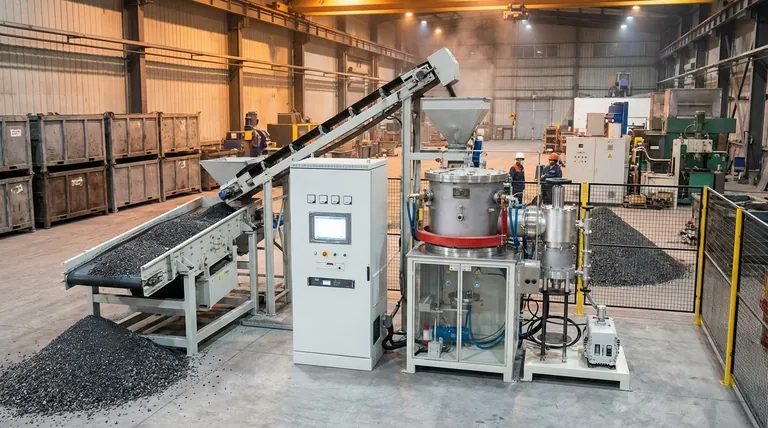
The primary purpose of screening magnesium slag is to physically separate and concentrate the magnesium-rich particles before they enter the vacuum furnace for recovery. This pretreatment step acts as a mechanical enrichment process, significantly improving the efficiency, reducing energy costs, and increasing the purity of the final recovered magnesium by removing non-valuable impurities upfront.
Screening is not just about sorting; it's a strategic enrichment process. By isolating the particle sizes where elemental magnesium is most concentrated, you effectively remove a large volume of waste, ensuring that energy is spent heating the target metal, not impurities.
The Core Principle: Mechanical Enrichment
Pretreating magnesium slag is fundamentally about improving the quality of the raw material, or "feedstock," before the energy-intensive distillation process begins. Screening is the most direct way to achieve this.
Isolating Magnesium-Rich Particles
Within the slag, elemental magnesium is not uniformly distributed. It tends to be concentrated in a specific particle size range, such as -18 to +60 mesh. A vibrating screen uses mechanical motion and different mesh sizes to precisely sort and capture this valuable fraction.
Improving Feedstock Grade
The "grade" of the feedstock refers to the concentration of the desired material—in this case, elemental magnesium. By screening out other materials, primarily impurities like calcium silicate, you dramatically increase the percentage of magnesium in every batch loaded into the furnace.
The Impact on Vacuum Distillation Efficiency
This simple mechanical step has a cascading positive effect on the entire subsequent recovery process, creating tangible improvements in cost, speed, and quality.
Reducing Energy Consumption
The single largest benefit is energy efficiency. The vacuum furnace must heat everything inside it to high temperatures. By removing a significant portion of non-magnesium material before this stage, you avoid wasting thermal energy on inert impurities that do not need to be heated.
Enhancing Furnace Throughput
Because each batch contains a higher concentration of magnesium, more final product can be recovered per distillation cycle. This increases the overall productivity and throughput of the equipment without requiring any changes to the furnace itself.
Increasing Final Product Purity
Removing contaminants at the very beginning is critical for achieving a high-purity final product. Fewer impurities in the feedstock mean there are fewer chances for unwanted elements to vaporize and co-deposit with the magnesium vapor during condensation, resulting in a cleaner, more valuable metal.
Understanding the Trade-offs
While highly effective, implementing a screening process requires careful consideration to ensure it is optimized for your specific operation.
Selecting the Optimal Particle Size
The ideal mesh range is not universal; it depends on the specific characteristics of your slag. Incorrectly calibrated screening can lead to either losing valuable magnesium (if the size range is too narrow) or leaving too many impurities in the feedstock (if the range is too broad).
Balancing Cost vs. Benefit
Screening equipment has associated capital, maintenance, and operational costs. These must be weighed against the financial gains from reduced energy consumption and higher magnesium yield to ensure a positive return on investment.
Material Handling and Safety
Screening processes can generate fine dust, which requires appropriate handling and safety protocols to protect workers and the environment. This must be factored into the design and operation of the pretreatment stage.
Making the Right Choice for Your Goal
Integrating a screening step is a strategic decision that optimizes the entire magnesium recovery workflow.
- If your primary focus is maximizing purity: Screening is non-negotiable, as it is the first line of defense against introducing contaminants into the high-temperature distillation environment.
- If your primary focus is reducing operational cost: This is a key benefit, as screening directly lowers the energy required per unit of magnesium produced by eliminating waste heating.
- If your primary focus is increasing throughput: Feeding a higher-grade, concentrated material allows for more efficient and productive furnace cycles, boosting your facility's total output.
Ultimately, pretreating slag with screening transforms a low-grade waste stream into a high-value, enriched feedstock, optimizing every subsequent step of the recovery operation.
Summary Table:
| Purpose of Screening | Key Benefit | Impact on Recovery Process |
|---|---|---|
| Mechanical Enrichment | Concentrates magnesium-rich particles | Increases feedstock grade for distillation |
| Remove Impurities | Eliminates non-valuable materials like calcium silicate | Reduces energy wasted on heating contaminants |
| Optimize Particle Size | Targets specific mesh ranges (e.g., -18 to +60) | Maximizes magnesium yield and final purity |
| Improve Throughput | Higher-grade feedstock per batch | Increases furnace productivity and output |
Ready to Optimize Your Magnesium Recovery Process?
Screening is a critical first step to maximize the efficiency and profitability of your vacuum distillation operation. By pretreating your slag, you can significantly reduce energy costs and increase the purity of your final product.
KINTEK's expert team can help you achieve this. Backed by expert R&D and manufacturing, KINTEK offers Vacuum systems, Muffle, Tube, Rotary, CVD systems, and other lab high-temp furnaces, all customizable for your unique slag recovery needs.
Contact us today to discuss how our solutions can enhance your recovery process and deliver a faster return on investment.
Get in touch with our experts now!
Visual Guide

Related Products
- Ultra High Vacuum Observation Window KF Flange 304 Stainless Steel High Borosilicate Glass Sight Glass
- Ultra High Vacuum CF Observation Window Flange with High Borosilicate Glass Sight Glass
- Ultra High Vacuum Observation Window Stainless Steel Flange Sapphire Glass Sight Glass for KF
- Ultra High Vacuum CF Flange Stainless Steel Sapphire Glass Observation Sight Window
- High Performance Vacuum Bellows for Efficient Connection and Stable Vacuum in Systems
People Also Ask
- Why is an environmental laboratory chamber equipped with an optical window required for synthesizing Hafnium Carbide?
- What are the structural functions of the dual-chamber quartz glass container? Optimize Magnesium Alloy Vapor Analysis
- What role do vacuum-sealed high-purity silica ampoules play in phase equilibrium experiments? Enhance Sample Integrity
- What is the purpose of utilizing a glassy carbon crucible and HCl gas treatment? Ensure Pure Molten Salt Systems
- Why is rapid quenching required during the preparation of amorphous glass fertilizers? Boost Nutrient Solubility