
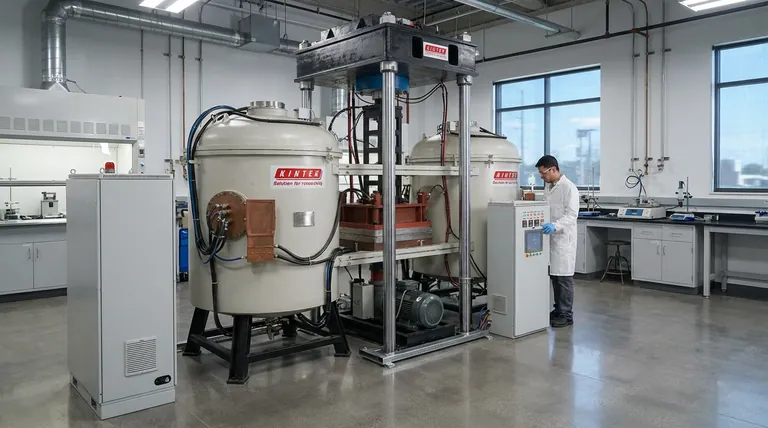
The vacuum arc-melting furnace is the specific instrument of choice for preparing Co-Ti-V superalloys because it simultaneously solves the problems of extreme heat generation and atmospheric contamination. By operating under low pressure (0.1 bar) in a protective argon environment, it allows for the melting of high-melting-point elements like Vanadium, Titanium, and Niobium without compromising their purity through oxidation.
Core Takeaway Processing reactive superalloys requires a delicate balance of intense energy and strict environmental isolation. The vacuum arc-melting furnace provides the thermal power to melt refractory metals while utilizing a vacuum-argon shield to prevent chemical degradation, ensuring the final alloy matches its precise design composition.
Overcoming Thermal Barriers
Melting Refractory Elements
The primary challenge in creating Co-Ti-V quaternary alloys is the inclusion of refractory metals. These alloys rely on components with exceptionally high melting points, specifically Vanadium (V), Niobium (Nb), and Titanium (Ti).
The Necessity of the Electric Arc
Standard resistance furnaces often cannot generate the intense, focused heat required to fully fuse these elements into a liquid solution. The vacuum arc-melting furnace utilizes a high-current electric arc to achieve these extreme temperatures, ensuring the complete melting of the refractory alloying elements.
Preserving Chemical Purity
The Threat of Oxidation
Titanium and Vanadium are highly reactive metals; at melting temperatures, they react violently with oxygen in the atmosphere. Without protection, these elements would form oxides immediately, ruining the alloy's mechanical properties and altering its chemical balance.
The Protective Atmosphere
To counter this, the furnace operates under a controlled low pressure of 0.1 bar combined with a high-purity argon gas environment. This inert shield effectively isolates the molten metal from oxygen and nitrogen.
Volatile Impurity Removal
Beyond simple protection, the vacuum environment plays an active role in purification. As demonstrated in similar reactive alloy processing (such as Ti-15Mo), the vacuum arc process helps remove volatile impurity gases from the melt, further enhancing the base material's quality.
Understanding the Trade-offs
The Issue of Segregation
While the vacuum arc-melting furnace is superior for chemical purity, the solidification process can lead to dendritic segregation. This results in chemical inhomogeneities where the element distribution is not perfectly uniform across the ingot immediately after casting.
The Need for Post-Processing
The arc-melting furnace produces a high-purity ingot, but it does not produce a finished microstructure. To achieve a uniform single-phase structure, the alloy typically requires subsequent processing in a laboratory high-temperature furnace to dissolve these segregated phases and homogenize the matrix.
Making the Right Choice for Your Goal
While the vacuum arc-melting furnace is the standard for the creation of these alloys, understanding where it fits in the wider workflow is critical.
- If your primary focus is Alloy Synthesis: Use the vacuum arc-melting furnace to combine high-melting-point precursors (Co, Ti, V, Nb) without oxidation or loss of material.
- If your primary focus is Microstructural Homogeneity: Recognize that the arc furnace is only the first step; you must follow it with high-temperature heat treatment to eliminate casting segregation.
Ultimately, the vacuum arc-melting furnace is the gatekeeper of quality, ensuring that complex superalloys exist as pure, precise chemical compositions before any structural refinement begins.
Summary Table:
| Feature | Vacuum Arc-Melting Furnace Benefit |
|---|---|
| Temperature Capacity | High-current electric arc melts refractory elements (V, Ti, Nb) easily. |
| Atmospheric Control | 0.1 bar low pressure + Argon gas prevents oxidation and contamination. |
| Material Purity | Actively removes volatile impurity gases during the melting process. |
| Target Material | Ideal for reactive Co-Ti-V quaternary superalloys and Ti-based alloys. |
| Post-Processing | Creates high-purity ingots ready for subsequent homogenization. |
Elevate Your Superalloy Synthesis with KINTEK
Precision in alloy development starts with the right thermal environment. At KINTEK, we understand that preparing complex Co-Ti-V quaternary superalloys requires more than just heat—it requires total control over atmospheric purity and thermal energy.
Backed by expert R&D and manufacturing, KINTEK offers a comprehensive range of Vacuum, Muffle, Tube, Rotary, and CVD systems, along with specialized lab high-temp furnaces. Whether you are synthesizing reactive materials or performing critical post-casting homogenization to eliminate segregation, our systems are fully customizable to meet your unique research needs.
Ready to achieve superior chemical purity and microstructural integrity?
Contact our technical experts today to find your custom solution.
References
- The Effect of Nb on the Microstructure and High-Temperature Properties of Co-Ti-V Superalloys. DOI: 10.3390/coatings15010053
This article is also based on technical information from Kintek Furnace Knowledge Base .
Related Products
- Vacuum Induction Melting Furnace
- Vacuum Heat Treat Sintering and Brazing Furnace
- Small Vacuum Heat Treat and Tungsten Wire Sintering Furnace
- Vacuum Heat Treat Sintering Furnace Molybdenum Wire Vacuum Sintering Furnace
- Vacuum Heat Treat Sintering Furnace with Pressure for Vacuum Sintering
People Also Ask
- What are the core functions of the High Vacuum Induction Melting (VIM) furnace? Optimize DD5 Superalloy Purification
- What is the role of VIM and directional solidification in aero-engine blade substrates? Engineering Extreme Durability
- What are the technical advantages of using a Vacuum Induction Melting furnace in the development of advanced packaging steel?
- What role does a Vacuum Induction Melting furnace play in the production of high-aluminum nickel-based superalloys?
- What are the advantages of using a VIM furnace to control residual oxygen pressure? Achieve Superior Metal Uniformity



















