
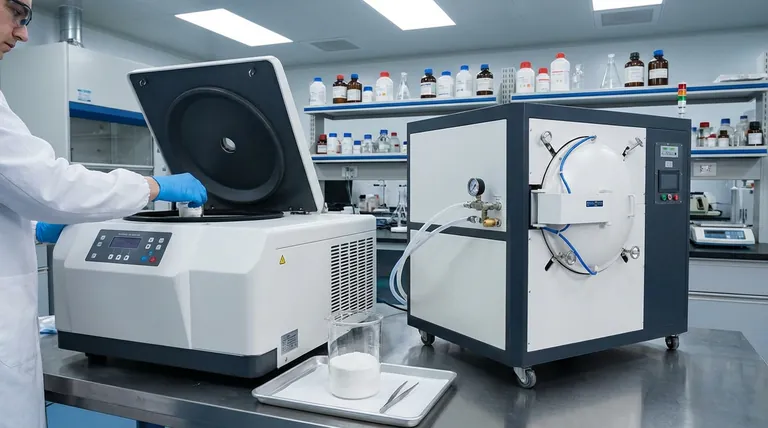
The combined use of a centrifuge and a vacuum drying oven establishes a standardized, non-destructive protocol for recovering H-Beta zeolite catalysts. This dual-instrument approach solves two specific problems: it efficiently isolates the solid catalyst from the reaction liquid, and it removes residual solvents without subjecting the material to damaging thermal stress.
Core Insight By coupling mechanical separation with low-temperature vacuum drying, you prevent the structural degradation that often occurs during conventional drying. This ensures that subsequent stability and reusability tests measure the catalyst's true performance, not the artifacts of a poor recovery process.
The Mechanics of Effective Recovery
Efficient Physical Separation
The first step in the recovery workflow utilizes a centrifuge.
Its primary role is to mechanically force the separation of the solid H-Beta zeolite catalyst from the surrounding reaction liquid.
This achieves a level of solid-liquid isolation that gravity filtration often cannot match, ensuring the bulk of the reaction mixture is removed immediately.
Gentle Solvent Removal
Once the bulk liquid is removed, the catalyst undergoes treatment in a vacuum drying oven.
This device is essential for removing the remaining solvents and moisture trapped within the catalyst’s pores.
By lowering the pressure, the oven allows these liquids to evaporate at significantly lower temperatures than would be required at standard atmospheric pressure.
Solving the Thermal Degradation Issue
Preventing Premature Decomposition
Standard drying methods often rely on high heat, which can be detrimental to complex catalysts.
According to supplementary technical data, vacuum drying is critical for preserving sensitive components, such as active nitro functional groups.
High temperatures, particularly in the presence of atmospheric oxygen, can cause these groups to decompose prematurely, altering the catalyst's chemical nature before you can even test it.
Preserving Structural Integrity
The structural architecture of the H-Beta zeolite is vital for its performance.
Vacuum drying maintains this structural integrity by avoiding the thermal shock and oxidation associated with conventional ovens.
This step ensures the catalyst is chemically and physically "clean" before it undergoes secondary calcination for regeneration.
Understanding the Trade-offs
Process Time vs. Data Quality
While this combined method offers superior protection for the catalyst, it is inherently slower than rapid, high-temperature drying.
You are trading speed for data reliability.
Attempting to rush the drying stage with higher heat may save time initially but will likely invalidate your long-term stability data.
Equipment Dependency
This workflow increases the complexity of your lab setup by requiring two distinct pieces of specialized equipment.
You must ensure the vacuum pump and oven seals are well-maintained; a fluctuating vacuum level can lead to inconsistent drying rates and variable catalyst quality.
Maximizing Reliability in Reusability Tests
The Link to Stability Testing
The ultimate goal of this workflow is to validate the catalyst's reusability over multiple cycles.
If the recovery process damages the catalyst, you cannot accurately determine if a drop in performance is due to the reaction itself or the recovery method.
Using this standardized approach eliminates recovery-induced damage as a variable, ensuring your stability data is reliable.
Making the Right Choice for Your Goal
- If your primary focus is Data Accuracy: Prioritize the vacuum drying step to ensure no active groups are thermally degraded between cycles.
- If your primary focus is Workflow Standardization: Implement strict centrifuge parameters (time and RPM) to ensure a consistent baseline of moisture content before the catalyst enters the oven.
By standardizing your recovery with these two instruments, you transform catalyst recycling from a variable risk into a controlled, reproducible scientific process.
Summary Table:
| Stage | Equipment | Core Function | Primary Benefit |
|---|---|---|---|
| Phase 1: Separation | Centrifuge | High-speed mechanical solid-liquid isolation | Efficiently recovers bulk solid without loss |
| Phase 2: Desiccation | Vacuum Drying Oven | Low-temperature solvent evaporation | Protects sensitive functional groups & pores |
| Final Goal | Combined System | Standardized recovery protocol | Ensures data reliability for reusability tests |
Maximize Your Catalyst Recovery Precision with KINTEK
Don't let thermal degradation compromise your research data. KINTEK provides high-performance laboratory solutions—including precision centrifuges and advanced vacuum drying systems—designed to preserve the structural integrity of sensitive materials like H-Beta zeolites.
Backed by expert R&D and manufacturing, we offer customizable Muffle, Tube, Rotary, Vacuum, and CVD systems tailored to your unique experimental needs.
Ready to standardize your recovery workflow? Contact us today to speak with our technical experts and find the perfect high-temperature furnace or vacuum system for your lab.
References
- Xinyi Xing, Jianxiu Hao. H-Beta Zeolite as Catalyst for the Conversion of Carbohydrates into 5-Hydroxymethylfurfural: The Role of Calcination Temperature. DOI: 10.3390/catal14040248
This article is also based on technical information from Kintek Furnace Knowledge Base .
Related Products
- Vacuum Heat Treat Sintering and Brazing Furnace
- Vacuum Heat Treat Sintering Furnace Molybdenum Wire Vacuum Sintering Furnace
- Dental Porcelain Zirconia Sintering Ceramic Vacuum Press Furnace
- Molybdenum Vacuum Heat Treat Furnace
- Vacuum Hot Press Furnace Machine Heated Vacuum Press
People Also Ask
- What are the benefits of using vacuum heat treating furnaces for metal alloys? Achieve Superior Metal Properties and Performance
- How does vacuum heat treating affect the grain structure of metal alloys? Achieve Precise Microstructure Control
- What is one of the most important uses of vacuum heat treating furnaces in aerospace? Achieve Superior Strength in Aircraft Alloys
- What is the temperature of a vacuum furnace brazing? Optimize Your Joint Strength and Cleanliness
- What are the steps involved in a typical vacuum brazing treatment? Master the Process for Strong, Clean Joints












