
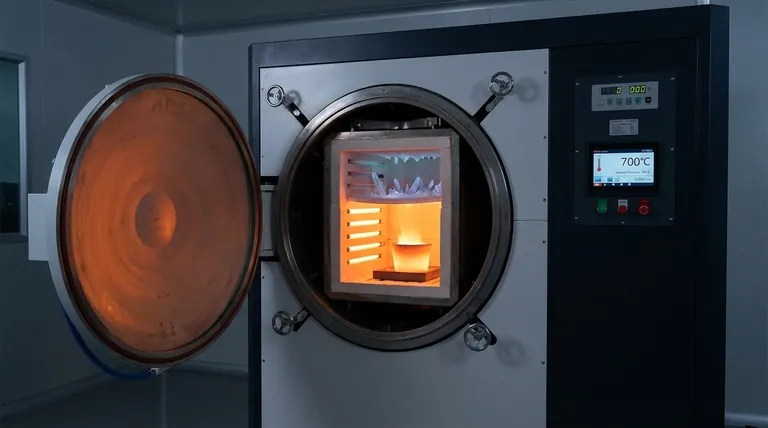
At its core, a resistance furnace provides two primary process conditions for the vacuum purification of magnesium: a high-temperature environment, typically between 650°C and 750°C, and precise, segmented thermal control over this environment. These conditions are engineered to facilitate the phase change of magnesium from a solid or liquid into a gas under vacuum, which is the foundational step of the entire purification process.
The crucial function of the resistance furnace isn't merely to supply heat, but to establish a highly controlled thermal gradient. This precise control is what governs the rate of purification, the stability of the magnesium vapor flow, and ultimately, the purity and quality of the final product.
The Role of Temperature in Phase Transition
The entire purification method, whether sublimation or distillation, hinges on turning crude magnesium into a vapor, leaving less volatile impurities behind. The furnace's thermal conditions make this possible.
Achieving the Evaporation Point
The temperature range of 650°C to 750°C is the operational sweet spot. It is high enough to provide the necessary thermal energy for magnesium atoms to break their metallic bonds and transition into a gaseous state under vacuum conditions.
Creating a Controlled Thermal Gradient
Effective purification requires more than just a single hot zone. A resistance furnace provides segmented temperature control, allowing operators to create a deliberate temperature difference between the lower evaporation zone and the upper condensation zone.
Why Precise Thermal Control is Non-Negotiable
Simply reaching the target temperature is insufficient for producing high-purity magnesium. The ability to precisely manage and stabilize the thermal environment is what separates an efficient process from an uncontrolled one.
Governing the Purification Rate
The temperature of the evaporation zone directly dictates the rate of purification. A higher temperature increases the speed at which magnesium vaporizes, affecting process throughput.
Ensuring Stable Vapor Migration
A stable and well-defined temperature gradient is essential for guiding the magnesium vapor. It ensures a smooth, predictable flow from the hot zone to the cooler condensation surface, preventing turbulence or premature crystallization in unwanted areas.
Dictating Final Crystal Quality
The conditions under which the magnesium vapor cools and solidifies determine the structure of the final crystals. A controlled condensation process, managed by the furnace's upper section temperature, results in a denser, higher-quality crystalline product.
Understanding the Trade-off: Rate vs. Purity
Optimizing furnace conditions involves balancing competing objectives. The primary trade-off in vacuum purification is between the speed of the process and the purity of the outcome.
The Risk of Higher Temperatures
Pushing the furnace to the upper end of its operational range (around 750°C) will significantly increase the purification rate. However, this raises the risk of co-evaporating certain impurities that have a vapor pressure close to that of magnesium, thereby lowering the final purity.
The Limitation of Lower Temperatures
Operating at the lower end (around 650°C) minimizes the energy available for impurities to vaporize, which can lead to higher potential purity. The drawback is a drastically reduced evaporation rate, making the process slower and potentially less economically viable.
Optimizing Furnace Conditions for Your Goal
The ideal furnace settings depend entirely on the specific objective of the purification run. Use these principles as your guide.
- If your primary focus is maximum purity: Operate at the lower end of the temperature range to minimize impurity co-evaporation, accepting a slower process rate.
- If your primary focus is process throughput: Utilize the higher end of the temperature range, but implement rigorous monitoring to ensure impurity levels remain within acceptable specifications.
- If your primary focus is consistent crystal quality: Prioritize establishing and maintaining a stable, unwavering temperature gradient between the evaporation and condensation zones.
Mastering the thermal conditions provided by the resistance furnace is the key to controlling the entire magnesium purification process.
Summary Table:
| Core Process Condition | Function in Purification | Key Benefit |
|---|---|---|
| High Temperature (650°C - 750°C) | Provides energy for magnesium sublimation/distillation | Enables phase transition from solid/liquid to vapor |
| Segmented Thermal Control | Creates a precise temperature gradient | Governs vapor flow rate and final crystal quality |
| Precise Thermal Stability | Maintains consistent evaporation and condensation zones | Ensures process repeatability and high product purity |
Achieve Unmatched Purity in Your Metal Purification Processes
Mastering the precise thermal conditions described is critical for success in vacuum purification. The right furnace makes all the difference.
KINTEK's advanced laboratory furnaces are engineered to deliver the exacting temperature control and stability your high-purity applications demand. Our Muffle, Tube, and Vacuum Furnaces offer the segmented heating and precise gradients needed to optimize your process, whether your goal is maximum purity, high throughput, or superior crystal structure.
Backed by expert R&D and manufacturing, KINTEK provides customizable heating solutions for your unique needs.
Ready to enhance your purification yield and quality? Contact our thermal experts today to discuss how we can tailor a furnace solution for your lab.
Visual Guide

Related Products
- Magnesium Extraction and Purification Condensing Tube Furnace
- Vacuum Induction Melting Furnace
- High Pressure Laboratory Vacuum Tube Furnace
- Molybdenum Vacuum Heat Treat Furnace
- Vacuum Heat Treat Sintering Furnace with Pressure for Vacuum Sintering
People Also Ask
- What are the advantages of using a condensing tube furnace for magnesium extraction? Achieve High Purity and Efficient Metal Recovery
- How does a tube furnace facilitate the activation and shaping of NiCoO2 nanowires? Optimize Your Catalyst Performance
- What are some common applications of tube furnaces in laboratories? Unlock Precision in Material Processing
- What is a tube furnace and what is its primary use? Achieve Precision High-Temp Processing for Your Lab
- Why is a tube furnace with nitrogen flow necessary for BaFe2-xCoxFe16O27 ceramics? Master Iron Valence Engineering



















