
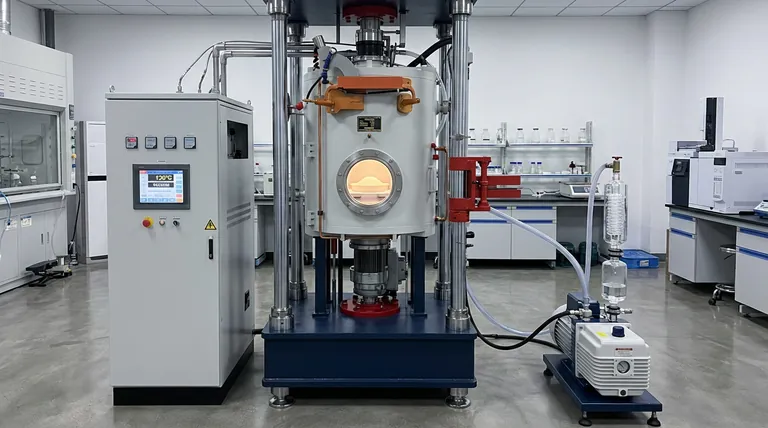
The post-treatment of FeZn-MOFs@Al2O3 catalysts requires a vacuum oven specifically to ensure the complete removal of residual solvents without compromising the material's chemical stability. Operating at 120 degrees Celsius under vacuum conditions allows for the efficient evacuation of ethanol and DMF (N,N-Dimethylformamide) molecules trapped within the pores. This method eliminates the presence of oxygen during heating, thereby preventing oxidation and preserving the integrity of the catalyst's microporous structure.
Core Takeaway A vacuum oven provides a controlled environment that decouples heating from oxidation, allowing you to drive out stubborn organic solvents from deep within the MOF structure. This process is essential for exposing active sites and preventing the structural collapse or chemical degradation that often occurs during standard air drying.
The Mechanics of Solvent Evacuation
Targeting Deep-Seated Solvents
The synthesis of FeZn-MOFs@Al2O3 involves washing steps using specific organic solvents, notably ethanol and DMF. These molecules can become trapped deep within the micropores of the Metal-Organic Framework (MOF) loaded on the aluminum oxide carrier.
The Role of Reduced Pressure
Standard evaporation is often insufficient for removing DMF due to its high boiling point and strong interaction with the pore walls. By applying a vacuum, the boiling point of these solvents is lowered. This ensures they are fully volatilized and removed from the porous architecture, even those lodged in the deepest recesses of the material.
Preventing Chemical Degradation
Eliminating Oxidation Risks
The primary danger of drying MOFs at high temperatures (such as 120°C) is the potential for reaction with atmospheric oxygen. If exposed to air at these temperatures, the FeZn components can undergo rapid oxidation.
Preserving Active Sites
The vacuum oven creates an oxygen-depleted environment. This allows the material to withstand the heat required for drying without chemically altering the metal centers. Consequently, the active sites remain in their metallic or desired coordination state, fully exposed and ready for catalysis.
Maintaining Structural Integrity
Preventing Pore Collapse
The structural value of a MOF lies in its specific porosity. Drying in a vacuum oven prevents the "hard agglomeration" of powders that can occur during high-temperature cracking or uneven drying in air.
Ensuring a Loose Powder Structure
By removing solvents gently yet thoroughly, the process maintains the fine, micro-nano structure of the catalyst. This results in a loose, porous powder rather than a dense aggregate, which is critical for maximizing the surface area available for future chemical reactions.
Understanding the Trade-offs
The Risk of Standard Oven Drying
It is a common mistake to assume a standard convection oven is a suitable substitute. Using a standard oven introduces oxygen during the heating phase, which will almost certainly lead to the oxidation of the FeZn metal centers. Furthermore, air drying often fails to fully remove DMF, leaving blocked pores and significantly reducing catalytic performance.
Temperature Sensitivity
While the vacuum allows for efficient drying, strict adherence to the temperature protocol (120°C for this specific catalyst) is vital. Excessive heat, even under vacuum, could potentially destabilize the organic linkers within the MOF structure, while insufficient heat may leave solvent residues that skew subsequent testing data.
Making the Right Choice for Your Goal
To optimize the performance of your FeZn-MOFs@Al2O3 catalyst, apply the vacuum treatment strategically:
- If your primary focus is Structural Stability: Ensure the vacuum seal is tight to eliminate all oxygen, preventing oxidative degradation of the metal centers during the 120°C heating cycle.
- If your primary focus is Maximizing Activity: Prioritize the duration of the vacuum phase to guarantee the absolute removal of DMF molecules, which effectively unblocks the micropores and exposes the maximum number of active sites.
By utilizing a vacuum oven, you transform a potentially destructive drying phase into a critical preservation step that secures both the physical geometry and chemical potency of your catalyst.
Summary Table:
| Feature | Vacuum Oven Treatment (120°C) | Standard Oven Drying |
|---|---|---|
| Oxygen Presence | Near-zero (prevents metal oxidation) | High (risks FeZn degradation) |
| Solvent Removal | Efficient evacuation of high-boiling DMF | Incomplete; leads to blocked pores |
| Structural Impact | Maintains loose, microporous structure | Risk of hard agglomeration & collapse |
| Catalytic Performance | Maximized via exposed active sites | Reduced due to residual solvents |
Elevate Your Catalyst Performance with KINTEK
Precision is the difference between a high-performing catalyst and a failed synthesis. KINTEK provides industry-leading vacuum and high-temperature furnace systems designed to meet the rigorous demands of MOF post-treatment and material science. Backed by expert R&D and manufacturing, we offer customizable Vacuum, Muffle, Tube, Rotary, and CVD systems tailored to your specific temperature and atmospheric requirements.
Don't let oxidation or residual solvents compromise your research. Contact KINTEK today to find the perfect thermal solution for your laboratory’s unique needs!
References
- He Bai, Shuangkou Chen. The Research on the Esterification Deacidification of Vacuum Gas Oil by FeZn Bimetal–Organic Frameworks Catalysts. DOI: 10.3390/ma18071647
This article is also based on technical information from Kintek Furnace Knowledge Base .
Related Products
- Vacuum Heat Treat Sintering and Brazing Furnace
- Vacuum Heat Treat Sintering Furnace Molybdenum Wire Vacuum Sintering Furnace
- Dental Porcelain Zirconia Sintering Ceramic Vacuum Press Furnace
- Vacuum Hot Press Furnace Machine for Lamination and Heating
- Vacuum Hot Press Furnace Machine Heated Vacuum Press
People Also Ask
- How does vacuum heat treating affect the grain structure of metal alloys? Achieve Precise Microstructure Control
- What are the benefits of using vacuum heat treating furnaces for metal alloys? Achieve Superior Metal Properties and Performance
- What is one of the most important uses of vacuum heat treating furnaces in aerospace? Achieve Superior Strength in Aircraft Alloys
- What is the temperature of a vacuum furnace brazing? Optimize Your Joint Strength and Cleanliness
- What are the steps involved in a typical vacuum brazing treatment? Master the Process for Strong, Clean Joints



















