
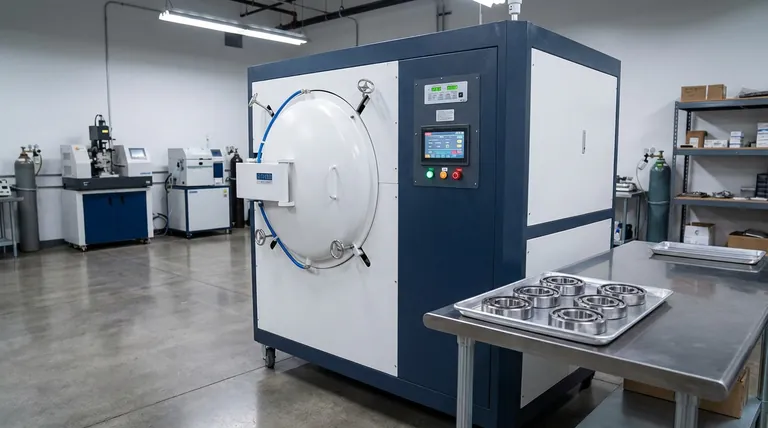
The primary advantage of using a vacuum heating furnace for SAE52100 steel is the absolute preservation of surface integrity during critical thermal cycles. By maintaining a vacuum environment, the furnace prevents chemical degradation while allowing for the precise thermal regulation—specifically 840 °C for quenching and 300 °C for tempering—necessary to achieve optimal mechanical properties.
Core Takeaway The vacuum environment eliminates the variables of oxidation and decarburization, ensuring that the SAE52100 steel develops a consistent fine martensitic structure. This guarantees that the resulting hardness and tensile strength reflect the material's inherent potential rather than heat treatment defects.
Preserving Surface Integrity
The most immediate benefit of vacuum heat treatment is the control of surface chemistry.
Elimination of Decarburization
SAE52100 is a high-carbon steel, and its surface is vulnerable at high temperatures. A vacuum furnace removes oxygen and other reactive gases from the chamber. This prevents the loss of carbon from the surface layer, which is critical for maintaining hardness.
Prevention of Oxidation
Standard furnaces often cause scaling or oxidation on the specimen surface. The vacuum environment ensures the steel remains clean and bright throughout the process. This eliminates the need for extensive post-treatment cleaning or grinding to remove surface oxides.
Optimizing Microstructure and Performance
Beyond surface protection, the vacuum furnace provides the thermal stability required for internal structural refinement.
Precise Temperature Regulation
Achieving the correct phase transformations requires exacting thermal control. The process typically involves heating to 840 °C for quenching and 300 °C for tempering. Industrial-grade vacuum furnaces provide the stability to hold these temperatures accurately over long durations (e.g., 120 minutes).
Achieving a Fine Martensitic Structure
The combination of precise heat and a protective atmosphere facilitates a specific microstructural transformation. It promotes the formation of a fine martensitic structure. This structure is the primary driver of the steel's high mechanical strength.
Uniform Carbide Distribution
Vacuum treatment ensures that carbides are distributed evenly throughout the matrix. This uniformity is essential for preventing weak points within the steel. It results in consistent high hardness and tensile strength across the entire specimen.
Ensuring Reliability in Testing
For engineers analyzing material failure or fatigue, the method of heat treatment is a critical variable.
Eliminating Heat Treatment Defects
Using a vacuum furnace ensures that the material properties observed are genuine. It prevents surface defects that could prematurely initiate cracks or failure. This ensures that studies on fatigue resistance reflect the material's inherent structural characteristics, not errors in the heating process.
Understanding the Trade-offs
While vacuum heating offers superior quality, it imposes specific operational constraints that must be managed.
Process Duration and Stability
High-precision vacuum treatment is not a rapid process. It requires stable, long-duration heating cycles (often exceeding 1000 °C for specific applications or holding times of 120 minutes) to ensure complete elemental diffusion and stress relief. Cutting these cycles short to save time will compromise the microstructural uniformity and defeat the purpose of using a vacuum system.
Making the Right Choice for Your Goal
The decision to use vacuum heating depends on your specific requirements for the SAE52100 components.
- If your primary focus is Maximum Durability: Use vacuum heating to ensure a decarburization-free surface, which is critical for high wear resistance and surface hardness.
- If your primary focus is Material Research: Use vacuum heating to eliminate environmental variables, ensuring that your fatigue and tensile data accurately represent the steel's inherent structure.
Using a vacuum furnace converts the heat treatment process from a variable risk into a controlled constant, guaranteeing the reliability of your SAE52100 components.
Summary Table:
| Benefit | Vacuum Furnace Mechanism | Outcome for SAE52100 Steel |
|---|---|---|
| Surface Integrity | Elimination of oxygen and reactive gases | No decarburization or oxidation; bright, scale-free finish |
| Microstructure | Precise thermal regulation at 840°C & 300°C | Formation of fine martensite and uniform carbide distribution |
| Mechanical Performance | Controlled cooling and heating cycles | Superior hardness, high tensile strength, and fatigue resistance |
| Reliability | Reduction of heat treatment defects | Genuine material properties ideal for testing and R&D |
Elevate Your Materials Research with KINTEK Precision
Don't let oxidation or decarburization compromise your SAE52100 steel's performance. KINTEK provides industry-leading vacuum heating solutions designed to deliver the thermal stability and atmospheric control required for high-precision heat treatment.
Backed by expert R&D and manufacturing, we offer a comprehensive range of Muffle, Tube, Rotary, Vacuum, and CVD systems, all customizable to meet your unique laboratory or industrial needs. Ensure the integrity of your specimens and achieve consistent, superior microstructures with our specialized high-temperature furnaces.
Ready to optimize your thermal processes? Contact KINTEK today to find the perfect furnace for your application!
References
- Yingxin Zhao, Like Pan. Fatigue-Limit Assessment via Infrared Thermography for a High-Strength Steel. DOI: 10.3390/ma18020279
This article is also based on technical information from Kintek Furnace Knowledge Base .
Related Products
- 2200 ℃ Graphite Vacuum Heat Treat Furnace
- Vacuum Heat Treat Furnace with Ceramic Fiber Liner
- Molybdenum Vacuum Heat Treat Furnace
- Vacuum Hot Press Furnace Machine Heated Vacuum Press
- 2200 ℃ Tungsten Vacuum Heat Treat and Sintering Furnace
People Also Ask
- Why are vacuum heat treating furnaces essential for aerospace? Ensure Superior Material Integrity for High-Stakes Applications
- What is the primary application of vacuum heat treating furnaces in aerospace? Enhance Component Performance with Precision
- How does a vacuum heat treating furnace improve the condition of metal alloys? Achieve Superior Metal Performance
- How does vacuum heat treating work in terms of temperature and time control? Master Precise Material Transformations
- What is the process of vacuum heat treating? Achieve Superior Metallurgical Properties



















