
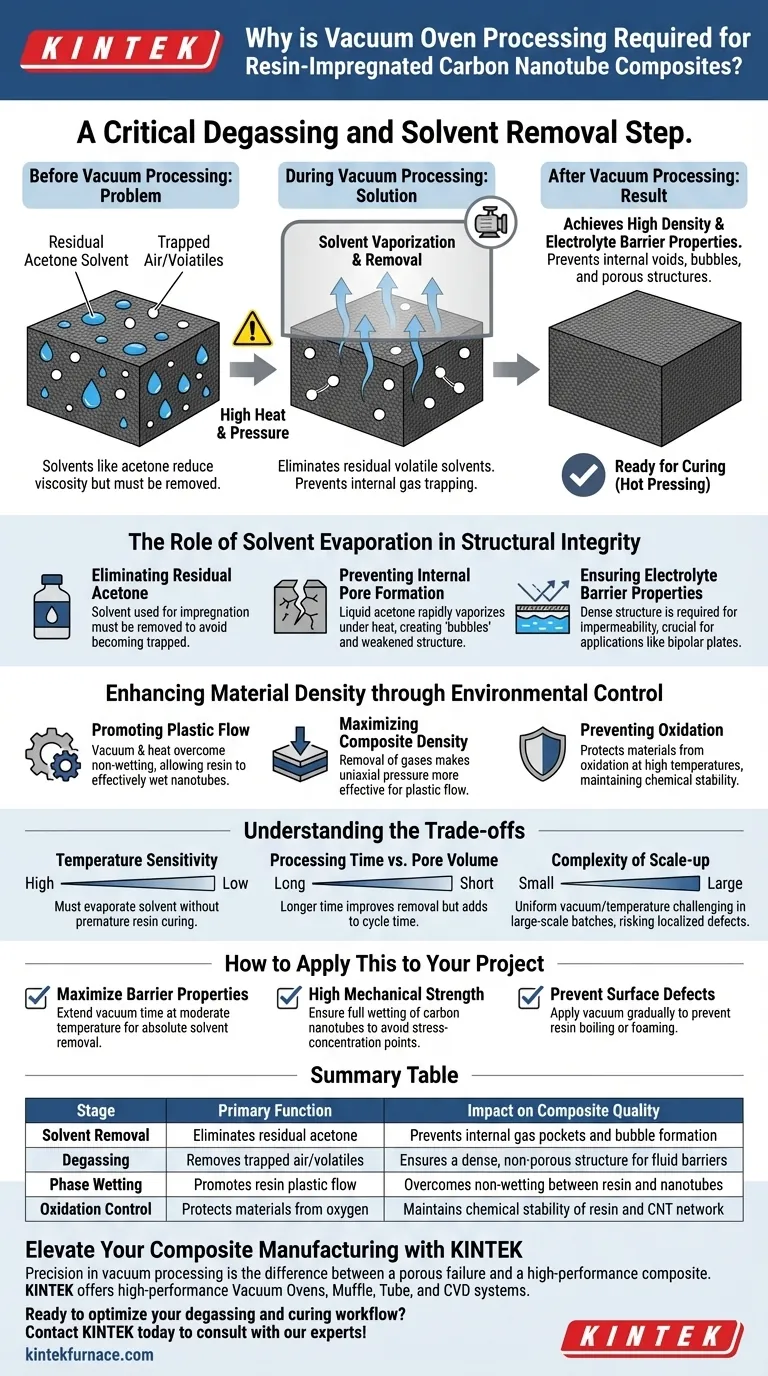
Vacuum oven processing is a critical degassing and solvent removal step. It serves as the primary safeguard against structural defects by removing residual solvents—specifically acetone—before the resin undergoes final curing. Without this phase, the subsequent application of heat and pressure would trigger solvent vaporization within the material, leading to the formation of internal voids and porous structures that compromise the composite's integrity.
Vacuum oven processing eliminates residual volatile solvents to prevent internal gas trapping and "bubble" formation. This step is essential for achieving the high density and electrolyte barrier properties required for functional horizontally aligned carbon nanotube (HACN) composites.
The Role of Solvent Evaporation in Structural Integrity
Eliminating Residual Acetone
Resin impregnation often utilizes acetone as a solvent to reduce viscosity and ensure the resin fully penetrates the carbon nanotube (CNT) network. If this solvent is not removed before the curing process begins, it becomes trapped within the matrix.
Preventing Internal Pore Formation
During the subsequent high-pressure hot pressing phase, any remaining liquid acetone will rapidly vaporize due to elevated temperatures. This creates internal gas pockets or "bubbles" that result in a porous, weakened final structure.
Ensuring Electrolyte Barrier Properties
For applications like bipolar plates (HACN-BP), the material must be completely impermeable to fluids. Vacuum processing ensures a dense structure, which is the only way to provide the effective barrier properties needed to prevent electrolyte leakage.
Enhancing Material Density through Environmental Control
Promoting Plastic Flow and Rearrangement
A vacuum environment, particularly when combined with heat, helps overcome the physical barriers of non-wetting between different material phases. By removing air and volatiles, the resin can more effectively wet the nanotubes.
Maximizing Composite Density
The removal of gases allows the application of uniaxial pressure to be more effective. Instead of compressing trapped air, the pressure works to promote the plastic flow of the materials, resulting in a significantly higher-density composite.
Preventing Oxidation
While primarily critical in metallic-reinforced composites, the vacuum environment also protects the materials from oxidation at high temperatures. This ensures that the chemical properties of both the resin and the carbon nanotubes remain stable throughout the thermal cycle.
Understanding the Trade-offs
Temperature Sensitivity
The vacuum oven temperature must be high enough to evaporate the solvent but low enough to avoid premature resin curing. If the resin begins to cross-link too early, it will trap the remaining solvent, defeating the purpose of the vacuum stage.
Processing Time vs. Pore Volume
Increasing the duration of the vacuum cycle improves the removal of volatiles, leading to a more reliable part. However, this adds significant cycle time to the manufacturing process, requiring a balance between production throughput and material quality.
Complexity of Scale-up
While effective for small-scale plates, maintaining a uniform vacuum and temperature profile across large-scale batches can be challenging. Inconsistent vacuum processing leads to localized defects, where some areas of a composite plate are dense while others remain porous.
How to Apply This to Your Project
When preparing resin-impregnated nanotubes for curing, your processing parameters should align with your final performance requirements.
- If your primary focus is maximizing barrier properties: Extend the vacuum processing time at a moderate temperature to ensure the absolute removal of all volatile solvents before applying pressure.
- If your primary focus is high mechanical strength: Use the vacuum stage to ensure the resin fully wets the carbon nanotubes, as any residual solvent will create stress-concentration points that lead to premature failure.
- If your primary focus is preventing surface defects: Ensure the vacuum is applied gradually to prevent the resin from "boiling" or foaming, which can displace the aligned nanotubes.
Proper vacuum processing transforms a potentially porous mixture into a high-performance, dense composite suitable for demanding electrochemical environments.
Summary Table:
| Stage | Primary Function | Impact on Composite Quality |
|---|---|---|
| Solvent Removal | Eliminates residual acetone | Prevents internal gas pockets and bubble formation |
| Degassing | Removes trapped air/volatiles | Ensures a dense, non-porous structure for fluid barriers |
| Phase Wetting | Promotes resin plastic flow | Overcomes non-wetting between resin and nanotubes |
| Oxidation Control | Protects materials from oxygen | Maintains chemical stability of resin and CNT network |
Elevate Your Composite Manufacturing with KINTEK
Precision in vacuum processing is the difference between a porous failure and a high-performance composite. Backed by expert R&D and manufacturing, KINTEK offers high-performance Vacuum Ovens, Muffle, Tube, and CVD systems designed to provide the rigorous environmental control needed for carbon nanotube and advanced material research.
Whether you need customizable thermal profiles to prevent premature curing or superior vacuum integrity for degassing, our lab solutions are engineered for your unique needs.
Ready to optimize your degassing and curing workflow? Contact KINTEK today to consult with our experts!
Visual Guide
References
- Jae‐Moon Jeong, Seong Su Kim. Aligned Carbon Nanotube Polymer Nanocomposite Bipolar Plates Technology for Vanadium Redox Flow Batteries. DOI: 10.1002/eem2.70030
This article is also based on technical information from Kintek Furnace Knowledge Base .
Related Products
- Vacuum Heat Treat Sintering and Brazing Furnace
- Vacuum Heat Treat Sintering Furnace Molybdenum Wire Vacuum Sintering Furnace
- Dental Porcelain Zirconia Sintering Ceramic Vacuum Press Furnace
- Vacuum Hot Press Furnace Machine for Lamination and Heating
- Vacuum Hot Press Furnace Machine Heated Vacuum Press
People Also Ask
- How does vacuum heat treating affect the grain structure of metal alloys? Achieve Precise Microstructure Control
- What are the benefits of using vacuum heat treating furnaces for metal alloys? Achieve Superior Metal Properties and Performance
- What is one of the most important uses of vacuum heat treating furnaces in aerospace? Achieve Superior Strength in Aircraft Alloys
- What is the temperature of a vacuum furnace brazing? Optimize Your Joint Strength and Cleanliness
- What are the steps involved in a typical vacuum brazing treatment? Master the Process for Strong, Clean Joints

















