
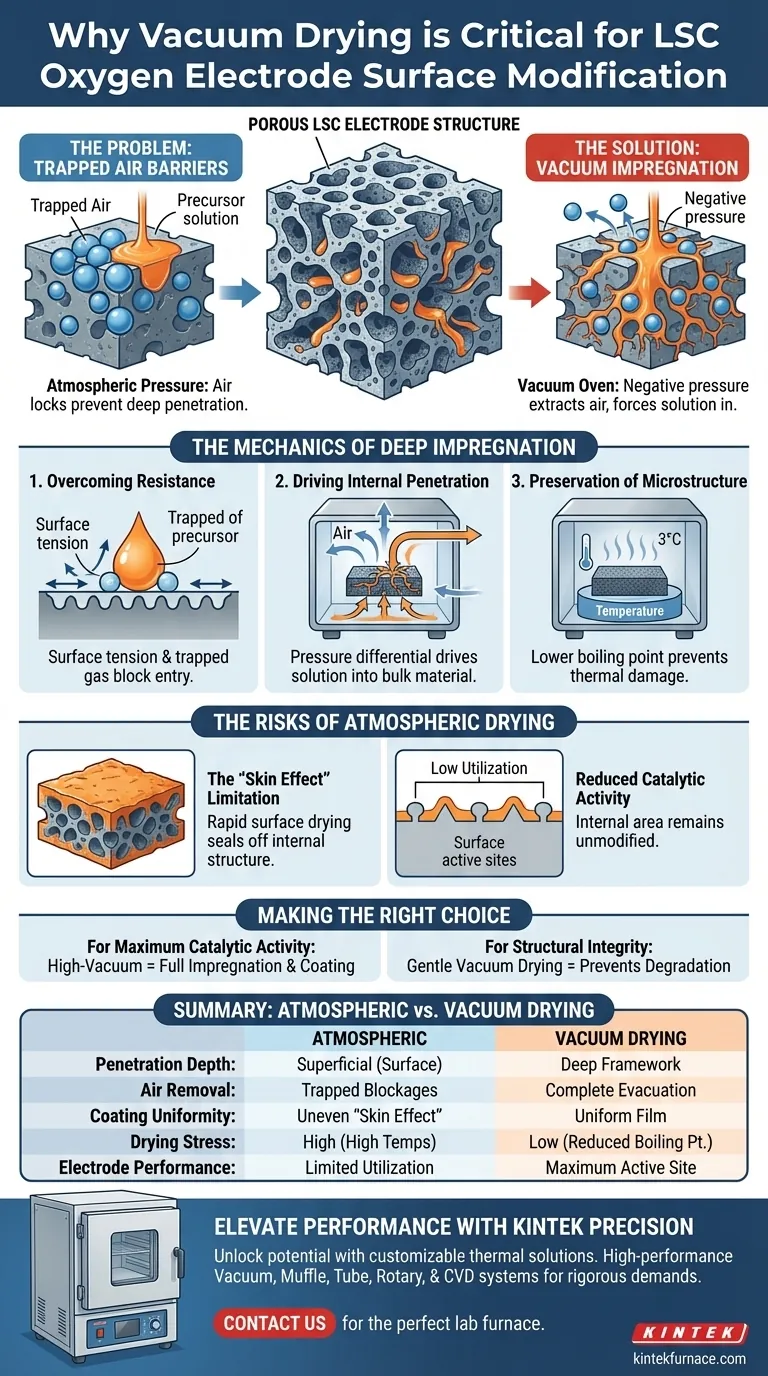
The application of a vacuum drying oven is fundamental to overcoming the physical barriers within porous electrode structures. It utilizes negative pressure to force the precursor solution deep into the complex LSC (Lanthanum Strontium Cobaltite) framework. This process evacuates trapped air that would otherwise block the liquid, ensuring the modification occurs throughout the entire internal volume rather than just on the exterior.
By actively removing air locks within the porous material, vacuum treatment transforms surface modification from a superficial coating process into a deep impregnation method, guaranteeing that nano-catalytic films are distributed uniformly throughout the electrode's active sites.
The Mechanics of Deep Impregnation
Overcoming Hydraulic Resistance
The porous structure of an LSC oxygen electrode is naturally resistant to liquid penetration due to surface tension and trapped gases.
When you apply a precursor solution under normal atmospheric conditions, air pockets remain lodged deep within the micropores.
A vacuum drying oven creates a negative pressure environment that physically extracts this trapped air, creating a void that the liquid precursor must fill.
Driving Internal Penetration
Once the air is evacuated, the pressure differential drives the precursor solution into the deepest layers of the electrode framework.
This ensures that the active material is not merely painted onto the surface but is impregnated into the bulk of the material.
This deep penetration is the mechanism that allows for the formation of a uniform nano-catalytic film across the entire internal surface area.
Preservation of Microstructure
Beyond impregnation, vacuum drying facilitates the removal of solvents at lower temperatures by reducing their boiling points.
This gentle evaporation prevents thermal stress or structural damage that might occur if high heat were used to force-dry the deep pores.
It ensures the electrode maintains its intricate porous architecture, which is vital for gas diffusion during operation.
The Risks of Atmospheric Drying
The "Skin Effect" Limitation
Without vacuum assistance, the precursor solution often dries rapidly on the outermost surface of the electrode.
This creates a "skin" or crust that blocks the underlying pores, effectively sealing off the internal structure from modification.
Reduced Catalytic Activity
If the precursor remains on the surface, the vast majority of the electrode's internal surface area remains unmodified and catalytically inactive.
This results in an electrode that theoretically has high potential but performs poorly in practice due to low utilization of the added catalyst.
Making the Right Choice for Your Goal
To maximize the performance of LSC oxygen electrodes, the drying process must be treated as an active impregnation step, not just a passive removal of liquid.
- If your primary focus is Maximum Catalytic Activity: Prioritize high-vacuum levels to fully evacuate micropores, ensuring every internal surface is coated with the nano-catalyst.
- If your primary focus is Structural Integrity: Use the vacuum to lower the boiling point of solvents, allowing for gentle drying that prevents thermal degradation of the LSC framework.
Vacuum drying is not merely a method of evaporation; it is the primary engine for achieving total structural utilization in porous electrodes.
Summary Table:
| Feature | Atmospheric Drying | Vacuum Drying Oven |
|---|---|---|
| Penetration Depth | Superficial (Surface Only) | Deep Framework Impregnation |
| Air Removal | Trapped gas creates blockages | Complete evacuation of micropores |
| Coating Uniformity | Uneven "Skin Effect" | Uniform nano-catalytic film |
| Drying Stress | High (Requires higher temps) | Low (Reduced solvent boiling point) |
| Electrode Performance | Limited catalytic utilization | Maximum active site utilization |
Elevate Your Electrode Performance with KINTEK Precision
Unlock the full potential of your porous materials with KINTEK’s advanced thermal solutions. Backed by expert R&D and manufacturing, KINTEK offers high-performance Vacuum, Muffle, Tube, Rotary, and CVD systems—all fully customizable to meet the rigorous demands of your surface modification and impregnation workflows.
Don't let trapped air limit your research. Our vacuum drying technology ensures uniform nano-catalytic distribution and preserves the delicate microstructure of your LSC frameworks. Contact us today to find the perfect customizable furnace for your lab and take the first step toward superior catalytic efficiency.
Visual Guide
References
- Binbin Liu, Tao Li. Pr<sub>2</sub>Ni<sub>0.8</sub>Co<sub>0.2</sub>O<sub>4+<i>δ</i></sub> impregnated La<sub>0.6</sub>Sr<sub>0.4</sub>CoO<sub>3−<i>δ</i></sub> oxygen electrode for efficient CO<sub>2</sub> electroreduction in solid oxide electrolysis cells. DOI: 10.1039/d4ra01848f
This article is also based on technical information from Kintek Furnace Knowledge Base .
Related Products
- Vacuum Heat Treat Sintering and Brazing Furnace
- Vacuum Heat Treat Sintering Furnace Molybdenum Wire Vacuum Sintering Furnace
- Dental Porcelain Zirconia Sintering Ceramic Vacuum Press Furnace
- Molybdenum Vacuum Heat Treat Furnace
- Vacuum Hot Press Furnace Machine Heated Vacuum Press
People Also Ask
- What is one of the most important uses of vacuum heat treating furnaces in aerospace? Achieve Superior Strength in Aircraft Alloys
- What are the benefits of using vacuum heat treating furnaces for metal alloys? Achieve Superior Metal Properties and Performance
- How does vacuum heat treating affect the grain structure of metal alloys? Achieve Precise Microstructure Control
- What is the temperature of a vacuum furnace brazing? Optimize Your Joint Strength and Cleanliness
- What are the steps involved in a typical vacuum brazing treatment? Master the Process for Strong, Clean Joints












