
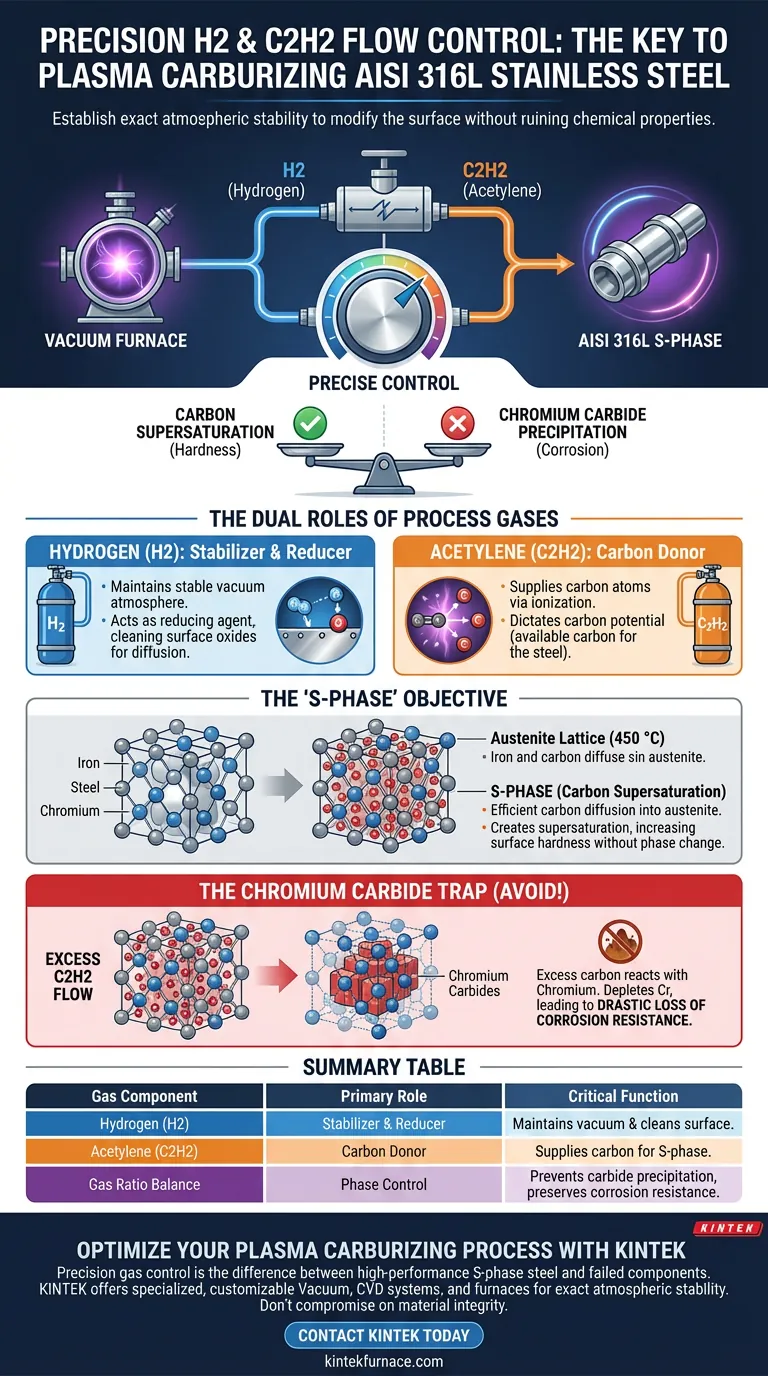
Precise control of Hydrogen (H2) and Acetylene (C2H2) flow rates is critical because it establishes the exact atmospheric stability required to modify the surface of AISI 316L stainless steel without ruining its chemical properties. This regulation ensures the correct concentration of carbon is available to diffuse into the steel's lattice structure while preventing the chemical reactions that lead to corrosion.
The success of plasma carburizing relies on a delicate equilibrium: generating enough carbon to achieve supersaturation for hardness, while strictly limiting carbon levels to prevent the precipitation of chromium carbides.
The Dual Roles of the Process Gases
To understand why flow rate precision is non-negotiable, you must first understand the distinct function of each gas within the furnace environment.
Hydrogen (H2): The Stabilizer and Reducer
Hydrogen acts as the carrier gas in this mixture. Its primary function is to maintain a stable atmosphere within the vacuum furnace.
Additionally, H2 serves as a reducing agent. It helps create the conditions necessary for clean diffusion by interacting with surface oxides, ensuring the steel surface is receptive to the carburizing process.
Acetylene (C2H2): The Carbon Donor
Acetylene serves as the carbon source. In the high-energy plasma environment, this gas is ionized to release carbon atoms.
These atoms are the active ingredients that diffuse into the surface of the AISI 316L specimen. The flow rate of C2H2 directly dictates the carbon potential of the atmosphere—essentially, how much carbon is available to enter the steel.
The "S-Phase" Objective
The ultimate goal of regulating these gases is to create a specific microstructural state known as the S-phase.
Achieving Carbon Supersaturation
When the flow rates are optimized, carbon atoms diffuse efficiently into the austenite lattice of the 316L steel.
Because the process occurs at a relatively low temperature (around 450 °C), these atoms become trapped in solid solution. This creates a state of carbon supersaturation, which significantly increases the surface hardness of the material.
Preserving the Lattice Structure
The S-phase is unique because it hardens the steel without changing its fundamental crystal structure.
To achieve this, the carbon concentration provided by the C2H2 flow must be high enough to fill the interstitial spaces in the lattice, but not so high that it forces a chemical phase change.
Understanding the Trade-offs: The Chromium Carbide Trap
The most critical reason for precise flow control is the avoidance of a specific, failure-inducing microstructural defect: chromium carbide precipitation.
The Consequence of Excess Carbon
If the C2H2 flow rate is too high, the concentration of carbon in the atmosphere exceeds the lattice's capacity to hold it in solution.
When this happens, the excess carbon reacts chemically with the chromium atoms present in the stainless steel.
The Loss of Corrosion Resistance
This reaction creates chromium carbides. While these are hard, their formation depletes the surrounding steel matrix of free chromium.
Since chromium is the element responsible for the "stainless" quality of the steel (by forming a passive oxide layer), its depletion leads to a drastic reduction in corrosion resistance. The steel may become hard, but it will essentially rust like plain iron.
Making the Right Choice for Your Goal
Achieving the S-phase requires navigating a narrow process window where temperature (450 °C) and gas ratios are strictly maintained.
- If your primary focus is Maximum Hardness: Prioritize the upper limit of the C2H2 flow rate to maximize carbon saturation, but verify the absence of carbide precipitates via microscopy.
- If your primary focus is Corrosion Resistance: Lean toward a conservative C2H2 to H2 ratio to ensure the austenite lattice remains free of chromium depletion, accepting slightly lower peak hardness.
Success in plasma carburizing is not about how much carbon you can add, but how precisely you can control its integration into the lattice.
Summary Table:
| Gas Component | Primary Role | Critical Function in Plasma Carburizing |
|---|---|---|
| Hydrogen (H2) | Stabilizer & Reducer | Maintains vacuum atmosphere and cleans surface oxides for diffusion. |
| Acetylene (C2H2) | Carbon Donor | Supplies carbon atoms for lattice supersaturation (S-phase development). |
| Gas Ratio Balance | Phase Control | Prevents chromium carbide precipitation to preserve corrosion resistance. |
Optimize Your Plasma Carburizing Process with KINTEK
Precision gas control is the difference between high-performance S-phase steel and failed, corroded components. At KINTEK, we understand the delicate equilibrium required for advanced material science.
Backed by expert R&D and manufacturing, KINTEK offers specialized Vacuum, CVD systems, and laboratory high-temperature furnaces—all fully customizable to provide the exact atmospheric stability and flow regulation your AISI 316L treatments demand. Don't compromise on material integrity.
Contact KINTEK today to discuss your custom furnace needs" Form)"
Visual Guide
References
- Lu Sun, Xiaomei Luo. Effect of Low-Temperature Plasma Carburization on Fretting Wear Behavior of AISI 316L Stainless Steel. DOI: 10.3390/coatings14020158
This article is also based on technical information from Kintek Furnace Knowledge Base .
Related Products
- Spark Plasma Sintering SPS Furnace
- Slide PECVD Tube Furnace with Liquid Gasifier PECVD Machine
- Inclined Rotary Plasma Enhanced Chemical Deposition PECVD Tube Furnace Machine
- Vacuum Heat Treat Sintering and Brazing Furnace
- Vacuum Heat Treat Sintering Furnace with Pressure for Vacuum Sintering
People Also Ask
- How does the heating mechanism of Spark Plasma Sintering (SPS) function? Enhance TiC/SiC Composite Fabrication
- Why is it necessary to maintain a high vacuum environment during the SPS of SiC? Key to High-Density Ceramics
- What are the technical advantages of using an SPS sintering furnace? Elevate Al2O3-TiC Material Performance
- What are the steps in the discharge plasma sintering process? Master Fast, High-Density Material Consolidation
- What are the advantages of spark plasma sintering (SPS) over traditional forging? Precision Microstructural Control



















