
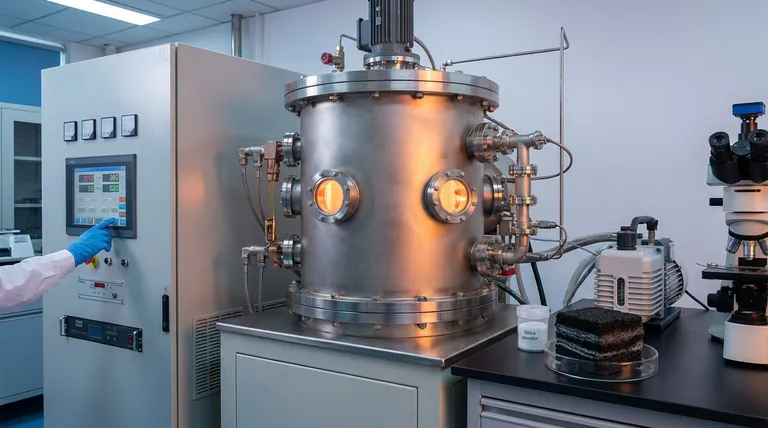
A vacuum high-temperature furnace ensures structural stability by creating a strictly controlled, oxygen-free environment that prevents the oxidation of carbon frameworks during the critical graphitization phase. By combining low pressure or high-purity inert atmospheres with precise thermal regulation, the furnace allows carbon precursors to fully graphitize around hard templates, forming rigid, high-strength thin layers that do not collapse once the template is removed.
The core stability mechanism lies in the prevention of decarburization; without the vacuum environment, high temperatures would oxidize the carbon skeleton, destroying the pore channels before they have the chance to harden into a stable hierarchical system.
Preventing Structural Collapse via Atmosphere Control
Eliminating Oxidation Risks
The primary threat to porous carbon structure is oxidation. In a standard atmosphere, high temperatures would cause the carbon precursor to react with oxygen, effectively burning away the material structure (decarburization).
Preserving the Carbon Skeleton
A vacuum furnace operates under very low pressure or utilizes a high-purity inert atmosphere to remove air, moisture, and reactive gases. This creates a "clean" environment where the carbon framework can be thermally treated without chemical degradation, ensuring the physical scaffold remains intact.
Enhancing Material Purity
By eliminating reactive gases, the furnace prevents unwanted chemical side reactions. This results in a cleaner surface chemistry, which is essential for preventing structural defects that could weaken the pore walls.
Strengthening the Framework Through Graphitization
Precise Temperature Regulation
Structural stability relies on the transformation of amorphous carbon into ordered graphite. Vacuum furnaces utilize advanced control systems (such as PID regulation) to maintain temperature stability within ±5℃.
Full Surface Graphitization
This high-precision heating allows the carbon precursor to fully graphitize on the surface of hard templates (such as silica). The result is a high-strength thin-layer structure that acts as a rigid reinforcement for the material.
Maintaining Hierarchical Pores
Because the carbon layer is graphitized and strengthened before the template is removed, the material retains a stable hierarchical pore system. The stiffened carbon walls prevent the pore channels from collapsing after the supporting template is etched away.
Understanding the Trade-offs
Process Complexity vs. Material Quality
While vacuum high-temperature furnaces provide superior structural stability, they introduce significant process complexity. The requirement for maintaining a high vacuum adds time to the production cycle compared to standard atmospheric furnaces.
Energy and Kinetic Considerations
Achieving the high temperatures required for full graphitization demands substantial energy. Furthermore, the precise control of heating rates is critical; if the temperature rises too fast, the decomposition kinetics of the template (e.g., the release of gases) can outpace the carbonization, potentially fracturing the structure rather than reinforcing it.
Optimizing Your Synthesis Strategy
To achieve the best structural stability for layered porous carbon, align your furnace parameters with your specific material requirements:
- If your primary focus is Structural Rigidity: Prioritize high-purity inert atmospheres to ensure full graphitization without surface defects or oxidation.
- If your primary focus is Pore Size Precision: Leverage the furnace's programmed temperature control to meticulously manage the decomposition kinetics of your template agent.
- If your primary focus is Surface Purity: Utilize high-vacuum settings to strip away moisture and contaminants that could interfere with catalytic activity.
By strictly controlling the atmosphere and thermal kinetics, you convert a fragile biomass precursor into a robust, high-performance carbon architecture.
Summary Table:
| Feature | Role in Structural Stability | Benefit to Porous Carbon |
|---|---|---|
| Oxygen-Free Environment | Prevents decarburization and oxidation | Preserves the integrity of the carbon skeleton |
| Precise PID Regulation | Maintains stable graphitization temperatures | Forms high-strength, rigid carbon thin layers |
| Inert/Vacuum Atmosphere | Eliminates reactive gases and contaminants | Prevents structural defects and ensures high purity |
| Thermal Kinetic Control | Manages template decomposition rates | Prevents fracturing and collapse of pore channels |
Elevate Your Materials Research with KINTEK Precision
Achieving the perfect hierarchical pore system requires more than just heat; it demands the absolute control found in KINTEK’s advanced thermal solutions. Backed by expert R&D and world-class manufacturing, we provide high-performance Muffle, Tube, Rotary, Vacuum, and CVD systems designed to meet the rigorous demands of carbon graphitization and template synthesis.
Whether you are a researcher developing next-gen energy storage or an industrial manufacturer scaling porous architectures, our furnaces are fully customizable to your unique atmospheric and thermal needs. Contact us today to find your custom solution and ensure your materials never compromise on structural stability.
References
- Shuling Liu, Baojun Li. Catalytically Active Carbon for Oxygen Reduction Reaction in Energy Conversion: Recent Advances and Future Perspectives. DOI: 10.1002/advs.202308040
This article is also based on technical information from Kintek Furnace Knowledge Base .
Related Products
- 2200 ℃ Tungsten Vacuum Heat Treat and Sintering Furnace
- 2200 ℃ Graphite Vacuum Heat Treat Furnace
- Molybdenum Vacuum Heat Treat Furnace
- Vacuum Heat Treat Sintering Furnace Molybdenum Wire Vacuum Sintering Furnace
- High Pressure Laboratory Vacuum Tube Furnace
People Also Ask
- How does a tungsten-heated vacuum sintering furnace prepare (TbxY1-x)2O3 ceramics? Achieve 99%+ Density & Purity
- How do compaction pressure and vacuum sintering optimize porous ceramics? Maximize Density & Toughness
- What wear-resistance enhancements are achieved by powder coating? The Role of Vacuum Sintering Furnaces
- What role does a high-temperature vacuum sintering furnace play in the densification of WC-10(Ni, Ni/Co) alloys?
- What core role does a high-temperature vacuum sintering furnace play in Sm:YAG ceramics? Mastering Optical Clarity



















