
Temperature is the defining variable that dictates the outcome of biomass thermochemical conversion. In industrial high-temperature furnaces, the specific heat level applied effectively steers the chemical reaction. Precision is critical because it determines whether the final output is a solid (biochar), a liquid (bio-oil), or a gas (syngas).
Precise temperature control acts as a selector switch for reaction pathways. By maintaining specific thermal zones, operators can maximize the yield of desired products while optimizing overall energy conversion efficiency.
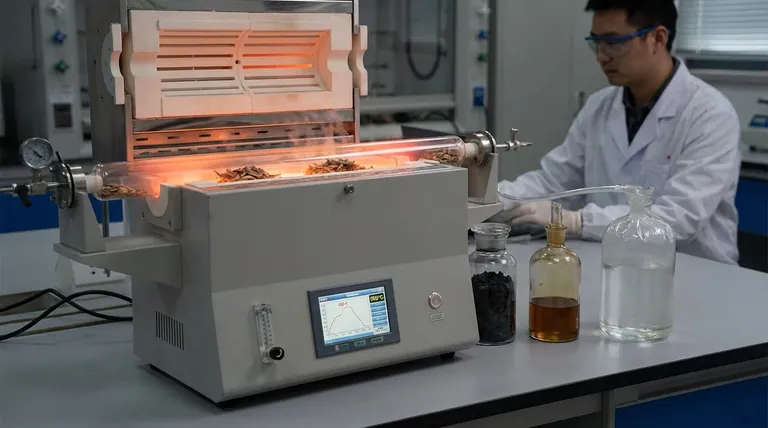
The Mechanics of Product Distribution
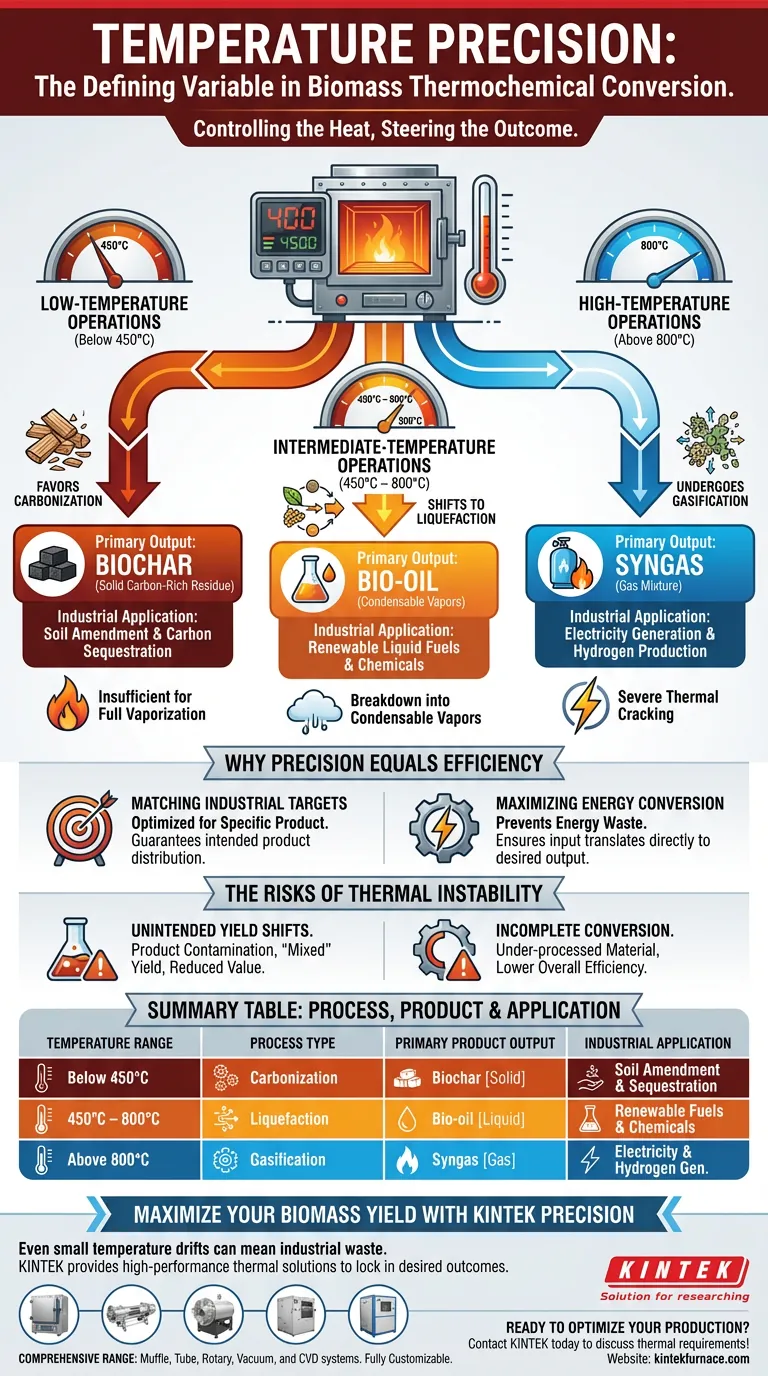
Low-Temperature Operations (Below 450°C)
When the furnace temperature is maintained below 450°C, the process favors carbonization.
In this range, the thermal energy is insufficient to fully vaporize the biomass structure. Consequently, the primary output becomes biochar, a solid carbon-rich residue.
Intermediate-Temperature Operations (450°C – 800°C)
Increasing the temperature to a window between 450°C and 800°C shifts the reaction toward liquefaction.
At these levels, the biomass components break down into condensable vapors. This effectively maximizes the production of bio-oil, which is the target for many liquid fuel applications.
High-Temperature Operations (Above 800°C)
When temperatures exceed 800°C, the reaction undergoes gasification.
The intense heat causes severe thermal cracking of the biomass. This shifts the primary output away from liquids and solids, converting the material almost entirely into syngas.
Why Precision Equals Efficiency
Matching Industrial Targets
Industrial facilities generally optimize for a specific product, not a random mixture.
High-precision control ensures the furnace environment remains locked within the specific thermal window required for that product. This guarantees that the product distribution matches the intended industrial targets.
Maximizing Energy Conversion
Inaccurate temperature control results in energy waste.
If the goal is bio-oil, heating beyond 800°C wastes energy by converting valuable liquid potential into gas. Precision ensures input energy translates directly into the desired output form.
The Risks of Thermal Instability
Unintended Yield Shifts
A lack of precision leads to product contamination.
Fluctuating temperatures create a "mixed" yield, where bio-oil might be degraded by syngas or contaminated with excess char. This reduces the purity and market value of the final product.
Incomplete Conversion
Drifting below target temperatures can result in under-processed material.
If the furnace fails to hold the minimum required heat, the biomass may not fully convert. This leaves unreacted material that lowers the overall efficiency of the operation.
Aligning Temperature with Production Goals
Success in thermochemical conversion depends on strict adherence to the thermal thresholds of your desired output.
- If your primary focus is Biochar Production: Maintain furnace temperatures strictly below 450°C to maximize solid carbon retention.
- If your primary focus is Bio-oil Synthesis: Stabilize operations between 450°C and 800°C to facilitate optimal liquefaction.
- If your primary focus is Syngas Generation: Push temperatures above 800°C to ensure complete gasification of the biomass.
Ultimately, precision in temperature control is the difference between a random chemical reaction and a targeted, efficient industrial process.
Summary Table:
| Temperature Range | Process Type | Primary Product Output | Industrial Application |
|---|---|---|---|
| Below 450°C | Carbonization | Biochar (Solid) | Soil amendment & carbon sequestration |
| 450°C – 800°C | Liquefaction | Bio-oil (Liquid) | Renewable liquid fuels & chemicals |
| Above 800°C | Gasification | Syngas (Gas) | Electricity generation & hydrogen production |
Maximize Your Biomass Yield with KINTEK Precision
In the world of thermochemical conversion, even a small temperature drift can be the difference between a high-value product and industrial waste. KINTEK provides the high-performance thermal solutions you need to lock in your desired outcomes.
Backed by expert R&D and manufacturing, we offer a comprehensive range of Muffle, Tube, Rotary, Vacuum, and CVD systems. Our lab and industrial high-temperature furnaces are fully customizable to meet your unique biomass processing needs, ensuring stable thermal zones and superior energy conversion efficiency.
Ready to optimize your production? Contact KINTEK today to discuss your specific thermal requirements with our engineering team!
Visual Guide
References
- Jean de Dieu Marcel Ufitikirezi, Luboš Smutný. Agricultural Waste Valorization: Exploring Environmentally Friendly Approaches to Bioenergy Conversion. DOI: 10.3390/su16093617
This article is also based on technical information from Kintek Furnace Knowledge Base .
Related Products
- 1700℃ High Temperature Laboratory Tube Furnace with Alumina Tube
- 1400℃ High Temperature Laboratory Tube Furnace with Alumina Tube
- 1800℃ High Temperature Muffle Oven Furnace for Laboratory
- 1700℃ High Temperature Muffle Oven Furnace for Laboratory
- 1200℃ Muffle Oven Furnace for Laboratory
People Also Ask
- How does zone-melting in tube furnaces synthesize bismuth micro-wires? Master Single-Crystal Thermoelectric Growth
- How are high-temp tube furnaces used to measure diffusion coefficients per Fick's law? Master Precision Annealing
- How are high-temperature laboratory tube furnaces applied in long-term vacuum homogenization heat treatments for intermetallic samples?
- How do high-temperature laboratory tube furnaces ensure environmental stability? Precision Thermal Reduction Tips
- How are high-temperature tube furnaces applied in testing ceramic-supported alloy membranes? Insights



















