
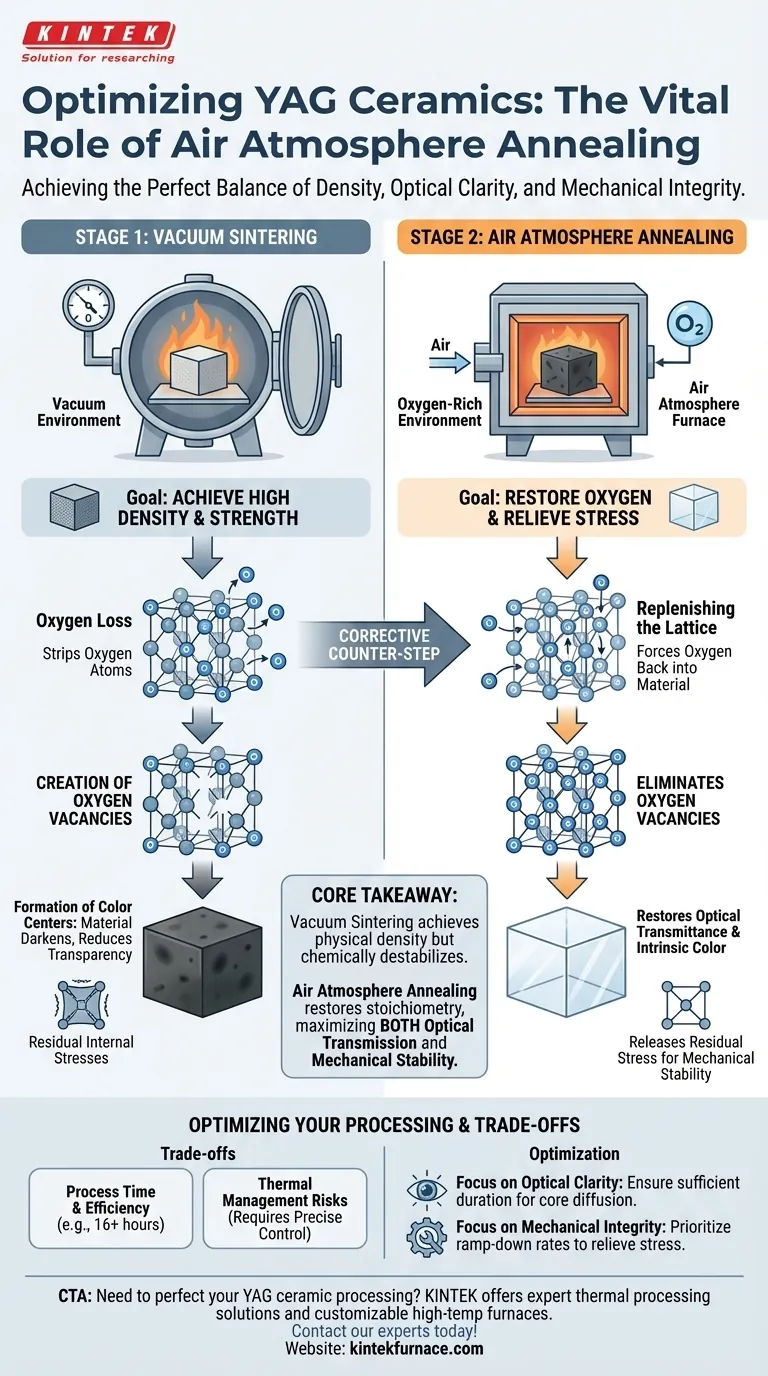
High-temperature annealing in an air atmosphere is essential because vacuum sintering, while effective for densification, strips oxygen atoms from the ceramic lattice. This creates "oxygen vacancies" that darken the material and reduce transparency. The annealing process utilizes an oxygen-rich environment to replenish these atoms, eliminate the dark defects, and relieve residual internal stresses generated during the sintering phase.
Core Takeaway Vacuum sintering achieves the necessary physical density but chemically destabilizes the material by causing oxygen loss. Air atmosphere annealing is the corrective counter-step required to restore the ceramic's stoichiometry, maximizing both optical transmission and mechanical stability.
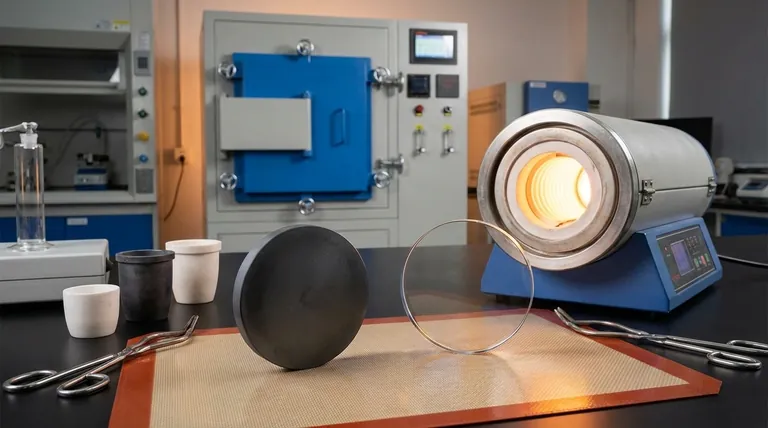
The Consequence of Vacuum Sintering
The Trade-off for Density
A vacuum furnace is the standard environment for sintering YAG ceramics because it effectively removes porosity. This ensures the final product achieves high density, hardness, and mechanical strength.
The Creation of Oxygen Vacancies
However, the vacuum environment creates a chemical imbalance. The low pressure causes the ceramic to lose oxygen atoms from its crystal structure.
Formation of Color Centers
These missing atoms leave behind "oxygen vacancies," which act as color centers. Instead of being transparent, these defects absorb light and cause the ceramic to appear dark or discolored.
How Air Atmosphere Annealing Fixes the Material
Replenishing the Lattice
High-temperature annealing in an Air Atmosphere Furnace exposes the ceramic to an oxygen-rich environment. This process forces oxygen back into the material, effectively filling the vacancies created during vacuum sintering.
Restoring Optical Transmittance
By eliminating the oxygen vacancy defects, the annealing process removes the color centers. This restores the intrinsic color of the ceramic and significantly improves its light transmittance, making it suitable for optical applications.
Releasing Residual Stress
Beyond chemistry, the sintering and hot-pressing processes generate significant internal mechanical stress. Subjecting the ceramic to prolonged heat treatment (e.g., 16 hours) allows the material structure to relax.
enhancing Mechanical Stability
This relaxation releases internal tension without altering the shape. The result is a ceramic that is not only clear but also mechanically stable and less prone to spontaneous cracking or failure.
Understanding the Trade-offs
Process Time and Efficiency
While annealing is necessary for optical quality, it significantly adds to the total processing time. A typical cycle can last 16 hours or more to ensure oxygen diffuses throughout the entire bulk of the material.
Thermal Management Risks
If the annealing temperature is uncontrolled or the cooling phase is too rapid, new thermal stresses can be introduced. Precise temperature control is required to repair defects without reversing the gains made in mechanical stability.
Optimizing Your Ceramic Processing
To achieve the highest quality YAG ceramics, you must view sintering and annealing as coupled, non-negotiable stages.
- If your primary focus is Optical Clarity: Ensure the annealing duration is sufficient to allow oxygen diffusion into the core of the ceramic, fully eliminating color centers.
- If your primary focus is Mechanical Integrity: Prioritize the annealing cycle's ramp-down rates to ensure residual internal stresses are fully relieved without inducing thermal shock.
True high-performance YAG ceramics are defined by the balance of vacuum-induced density and air-restored clarity.
Summary Table:
| Process Stage | Primary Goal | Key Outcome |
|---|---|---|
| Vacuum Sintering | Achieve high density | High mechanical strength, but creates oxygen vacancies (darkening) |
| Air Atmosphere Annealing | Restore oxygen & relieve stress | Eliminates color centers, enhances optical transmittance, and improves mechanical stability |
Need to perfect your YAG ceramic processing?
Our expertise in thermal processing ensures your materials achieve the ideal balance of density, optical clarity, and mechanical integrity. Backed by expert R&D and manufacturing, KINTEK offers Muffle, Tube, Rotary, Vacuum, CVD systems, and other lab high-temp furnaces, all customizable for unique needs like precise YAG annealing cycles.
Contact our experts today to discuss how our furnaces can optimize your ceramic production.
Visual Guide
Related Products
- Controlled Inert Nitrogen Hydrogen Atmosphere Furnace
- Mesh Belt Controlled Atmosphere Furnace Inert Nitrogen Atmosphere Furnace
- 1400℃ Controlled Inert Nitrogen Atmosphere Furnace
- 1200℃ Controlled Inert Nitrogen Atmosphere Furnace
- 1700℃ Controlled Inert Nitrogen Atmosphere Furnace
People Also Ask
- How does hydrogen furnace annealing assist in preparing mechanically alloyed powders for compaction?
- How does atmospheric annealing in a controlled hydrogen furnace affect the cold compaction behavior of metal powders?
- What are the characteristics and uses of hydrogen atmosphere in furnaces? Achieve Superior Surface Purity and Bonding
- What are the characteristics and uses of hydrogen atmospheres in furnaces? Unlock Clean Metal Processing
- What controlled-atmosphere furnace conditions are required for sintering powder metallurgy copper alloy compacts? Ideal Setup






