
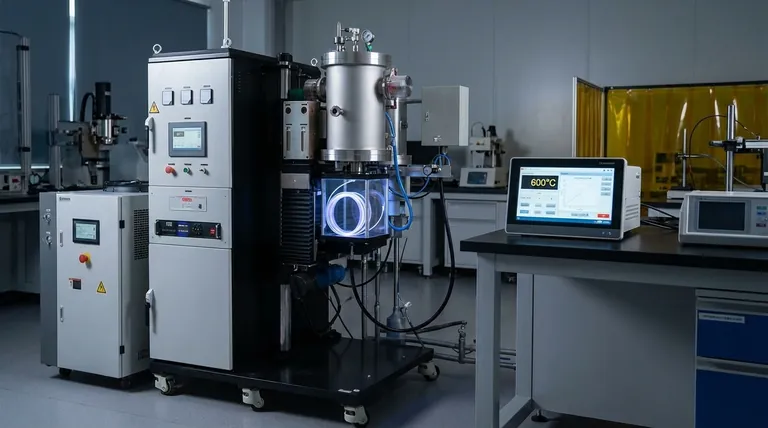
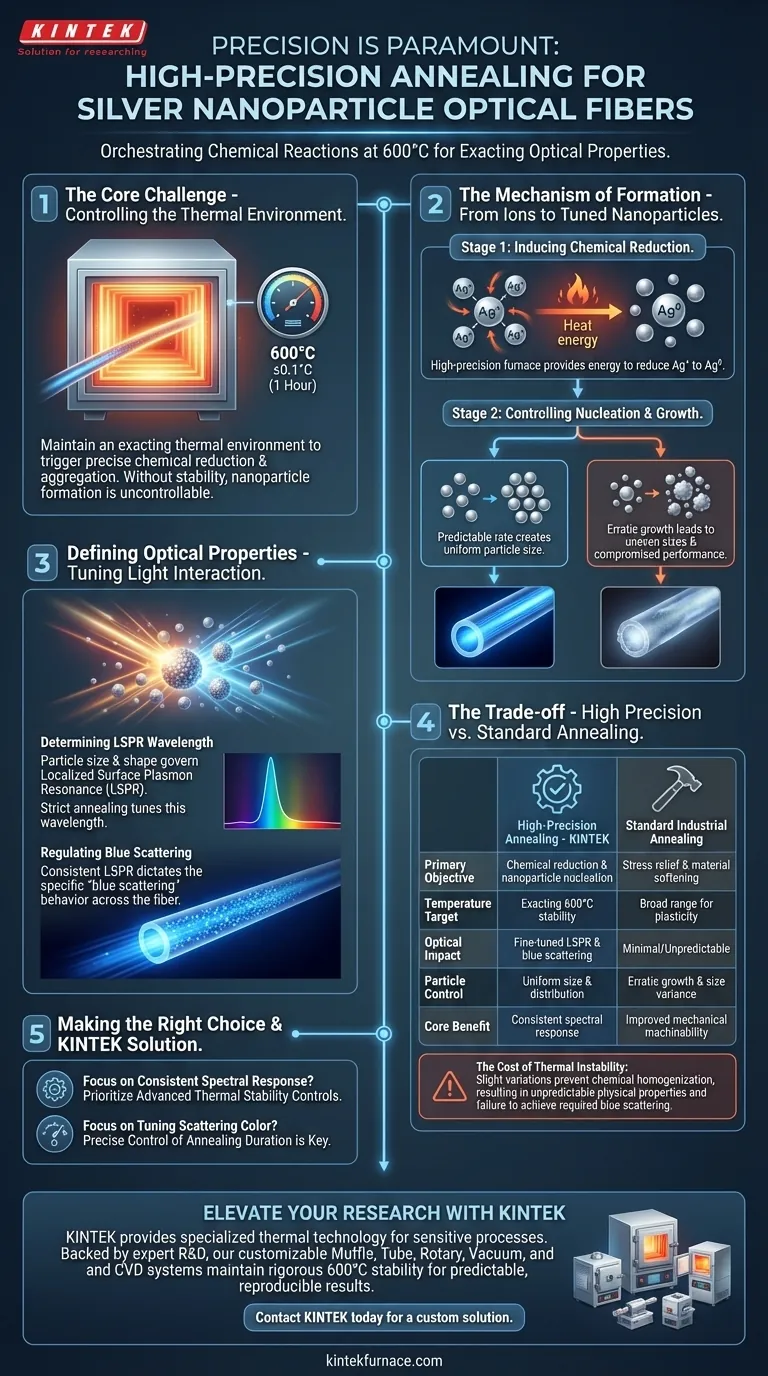
Precision is the defining factor in the post-treatment of optical fibers containing silver nanoparticles. A high-precision annealing furnace is necessary to maintain an exacting thermal environment—specifically around 600°C for one hour—to trigger the chemical reduction and aggregation of silver ions within the glass matrix. Without this rigorous stability, it is impossible to control the formation of nanoparticles or the resulting optical properties of the fiber.
The furnace is not merely heating the glass; it is orchestrating a precise chemical reaction. The accuracy of temperature and duration directly dictates the nucleation of silver nanoparticles, which determines the fiber's Localized Surface Plasmon Resonance (LSPR) and its specific scattering characteristics.
The Mechanism of Nanoparticle Formation
Inducing Chemical Reduction
The primary goal of this annealing process is to alter the chemical state of the silver within the fiber.
The high-precision furnace provides the energy required to reduce silver ions ($Ag^+$) into elemental silver ($Ag^0$). This chemical reduction is the foundational step for creating the desired optical effects.
Controlling Nucleation and Growth
Once reduced, the silver atoms must aggregate to form nanoparticles.
This stage is comprised of nucleation (the birth of new particles) and growth (the increase in particle size). Precise thermal control ensures these two phases happen at a predictable rate.
If the temperature fluctuates, the growth rate becomes erratic. This leads to uneven particle sizes throughout the fiber, compromising its performance.
Defining Optical Properties
Determining the LSPR Wavelength
The physical size and shape of the silver nanoparticles govern how they interact with light.
This interaction is known as Localized Surface Plasmon Resonance (LSPR). By strictly controlling the annealing time and temperature, you are effectively "tuning" the LSPR wavelength.
Regulating Blue Scattering
The LSPR directly influences the spectral characteristics of the fiber.
specifically, the process regulates the blue scattering behavior of the optical fiber. A high-precision furnace ensures that this scattering effect is consistent and reproducible across the entire length of the fiber.
Understanding the Trade-offs
High Precision vs. General Annealing
It is important to distinguish this process from standard industrial annealing.
As noted in general mechanical applications, standard annealing is often used simply to soften materials, remove residual stress, or improve plasticity. While stress removal is a beneficial side effect for optical fibers, it is not the primary objective here.
The Cost of Thermal Instability
Using a standard, low-precision furnace introduces significant risk.
If the "thermal history" of the fiber varies even slightly, the chemical composition will not be homogenized. This results in unpredictable physical properties and a failure to achieve the specific blue scattering spectrum required for the application.
Making the Right Choice for Your Goal
To ensure your optical fiber performs as intended, you must align your equipment capabilities with your specific processing objectives.
- If your primary focus is consistent spectral response: Prioritize a furnace with advanced thermal stability controls to ensure uniform nanoparticle size distribution.
- If your primary focus is tuning the scattering color: Focus on the precise control of the annealing duration, as the time spent at 600°C directly impacts particle growth and the resulting LSPR shift.
Mastering the thermal environment is the only way to transition from raw materials to a functional, high-performance optical component.
Summary Table:
| Feature | High-Precision Annealing | Standard Industrial Annealing |
|---|---|---|
| Primary Objective | Chemical reduction & nanoparticle nucleation | Stress relief & material softening |
| Temperature Target | Exacting 600°C stability | Broad range for plasticity |
| Optical Impact | Fine-tuned LSPR & blue scattering | Minimal/Unpredictable |
| Particle Control | Uniform size & distribution | Erratic growth & size variance |
| Core Benefit | Consistent spectral response | Improved mechanical machinability |
Elevate Your Optical Fiber Research with KINTEK
Precision is the difference between a raw material and a high-performance optical component. KINTEK provides the specialized thermal technology required for sensitive processes like silver nanoparticle aggregation.
Backed by expert R&D and manufacturing, we offer Muffle, Tube, Rotary, Vacuum, and CVD systems—all of which are fully customizable to maintain the rigorous 600°C stability your lab demands. Whether you are tuning LSPR wavelengths or perfecting blue scattering effects, our high-temp furnaces ensure your chemical reactions are predictable and reproducible.
Ready to achieve superior thermal accuracy? Contact KINTEK today for a custom solution.
Visual Guide
References
- Jan Schröder, Lothar Wondraczek. Functional Optical Fibers with Tailored Side Emission from Modified Rod‐in‐Tube Preforms. DOI: 10.1002/adpr.202500018
This article is also based on technical information from Kintek Furnace Knowledge Base .
Related Products
- Spark Plasma Sintering SPS Furnace
- Controlled Inert Nitrogen Hydrogen Atmosphere Furnace
- High Temperature Muffle Oven Furnace for Laboratory Debinding and Pre Sintering
- Laboratory Muffle Oven Furnace with Bottom Lifting
- Vertical Laboratory Quartz Tube Furnace Tubular Furnace
People Also Ask
- Why is it necessary to maintain a high vacuum environment during the SPS of SiC? Key to High-Density Ceramics
- How does the heating mechanism of Spark Plasma Sintering (SPS) function? Enhance TiC/SiC Composite Fabrication
- What are the technical advantages of using an SPS sintering furnace? Elevate Al2O3-TiC Material Performance
- What are the steps in the discharge plasma sintering process? Master Fast, High-Density Material Consolidation
- What are the advantages of spark plasma sintering (SPS) over traditional forging? Precision Microstructural Control



















