
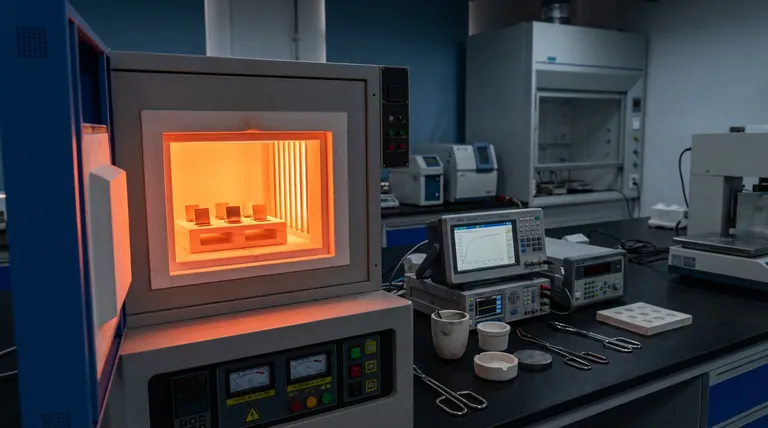
Industrial-grade constant temperature furnaces serve as the critical validation environment for determining the longevity of NiCoCrAlY coatings. Their primary function is to conduct long-term static isothermal oxidation tests, which simulate the thermal stresses of real-world working conditions—typically at temperatures between 800°C and 900°C.
The core purpose of this equipment is to provide a stable thermal field necessary to verify whether a pre-oxidized α-Al2O3 layer effectively inhibits oxygen diffusion and slows the growth rate of Thermally Grown Oxides (TGO).
Simulating Real-World Service Conditions
To understand the kinetics of oxidation, one must replicate the environment in which the material will operate.
Replicating High-Temperature Environments
The furnace is designed to maintain high temperatures, specifically targeting the 800°C and 900°C range.
This capability allows researchers to observe how the NiCoCrAlY material behaves under the thermal loads it would experience in actual industrial applications.
Long-Term Static Testing
The reference specifies that these furnaces are used for long-term static tests.
Unlike short bursts of heat, these extended durations expose the cumulative effects of oxidation, revealing how the material degrades over time rather than just its immediate reaction to heat.
Verifying Protective Mechanisms
The ultimate goal of using these furnaces is to validate the effectiveness of the material's protective strategies.
Testing Oxygen Diffusion Inhibition
The furnace environment tests the integrity of the pre-oxidized α-Al2O3 layer.
By maintaining a constant temperature, researchers can isolate variables and determine if this layer successfully acts as a barrier to prevent oxygen from penetrating the coating.
Monitoring TGO Growth Rates
A critical metric in these studies is the growth rate of Thermally Grown Oxides (TGO).
The stable thermal field provided by the furnace ensures that any observed slowing of TGO growth is due to the material's properties, not fluctuations in the test environment.
Understanding the Trade-offs
While essential for kinetic studies, it is important to recognize the specific scope of these tests.
Static vs. Cyclic Limitations
The primary reference explicitly notes these are static isothermal tests.
This means the furnace maintains a constant temperature, which is excellent for studying chemical oxidation kinetics but does not simulate the mechanical stresses caused by rapid heating and cooling cycles (thermal cycling) often found in engine operations.
Dependence on Thermal Stability
The reliability of the data is entirely dependent on the furnace's ability to maintain a stable thermal field.
If the furnace lacks industrial-grade precision, minor temperature fluctuations can skew the data regarding oxygen diffusion rates, leading to incorrect conclusions about the coating's lifespan.
Making the Right Choice for Your Research
When utilizing these furnaces for NiCoCrAlY studies, align your testing protocols with your specific material goals.
- If your primary focus is Chemical Stability: Prioritize long-term durations at steady temperatures to accurately plot the growth curve of the TGO layer.
- If your primary focus is Barrier Verification: Use the 800°C–900°C range to stress-test the permeability of the α-Al2O3 layer against oxygen ingress.
Success in these studies relies on the absolute consistency of the thermal field to isolate the protective performance of the oxide layer.
Summary Table:
| Feature | Function in NiCoCrAlY Studies | Research Impact |
|---|---|---|
| Temperature Stability | Maintains 800°C–900°C isothermal environment | Ensures precise calculation of TGO growth kinetics |
| Static Thermal Field | Long-term exposure (isothermal oxidation) | Validates oxygen diffusion inhibition of α-Al2O3 layers |
| Atmosphere Control | Simulates industrial service environments | Predicts coating lifespan and material degradation |
| Validation Precision | Isolates material variables from fluctuations | Verifies effectiveness of protective oxide barriers |
Maximize Your Material Research Precision with KINTEK
Precise thermal stability is the backbone of reliable oxidation kinetics research. Backed by expert R&D and manufacturing, KINTEK offers high-performance Muffle, Tube, Rotary, Vacuum, and CVD systems, specifically engineered to maintain the stable thermal fields required for validating NiCoCrAlY coatings and TGO growth rates.
Whether you need standard lab high-temp furnaces or fully customizable solutions for your unique oxidation studies, KINTEK provides the industrial-grade accuracy your research demands.
Ready to ensure the integrity of your thermal data? Contact our experts today to find the perfect furnace for your laboratory.
References
- Masahiro Negami, Yoko Yamabe‐Mitarai. The Oxidation Behaviors of NiCoCrAlY Coatings After Pre-Oxidation Treatment During High-Temperature Oxidation at 800 ℃ and 900 ℃. DOI: 10.1007/s11085-024-10221-6
This article is also based on technical information from Kintek Furnace Knowledge Base .
Related Products
- 1400℃ High Temperature Laboratory Tube Furnace with Alumina Tube
- 1400℃ Controlled Inert Nitrogen Atmosphere Furnace
- 1700℃ High Temperature Laboratory Tube Furnace with Alumina Tube
- 1700℃ Controlled Inert Nitrogen Atmosphere Furnace
- 1700℃ High Temperature Muffle Oven Furnace for Laboratory
People Also Ask
- How do high-temperature laboratory tube furnaces ensure environmental stability? Precision Thermal Reduction Tips
- How are high-temperature laboratory tube furnaces applied in long-term vacuum homogenization heat treatments for intermetallic samples?
- What is the function of a furnace in CuAlMn alloy treatment? Achieve Perfect Microstructural Homogenization
- What is the mechanism of a high-temperature furnace in Bi-2223 sintering? Achieve Precision Phase Transformation
- How does a laboratory high-temperature tube furnace contribute to the conversion of electrospun fibers? Expert Insights



















