
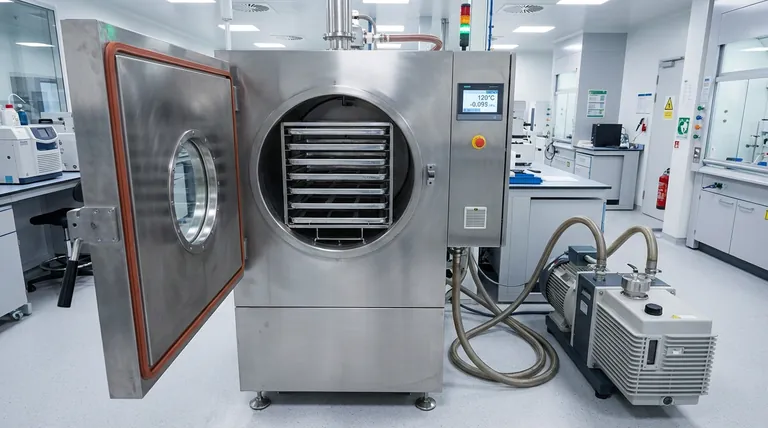
A vacuum drying oven is the definitive safeguard in the electrode manufacturing process, ensuring the chemical and structural integrity of the battery. It utilizes a high-temperature environment (typically 120 °C) coupled with negative pressure to aggressively extract residual organic solvents—specifically NMP—and trace moisture from the coated electrode sheets.
Core Takeaway The vacuum drying process is critical because it prevents microscopic water molecules from reacting with the battery's electrolyte. By eliminating moisture, you stop the formation of corrosive hydrofluoric acid (HF), thereby preserving the electrolyte's stability and significantly extending the battery's cycle life.
The Critical Role of Moisture and Solvent Removal
Preventing Corrosive Chemical Reactions
The primary function of the vacuum oven is the complete removal of adsorbed moisture. If water remains in the electrode, it reacts with the electrolyte salt (such as LiPF6) once the battery is assembled.
This reaction produces hydrofluoric acid (HF), a highly corrosive by-product. HF degrades the cathode material and destabilizes the solid electrolyte interphase (SEI), leading to rapid capacity fade.
Ensuring Complete NMP Extraction
Electrode slurries often use N-Methyl-2-pyrrolidone (NMP) as a solvent, which has a high boiling point. Standard heating alone is often insufficient to remove it completely from deep within the porous electrode structure.
The vacuum environment lowers the boiling point of NMP. This ensures thorough evaporation even from the deepest pores without requiring excessive temperatures that could damage the active materials.
Enhancing Structural and Electrical Integrity
Lowering Interfacial Impedance
Residual air or solvent trapped in the electrode pores acts as an insulator. This increases the internal resistance (impedance) of the battery.
Vacuum drying evacuates these trapped gases, ensuring optimal contact between the electrolyte and the pore surfaces. This facilitates efficient ion transport and improves overall battery performance.
Strengthening Electrode Adhesion
The drying process is vital for the mechanical properties of the electrode. It solidifies the binder (such as PVDF), creating a robust bond between the active material, the carbon nanofibers, and the current collector.
Proper vacuum drying prevents the electrode layer from peeling or delaminating during the winding and packaging stages.
Preventing Oxidation
Standard thermal drying exposes materials to oxygen, which can degrade sensitive active components.
The vacuum oven operates in an oxygen-free (negative pressure) environment. This protects the active materials and current collectors from oxidation during the high-temperature treatment.
Understanding the Trade-offs
Temperature Sensitivity vs. Drying Efficiency
While high temperatures accelerate drying, excessive heat can degrade the polymer binder or damage the active material structure. The process requires a precise balance: high enough to drive out moisture (110-120 °C), but controlled enough to maintain material integrity.
Throughput Limitations
Vacuum drying is a batch process that takes time to achieve the necessary negative pressure and thermal equilibrium. This can be a bottleneck in high-speed manufacturing lines compared to continuous hot-air drying, making the optimization of drying time crucial for production efficiency.
Making the Right Choice for Your Goal
- If your primary focus is Long-Term Cycle Life: Prioritize the removal of trace moisture to parts-per-million levels to prevent hydrofluoric acid formation and electrolyte decomposition.
- If your primary focus is Mechanical Durability: Focus on the controlled removal of NMP solvents to ensure the binder cures correctly, preventing delamination between the coating and the current collector.
- If your primary focus is Electrical Performance: Ensure the vacuum process effectively evacuates air from the pores to minimize interfacial impedance and maximize ion transport.
The vacuum drying oven transforms a coated sheet into a chemically stable, high-performance battery electrode.
Summary Table:
| Feature | Function | Impact on Battery |
|---|---|---|
| Moisture Removal | Prevents HF acid formation | Extends cycle life and electrolyte stability |
| NMP Extraction | Deep solvent evaporation | Improves safety and binder solidification |
| Negative Pressure | Prevents material oxidation | Protects active components and collectors |
| Pore Evacuation | Lowers interfacial impedance | Enhances ion transport and power output |
Elevate Your Battery Manufacturing Precision with KINTEK
Don't let trace moisture or residual solvents compromise your lithium-ion battery performance. KINTEK provides industry-leading thermal solutions backed by expert R&D and precision manufacturing.
Our extensive range of Muffle, Tube, Rotary, Vacuum, and CVD systems are fully customizable to meet the unique requirements of your electrode processing and material research. Whether you need to optimize binder adhesion or eliminate corrosive chemical reactions, KINTEK has the high-temperature lab technology to help you succeed.
Ready to scale your production with superior thermal control?
Contact our technical experts today to find your custom solution!
References
- Lenka Oroszová, Karel Saksl. Utilizing High-Capacity Spinel-Structured High-Entropy Oxide (CrMnFeCoCu)3O4 as a Graphite Alternative in Lithium-Ion Batteries. DOI: 10.3390/cryst14030218
This article is also based on technical information from Kintek Furnace Knowledge Base .
Related Products
- Vacuum Heat Treat Sintering and Brazing Furnace
- Vacuum Heat Treat Sintering Furnace Molybdenum Wire Vacuum Sintering Furnace
- Dental Porcelain Zirconia Sintering Ceramic Vacuum Press Furnace
- Vacuum Hot Press Furnace Machine for Lamination and Heating
- Vacuum Hot Press Furnace Machine Heated Vacuum Press
People Also Ask
- What are the benefits of using vacuum heat treating furnaces for metal alloys? Achieve Superior Metal Properties and Performance
- How does vacuum heat treating affect the grain structure of metal alloys? Achieve Precise Microstructure Control
- What is one of the most important uses of vacuum heat treating furnaces in aerospace? Achieve Superior Strength in Aircraft Alloys
- What is the temperature of a vacuum furnace brazing? Optimize Your Joint Strength and Cleanliness
- What are the steps involved in a typical vacuum brazing treatment? Master the Process for Strong, Clean Joints







