
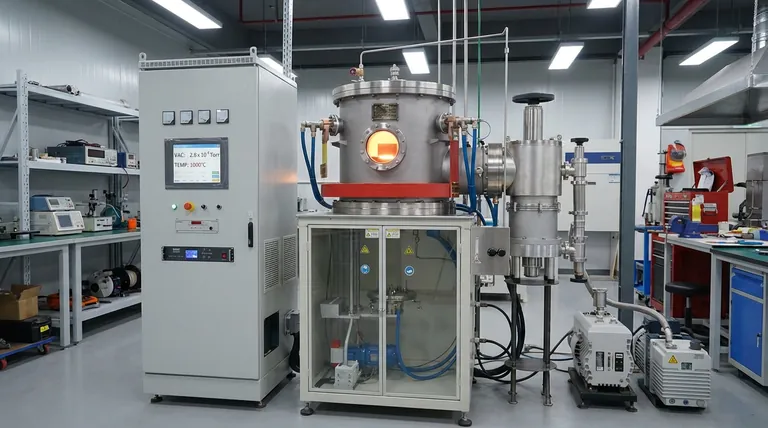
To ensure the integrity of Commercially Pure Titanium (CP-Ti) during high-temperature annealing, specifically at 1000°C, you must maintain a vacuum level in the range of 2.8 x 10^-6 Torr. This ultra-high vacuum is required to prevent oxidation and stabilize the material's chemical composition during exposure times of approximately one hour.
Achieving a vacuum of 2.8 x 10^-6 Torr is critical not only for surface cleanliness but for preventing the uptake of dissolved oxygen, which preserves the material's beta transus temperature and overall mechanical stability.
The Critical Role of Ultra-High Vacuum
Preventing Surface Contamination
Titanium is highly reactive at elevated temperatures. Without an ultra-high vacuum environment, the metal will rapidly react with any residual gases present in the furnace.
Maintaining a pressure of 2.8 x 10^-6 Torr is necessary to actively remove surface contaminants. This prevents the formation of oxides that would otherwise compromise the surface finish and fatigue life of the component.
Controlling Dissolved Oxygen
The threat to CP-Ti is not just surface-level; oxygen can diffuse directly into the metal matrix.
A vacuum level in the 10^-6 Torr range ensures that the dissolved oxygen content does not significantly increase during the heat treatment cycle. If the vacuum is insufficient, the material will absorb oxygen, causing it to become brittle.
Maintaining Phase Stability
The chemical stability of Titanium is directly linked to its phase transformation points.
By preventing oxygen uptake, you ensure the beta transus temperature remains stable. Oxygen is a strong alpha-stabilizer; if dissolved oxygen levels rise due to poor vacuum, the beta transus temperature will shift, leading to unpredictable material properties.
Understanding the Operational Trade-offs
Equipment Complexity
Achieving 10^-6 Torr requires more than standard roughing pumps.
You will likely rely on high-performance diffusion or turbomolecular pumps. This increases the complexity of your furnace setup and requires rigorous maintenance to ensure seals and pumps perform at peak efficiency.
Sensitivity to Leaks
At this level of vacuum, the system is unforgiving.
Even microscopic leaks that would be acceptable for heat-treating steel will be catastrophic for Titanium. The system must be perfectly sealed, as even a minor ingress of atmosphere at 1000°C will result in the immediate degradation of the workpiece.
Making the Right Choice for Your Goal
When configuring your furnace for CP-Ti annealing, your equipment capabilities must align with the material's chemical sensitivity.
- If your primary focus is Surface Purity: Ensure your pumping stack is rated to reach and sustain 2.8 x 10^-6 Torr well before the heater reaches peak temperature.
- If your primary focus is Material Consistency: Monitor vacuum levels to prevent oxygen absorption, which is the only way to guarantee a stable beta transus temperature across the batch.
Strict adherence to this ultra-high vacuum standard is the only reliable way to process CP-Ti at high temperatures without compromising its chemical and mechanical stability.
Summary Table:
| Parameter | Requirement | Why It Matters |
|---|---|---|
| Temperature | 1000°C | Target annealing point for CP-Ti |
| Vacuum Level | 2.8 x 10^-6 Torr | Prevents surface oxidation and brittleness |
| Exposure Time | ~1 Hour | Ensures uniform heat treatment and stability |
| Oxygen Control | Ultra-Low | Preserves beta transus temperature and ductility |
| Pump Type | Diffusion/Turbo | Necessary to achieve ultra-high vacuum levels |
Elevate Your Titanium Processing with KINTEK Precision
Don't let oxidation compromise your material integrity. KINTEK provides industry-leading high-temperature vacuum and induction furnaces designed to achieve and maintain the ultra-high vacuum levels (2.8 x 10^-6 Torr) required for sensitive metals like CP-Ti.
Backed by expert R&D and world-class manufacturing, our Muffle, Tube, Rotary, Vacuum, and CVD systems are fully customizable to meet your specific research or production needs. Ensure stable phase transformation and superior surface purity with our advanced thermal solutions.
Ready to optimize your lab's thermal performance? Contact our experts today to discuss your custom furnace needs!
References
- Hannah Sims, John J. Lewandowski. The Use of DSC and Independent Oxygen Analyses to Correlate the β Transus Temperature in CP-Ti Grade 2 Materials Processed via Different Techniques. DOI: 10.1007/s11661-025-07922-1
This article is also based on technical information from Kintek Furnace Knowledge Base .
Related Products
- Molybdenum Vacuum Heat Treat Furnace
- 2200 ℃ Tungsten Vacuum Heat Treat and Sintering Furnace
- 2200 ℃ Graphite Vacuum Heat Treat Furnace
- 1400℃ Controlled Inert Nitrogen Atmosphere Furnace
- High Temperature Muffle Oven Furnace for Laboratory Debinding and Pre Sintering
People Also Ask
- How does vacuum heat treating work in terms of temperature and time control? Master Precise Material Transformations
- What is the primary application of vacuum heat treating furnaces in aerospace? Enhance Component Performance with Precision
- What is the process of vacuum heat treating? Achieve Superior Metallurgical Properties
- Why are vacuum heat treating furnaces essential for aerospace? Ensure Superior Material Integrity for High-Stakes Applications
- How does a vacuum heat treating furnace improve the condition of metal alloys? Achieve Superior Metal Performance



















