
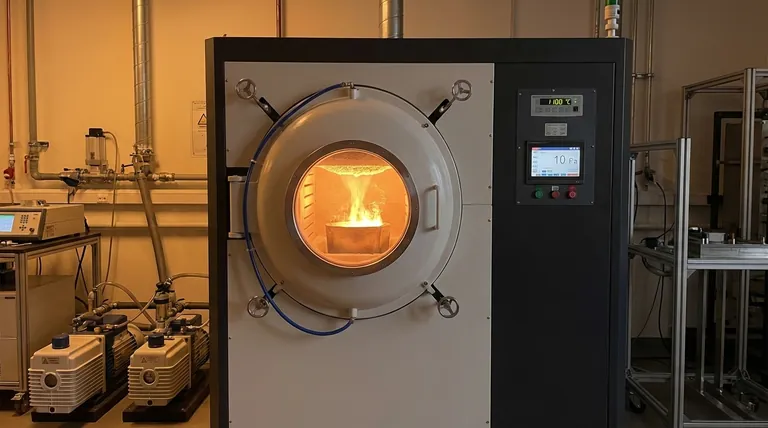
At its core, a vacuum furnace provides the two essential physical conditions required to separate magnesium from aluminum in an alloy: extremely high temperature and a high-vacuum environment. The furnace heats the alloy until the magnesium’s vapor pressure is significant, while the vacuum dramatically lowers its boiling point and clears the path for the resulting vapor to be collected, leaving behind purified aluminum.
The vacuum furnace is not merely a container; it is a highly controlled environment engineered to manipulate the fundamental boiling points of metals. It exploits the large difference in volatility between magnesium and aluminum to achieve an efficient and high-purity separation that would be impossible under normal atmospheric conditions.
The Physics of Separation: Temperature and Pressure
To understand the furnace's role, you must first understand the two physical principles it manipulates: vapor pressure and boiling point. These two factors are the levers that make vacuum distillation possible.
Driving Volatility with Heat
Every metal has a natural tendency to turn into a gas, a property known as vapor pressure. This pressure increases dramatically with temperature.
A vacuum furnace heats the aluminum-magnesium alloy to a very high temperature, typically around 1373 K (1100 °C). At this temperature, the vapor pressure of magnesium becomes substantial, meaning its atoms are energetically ready to escape the liquid alloy.
Enabling Evaporation with Vacuum
A liquid boils when its vapor pressure equals the pressure of the environment around it. Under normal atmospheric pressure, magnesium must be extremely hot to boil.
The furnace's second critical function is to create a high vacuum (10-15 Pa). This removes the vast majority of air molecules, drastically lowering the external pressure. This allows magnesium to effectively boil and vaporize at a much lower temperature than it would in open air.
The Critical Partnership
Heat and vacuum work in tandem. The high temperature gives the magnesium atoms the energy to escape, while the high vacuum removes the physical barrier (air pressure) that holds them in the liquid state. Aluminum, having a much lower vapor pressure, remains a liquid.
Maximizing Efficiency and Purity
Creating the right conditions is only half the battle. The furnace's design is also central to ensuring the process is efficient and the resulting metals are pure.
Clearing the Path for Vapor
In a high vacuum, the few remaining gas molecules are very far apart. This creates a long mean free path—the average distance a vaporized magnesium atom can travel before colliding with another molecule.
This extended path allows the magnesium vapor to travel rapidly and directly from the molten alloy to the cooler condenser surface for collection. This minimizes losses and dramatically increases the magnesium recovery rate.
Preventing Contamination and Oxidation
Molten aluminum and magnesium are highly reactive with oxygen. If this process were attempted in the presence of air, the metals would rapidly form oxides, leading to impurities and significant material loss.
The vacuum environment is fundamentally an oxygen-free environment. By removing reactive gases, the furnace ensures the integrity of both the separated magnesium and the remaining high-purity aluminum.
Understanding the Practical Demands
Operating at such high temperatures and low pressures places extreme demands on the furnace and its components. This is not a simple heating process.
The Challenge of Material Containment
The crucible holding the molten alloy is a critical component. It must be chemically inert and stable at 1373 K while in contact with highly reactive liquid metals.
Any reaction between the crucible and the alloy would contaminate the final products. For this reason, materials like high-purity graphite or specialized ceramics are essential to maintain the quality of the separation.
The Need for Precise Control
The efficiency and purity of the separation depend on precise and stable control over both temperature and vacuum level.
Even small fluctuations can affect the rate of evaporation and the potential for impurities to vaporize, making sophisticated control systems a mandatory feature of these industrial furnaces.
Making the Right Choice for Your Goal
The vacuum furnace is a precision tool, and optimizing its use depends on your primary metallurgical objective.
- If your primary focus is maximizing magnesium recovery rate: Achieving the highest possible vacuum (in the 10-15 Pa range) is your most critical parameter to ensure vapor travels unimpeded to the condenser.
- If your primary focus is ensuring product purity: Your attention must be on both maintaining a strong vacuum to prevent oxidation and verifying the chemical inertness of your crucible material.
- If your primary focus is process efficiency: The key is the synergy between heat and vacuum; finding the optimal temperature that maximizes magnesium vapor pressure without wasting energy is crucial.
Ultimately, the vacuum furnace provides precise control over the physical laws governing materials, allowing you to separate elements with exceptional purity.
Summary Table:
| Key Function | Role in Separation | Typical Parameter |
|---|---|---|
| High-Temperature Heating | Increases magnesium vapor pressure for evaporation. | ~1373 K (1100 °C) |
| High-Vacuum Environment | Lowers boiling point and enables vapor travel. | 10-15 Pa |
| Oxygen-Free Atmosphere | Prevents oxidation, ensuring product purity. | Reactive gas removal |
| Crucible Material | Contains molten alloy without contamination. | High-purity graphite/ceramics |
Ready to Achieve High-Purity Metal Separation?
Backed by expert R&D and manufacturing, KINTEK offers Vacuum, CVD, and other lab high-temp furnace systems, all customizable for unique needs. Our vacuum furnaces are engineered to provide the precise temperature and vacuum control required for efficient, high-purity distillation processes like aluminum-magnesium alloy separation.
Contact us today to discuss how our solutions can enhance your metallurgical processes!
Visual Guide

Related Products
- Magnesium Extraction and Purification Condensing Tube Furnace
- Vacuum Heat Treat Sintering Furnace with Pressure for Vacuum Sintering
- Molybdenum Vacuum Heat Treat Furnace
- Small Vacuum Heat Treat and Tungsten Wire Sintering Furnace
- Vacuum Hot Press Furnace Machine for Lamination and Heating
People Also Ask
- What are the advantages of using a condensing tube furnace for magnesium extraction? Achieve High Purity and Efficient Metal Recovery
- Why is uniform temperature distribution important in a tube furnace? Ensure Reliable and Repeatable Material Processing
- What is the uniform length of a tube furnace? Maximize Thermal Stability for Reliable Results
- How does a tube furnace contribute to the accuracy of microplastic thermal decomposition? Ensure Pyrolysis Precision
- Why use a tube furnace instead of a muffle furnace for annealing? Achieve Superior Process Control



















