
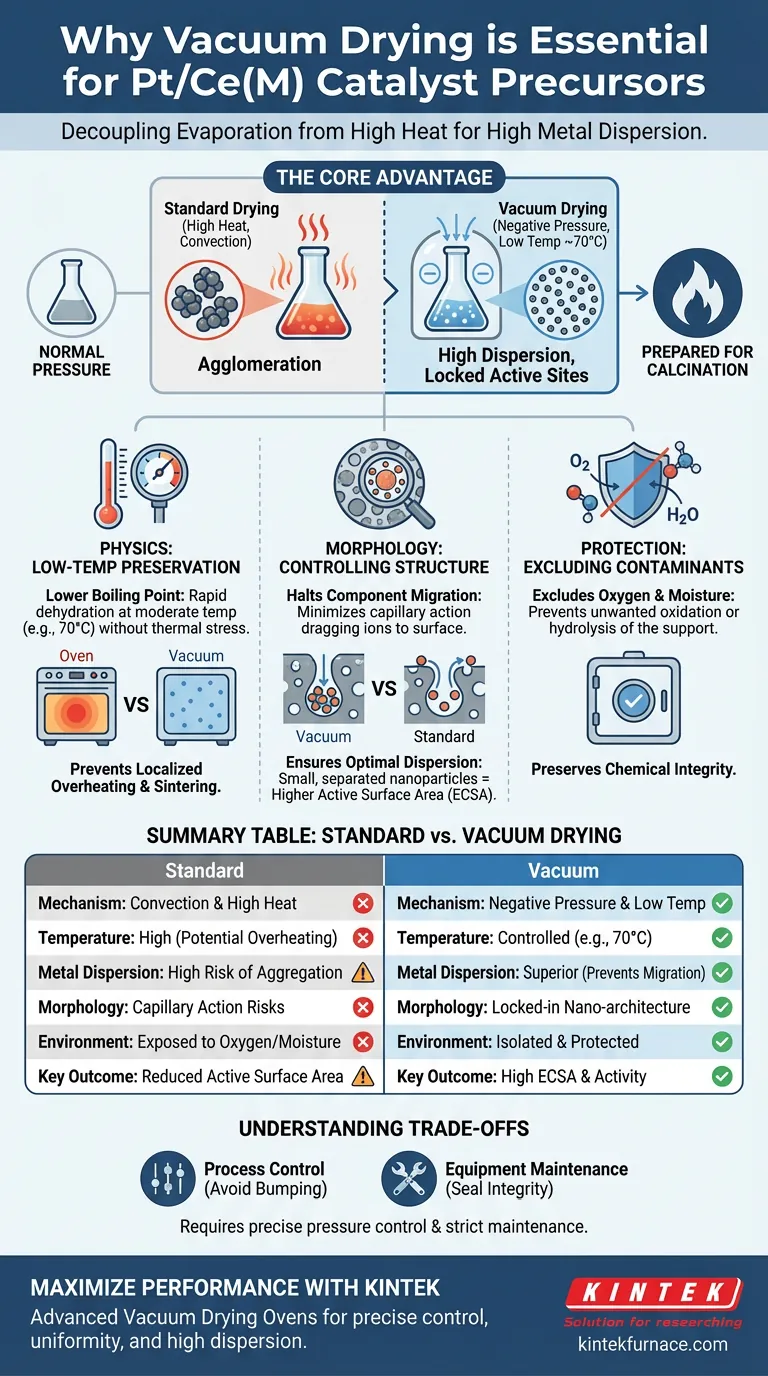
The primary function of a vacuum drying oven in Pt/Ce(M) precursor treatment is to maintain high metal dispersion by decoupling evaporation from high heat. By lowering the boiling point of solvents, the oven allows for rapid dehydration at a moderate temperature of 70°C. This process specifically prevents the migration and pre-aggregation of active metal components that typically result from the localized overheating found in standard drying methods.
The Core Advantage Vacuum drying solves the conflict between removing solvents and preserving catalyst structure. By utilizing negative pressure rather than excessive heat, it locks active sites in place and ensures the metal precursors remain highly dispersed for the subsequent calcination phase.
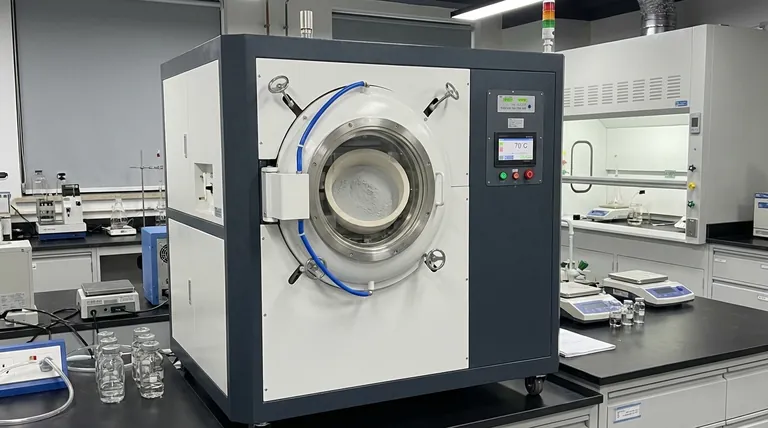
The Physics of Low-Temperature Preservation
Lowering the Boiling Point
The fundamental mechanism at work is the relationship between pressure and the boiling point of liquids. A vacuum environment significantly reduces the pressure surrounding the catalyst precursor.
This allows solvents to evaporate rapidly at much lower temperatures, such as 70°C. You achieve efficient drying without subjecting the delicate precursor structure to the thermal stress of standard atmospheric drying.
Preventing Localized Overheating
Standard drying ovens rely on convection, which can create hot spots or uneven temperature gradients within the powder bed.
Vacuum drying mitigates this risk entirely. By operating at a lower overall temperature, it eliminates the "localized overheating" that causes metal particles to sinter (clump together) prematurely.
Controlling Catalyst Morphology
Halting Component Migration
One of the biggest risks during the drying of impregnated supports is capillary action. As solvents evaporate in a standard oven, they can drag metal ions from the pores to the outer surface.
Vacuum drying removes the solvent so efficiently and at such low thermal energy that this migration is minimized. It stabilizes the spatial distribution of the precursor, keeping the platinum where you deposited it—deep within the support pores or evenly across the surface.
Ensuring Optimal Dispersion
For Platinum (Pt) based catalysts, activity is directly linked to surface area. You need small, separated nanoparticles, not large agglomerates.
By preventing the pre-aggregation of active components during the drying phase, the vacuum method ensures the material enters the high-temperature calcination stage with a "loose" and highly dispersed structure. This directly translates to a higher electrochemically active surface area (ECSA) in the final product.
Protection Against Environmental Contaminants
Excluding Oxygen and Moisture
While the primary goal is solvent removal, the vacuum environment offers a secondary benefit: isolation.
Standard air drying exposes the precursor to atmospheric oxygen and humidity, which can lead to unwanted hydrolysis or oxidation of the support. Vacuum drying excludes these factors, preserving the chemical integrity of the precursor and preventing the deactivation of surface functional groups.
Understanding the Trade-offs
Process Control vs. Speed
While vacuum drying is superior for quality, it requires more precise process control than a standard oven.
Dropping the pressure too rapidly can cause "bumping" (flash boiling), where the solvent evaporates so violently it physically disrupts the powder bed. Operators must manage the vacuum ramp-rate carefully to ensure evaporation is rapid but controlled.
Equipment Complexity
Unlike a simple convection oven, vacuum drying introduces variables regarding seal integrity and pump maintenance.
Any leak in the system introduces atmospheric moisture, which negates the protective benefits of the vacuum. This method requires a stricter adherence to equipment maintenance schedules to ensure repeatability.
Making the Right Choice for Your Goal
When finalizing your catalyst preparation protocol, consider your specific performance metrics.
- If your primary focus is maximizing catalytic activity: Use vacuum drying to ensure the highest possible dispersion of Pt nanoparticles and prevent active site agglomeration.
- If your primary focus is material purity: Rely on the vacuum environment to protect sensitive precursors from hydrolysis or oxidation caused by atmospheric humidity.
The vacuum drying oven is not merely a drying tool; it is a structural control device. It ensures that the sophisticated nano-architecture you designed during impregnation is not destroyed by the brute force of thermal evaporation.
Summary Table:
| Feature | Standard Drying Oven | Vacuum Drying Oven |
|---|---|---|
| Mechanism | Convection & High Heat | Negative Pressure & Low Temp |
| Temperature | High (Potential Overheating) | Controlled (e.g., 70°C) |
| Metal Dispersion | High Risk of Aggregation | Superior (Prevents Migration) |
| Morphology | Capillary Action Risks | Locked-in Nano-architecture |
| Environment | Exposed to Oxygen/Moisture | Isolated & Protected |
| Key Outcome | Reduced Active Surface Area | High ECSA & Activity |
Maximize Your Catalyst Performance with KINTEK
Don't let thermal stress compromise your research. KINTEK’s advanced Vacuum Drying Ovens provide the precise pressure control and temperature uniformity required to maintain high metal dispersion and prevent nanoparticle aggregation in Pt/Ce(M) precursors.
Backed by expert R&D and manufacturing, KINTEK offers Muffle, Tube, Rotary, Vacuum, and CVD systems—all customizable for your unique lab requirements. Ensure the integrity of your nano-architecture today.
Visual Guide
References
- Matías G. Rinaudo, María R. Morales. Insights into Contribution of Active Ceria Supports to Pt-Based Catalysts: Doping Effect (Zr; Pr; Tb) on Catalytic Properties for Glycerol Selective Oxidation. DOI: 10.3390/inorganics13020032
This article is also based on technical information from Kintek Furnace Knowledge Base .
Related Products
- Vacuum Heat Treat Sintering and Brazing Furnace
- Vacuum Heat Treat Sintering Furnace Molybdenum Wire Vacuum Sintering Furnace
- Dental Porcelain Zirconia Sintering Ceramic Vacuum Press Furnace
- Molybdenum Vacuum Heat Treat Furnace
- Vacuum Hot Press Furnace Machine Heated Vacuum Press
People Also Ask
- How does vacuum heat treating affect the grain structure of metal alloys? Achieve Precise Microstructure Control
- What is one of the most important uses of vacuum heat treating furnaces in aerospace? Achieve Superior Strength in Aircraft Alloys
- What are the benefits of using vacuum heat treating furnaces for metal alloys? Achieve Superior Metal Properties and Performance
- What is the temperature of a vacuum furnace brazing? Optimize Your Joint Strength and Cleanliness
- What are the steps involved in a typical vacuum brazing treatment? Master the Process for Strong, Clean Joints












