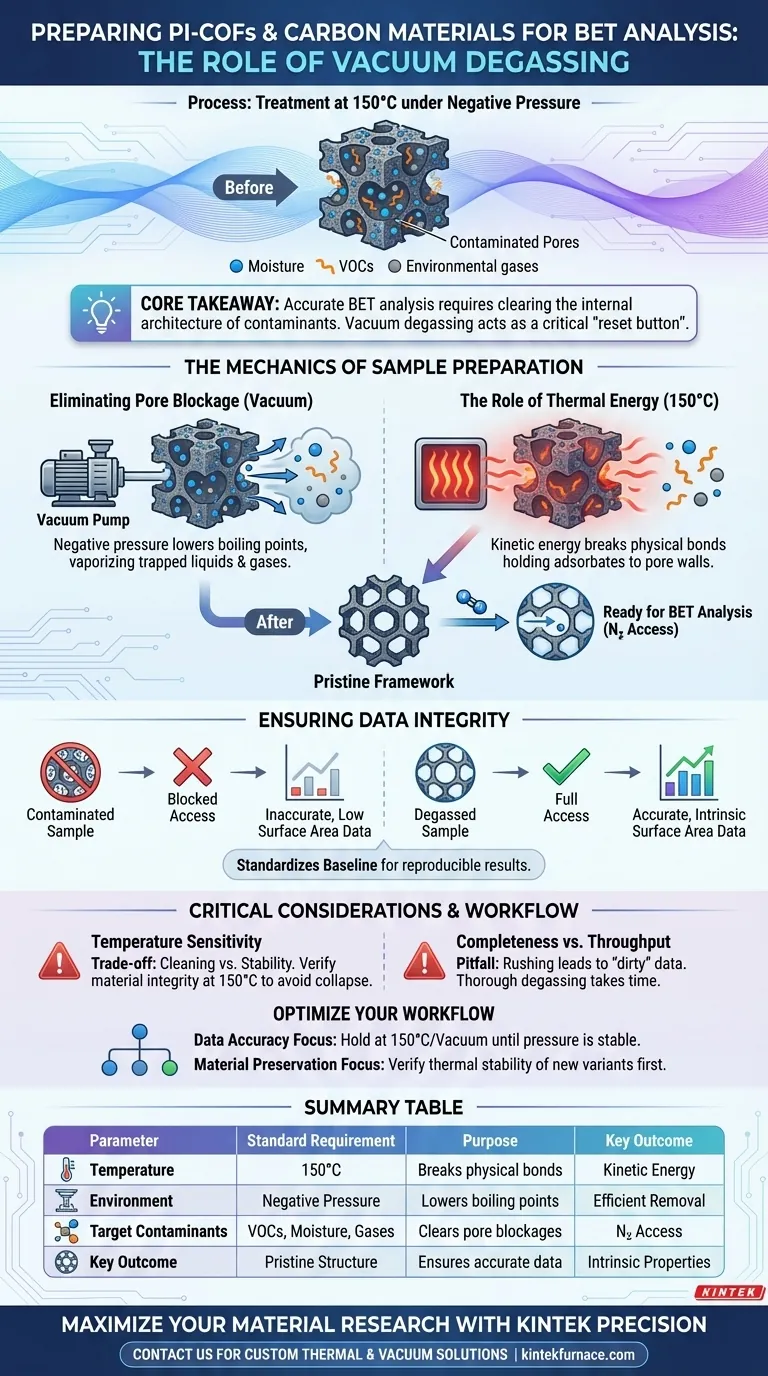
Vacuum degassing prepares Polyimide Covalent Organic Frameworks (PI-COFs) and carbon materials by treating them at 150°C under vacuum prior to analysis. This thermal and vacuum exposure systematically forces moisture, volatile organic compounds (VOCs), and trapped environmental gases out of the material's porous structure.
Core Takeaway Accurate specific surface area and pore size measurements are impossible if the pores are already filled with atmospheric contaminants. Vacuum degassing serves as a critical "reset button," clearing the material's internal architecture to ensure data reflects the framework's actual structure, not the debris trapped inside it.
The Mechanics of Sample Preparation
Eliminating Pore Blockage
Porous materials like PI-COFs and carbon derivatives act as sponges for their environment. Before analysis, their pores are often saturated with moisture and volatile organic compounds (VOCs).
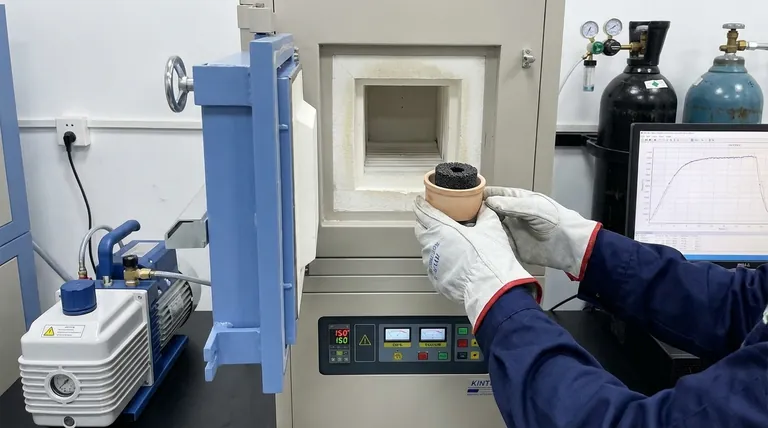
A vacuum degassing system addresses this by creating a negative pressure environment. This lowers the boiling point of trapped liquids and gases, allowing them to vaporize and exit the pores.
The Role of Thermal Energy
The application of 150°C heat provides the necessary kinetic energy to break the weak physical bonds holding contaminants to the pore walls.
Without this thermal input, vacuum alone might be insufficient to dislodge tightly adsorbed molecules. The combination of heat and vacuum ensures a thorough cleaning of the internal surface area.
Ensuring Data Integrity
Revealing Intrinsic Characteristics
The primary goal of Nitrogen Adsorption-Desorption (BET) analysis is to measure the material, not its contaminants.
If pores remain blocked during analysis, the nitrogen gas cannot access the full internal volume. This results in calculated surface areas that are significantly lower than reality.
Standardizing the Baseline
Degassing creates a standardized baseline for comparison. By consistently treating samples at 150°C under vacuum, researchers ensure that variations in data are due to actual structural differences in the PI-COFs, rather than varying levels of humidity or contamination in the lab environment.
Critical Considerations and Trade-offs
Temperature Sensitivity
While 150°C is the standard for these materials, it represents a trade-off between cleaning efficiency and material stability.
You must ensure that the structural integrity of your specific carbon material or COF can withstand this temperature without collapsing. If the material degrades at 150°C, the resulting BET data will reflect a damaged structure rather than the original sample.
Completeness vs. Throughput
Thorough degassing takes time. Rushing this step to increase sample throughput is a common pitfall that leads to "dirty" data and non-reproducible results.
Optimizing Your Analysis Workflow
To ensure your BET analysis yields valid data for PI-COFs and carbon materials, consider the following approach:
- If your primary focus is Data Accuracy: Ensure the sample is held at 150°C under vacuum until the pressure remains stable, indicating no further outgassing of contaminants.
- If your primary focus is Material Preservation: Verify the thermal stability of new PI-COF variants before degassing to confirm they do not structurally degrade at the standard 150°C treatment temperature.
Effective preparation transforms a contaminated sample into a pristine framework, allowing the true properties of your material to shine through.
Summary Table:
| Parameter | Standard Requirement | Purpose in Degassing |
|---|---|---|
| Temperature | 150°C | Provides kinetic energy to break physical bonds of adsorbates. |
| Environment | Negative Pressure (Vacuum) | Lowers boiling points of contaminants for efficient removal. |
| Target Contaminants | VOCs, Moisture, Lab Gases | Clears pore blockages to allow nitrogen access. |
| Key Outcome | Pristine Internal Structure | Ensures calculated surface area reflects intrinsic properties. |
Maximize Your Material Research with KINTEK Precision
Don't let contaminated samples compromise your research data. KINTEK provides high-performance thermal and vacuum systems specifically designed to handle delicate degassing and material preparation for PI-COFs, carbon frameworks, and more.
Backed by expert R&D and manufacturing, we offer a comprehensive range of Muffle, Tube, Rotary, Vacuum, and CVD systems, all fully customizable to meet your unique laboratory requirements. Ensure your BET analysis reflects the true potential of your materials with our reliable high-temp solutions.
Ready to elevate your lab's efficiency? Contact us today to find your custom solution!
Visual Guide
References
- Atsushi Nagai, Atsunori Matsuda. Synthesis and Electrical Property of Graphite Oxide-like Mesoporous <i>N</i>-Carbon Derived from Polyimide-Covalent Organic Framework Templates. DOI: 10.1021/acsomega.5c03968
This article is also based on technical information from Kintek Furnace Knowledge Base .
Related Products
- Vacuum Induction Melting Furnace
- Custom Made Versatile CVD Tube Furnace Chemical Vapor Deposition CVD Equipment Machine
- Cylindrical Resonator MPCVD Machine System for Lab Diamond Growth
- Slide PECVD Tube Furnace with Liquid Gasifier PECVD Machine
- Vacuum Heat Treat Sintering and Brazing Furnace
People Also Ask
- What are the core functions of the High Vacuum Induction Melting (VIM) furnace? Optimize DD5 Superalloy Purification
- What are the technical advantages of using a Vacuum Induction Melting furnace in the development of advanced packaging steel?
- What is the role of VIM and directional solidification in aero-engine blade substrates? Engineering Extreme Durability
- What role does a Vacuum Induction Melting furnace play in the production of high-aluminum nickel-based superalloys?
- What are the advantages of using a VIM furnace to control residual oxygen pressure? Achieve Superior Metal Uniformity