
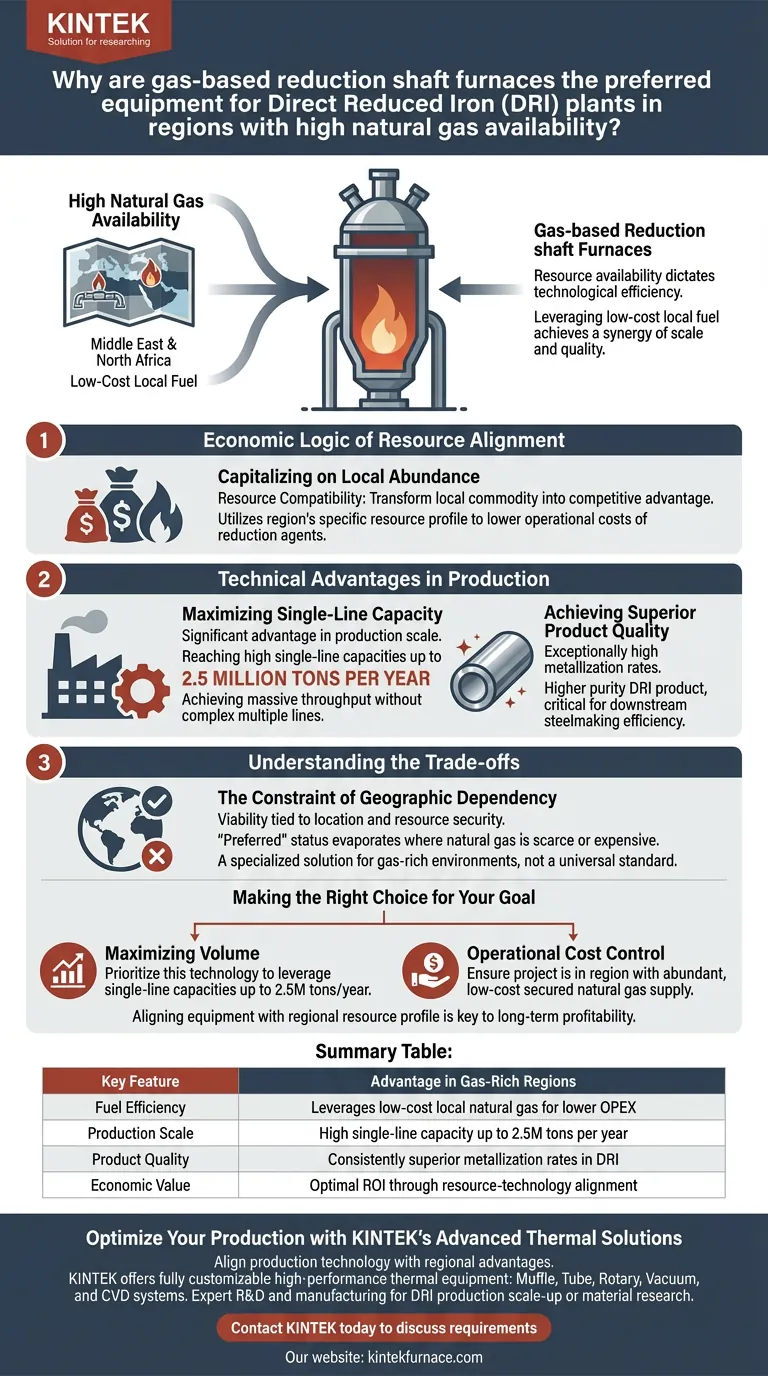
Resource availability dictates technological efficiency. In regions possessing abundant and cost-effective natural gas, such as the Middle East and North Africa, gas-based reduction shaft furnaces are the preferred technology because they align directly with the local resource profile to maximize economic and operational efficiency.
By leveraging low-cost local fuel, these furnaces achieve a synergy of scale and quality, enabling high single-line production capacities while ensuring superior metallization in the final Direct Reduced Iron (DRI) product.
The Economic Logic of Resource Alignment
Capitalizing on Local Abundance
The primary driver for adopting gas-based shaft furnaces is resource compatibility.
In areas where natural gas is plentiful, these systems transform a local commodity into a competitive advantage.
By utilizing the region's specific resource profile, operators can significantly lower the operational costs associated with reduction agents.
Technical Advantages in Production
Maximizing Single-Line Capacity
Beyond fuel costs, these furnaces offer significant advantages in production scale.
They are capable of reaching high single-line capacities, with output reaching up to 2.5 million tons per year.
This allows plants to achieve massive throughput without the complexity of managing multiple smaller processing lines.
Achieving Superior Product Quality
Quantity does not come at the expense of quality in these systems.
Gas-based reduction shaft furnaces are noted for ensuring exceptionally high metallization rates.
This results in a higher purity DRI product, which is critical for downstream steelmaking efficiency.
Understanding the Trade-offs
The Constraint of Geographic Dependency
While highly efficient, the viability of this technology is strictly tied to location and resource security.
The "preferred" status of these furnaces evaporates in regions where natural gas is scarce or expensive.
Investors must recognize that this technology is a specialized solution for gas-rich environments, not a universal standard for all geographies.
Making the Right Choice for Your Goal
To determine if this technology fits your strategic roadmap, consider your primary constraints:
- If your primary focus is maximizing volume: Prioritize this technology to leverage single-line capacities that can reach 2.5 million tons per year.
- If your primary focus is operational cost control: Ensure your project is located in a region where the natural gas supply is both abundant and secured at a low cost.
Aligning your equipment choice with your regional resource profile is the single most important factor in securing long-term plant profitability.
Summary Table:
| Key Feature | Advantage in Gas-Rich Regions |
|---|---|
| Fuel Efficiency | Leverages low-cost local natural gas for lower OPEX |
| Production Scale | High single-line capacity up to 2.5M tons per year |
| Product Quality | Consistently superior metallization rates in DRI |
| Economic Value | Optimal ROI through resource-technology alignment |
Optimize Your Production with KINTEK’s Advanced Thermal Solutions
Are you looking to align your production technology with regional resource advantages? At KINTEK, we understand that precision and efficiency are paramount. Backed by expert R&D and manufacturing, we offer a comprehensive range of high-performance thermal equipment—including Muffle, Tube, Rotary, Vacuum, and CVD systems—all of which are fully customizable to meet your unique industrial or laboratory needs.
Whether you are scaling up DRI production or conducting specialized material research, our engineering team is ready to provide the technical edge you need. Contact KINTEK today to discuss your specific requirements and discover how our tailored high-temperature solutions can drive your project's success.
Visual Guide
References
- Tetiana Golub, Molchanov Lavr. ESTABLISHMENT OF THERMODYNAMICAL AND PHYSICO-CHEMICAL PREREQUISITES FOR DIRECT OBTAINING IRON BY THERMOLISIS OF OXIDES. DOI: 10.31319/2519-2884.47.2025.1
This article is also based on technical information from Kintek Furnace Knowledge Base .
Related Products
- 1200℃ Controlled Inert Nitrogen Atmosphere Furnace
- Spark Plasma Sintering SPS Furnace
- Slide PECVD Tube Furnace with Liquid Gasifier PECVD Machine
- Mesh Belt Controlled Atmosphere Furnace Inert Nitrogen Atmosphere Furnace
- Custom Made Versatile CVD Tube Furnace Chemical Vapor Deposition CVD Equipment Machine
People Also Ask
- What controlled-atmosphere furnace conditions are required for sintering powder metallurgy copper alloy compacts? Ideal Setup
- How do surface oxide layers on ceramic powders like silicon nitride affect sintering? Master Atmosphere Control
- What causes discrepancies between theoretical and experimental grain boundary mobility during ceramic sintering? Explained
- What Roles Do a Controlled Atmosphere Furnace and Oil Quenching Tank Play in AISI 5140 Steel Heat Treatment?
- What factors should be considered when choosing a controlled atmosphere furnace? Ensure Optimal Performance for Your Materials



















