
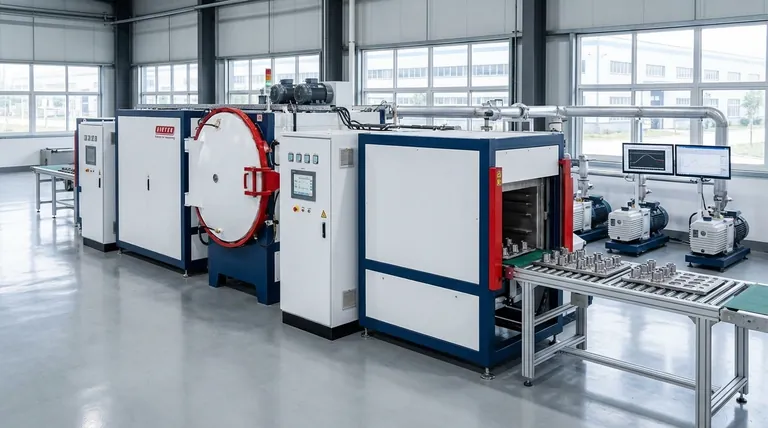
At its core, vacuum sintering is significant because it creates a controlled environment free of atmospheric contaminants. This process is crucial for manufacturing high-purity, dense, and mechanically superior metal parts by heating powdered materials below their melting point. Continuous vacuum furnaces facilitate this on an industrial scale by automating the process, ensuring uninterrupted production and absolute consistency by maintaining stable temperature and vacuum levels from start to finish.
The true value of vacuum sintering is not just heating metal—it is a precision engineering process that prevents oxidation and contamination to produce advanced materials with properties unattainable in a normal atmosphere. Continuous furnaces make this high-level process efficient and repeatable for large-scale manufacturing.
The Fundamental Advantage: Why a Vacuum Matters
Sintering in a vacuum is a fundamentally different process than heating in open air. The removal of atmosphere unlocks unique material advantages that are critical for high-performance applications.
Preventing Oxidation and Contamination
At the high temperatures required for sintering, most metals are highly reactive with oxygen and other gases in the air. This reaction, oxidation, forms a layer on the metal particles, inhibiting proper bonding.
A vacuum environment removes these reactive gases. This ensures the particle surfaces remain perfectly clean, allowing for direct, strong metallurgical bonds to form, which is essential for achieving full density and strength.
Enhancing Material Density and Strength
By preventing oxide layers, the vacuum allows metal particles to fuse together more effectively. This process closes the pores between particles, significantly increasing the final part's density.
Furthermore, the vacuum helps pull out any trapped gases from within the powder mass. The result is a component with superior strength, toughness, and fatigue resistance compared to one sintered in a conventional atmosphere.
Enabling Advanced and Reactive Materials
Certain materials, such as titanium, refractory metals, and specific superalloys, are so reactive that heating them in the presence of air is impossible without compromising their integrity.
Vacuum sintering is not just an option for these materials; it is a mandatory processing step to achieve the desired chemical and mechanical properties required for demanding industries like aerospace and medical implants.
How Continuous Furnaces Optimize the Process
While batch vacuum furnaces are effective, continuous vacuum furnaces are engineered for high-throughput, industrial-scale production. They transition parts through various heating and cooling zones without ever breaking the core vacuum.
Uninterrupted Production and Throughput
The key benefit of a continuous furnace is uninterrupted production. Parts are loaded into an entry module, moved through the controlled sintering stages, and removed from an exit module, all while the central furnace remains under a stable vacuum.
This design eliminates the time-consuming cycles of heating, cooling, and re-establishing a vacuum inherent in batch processing, dramatically increasing throughput and operational efficiency.
Absolute Process Consistency
Continuous furnaces excel at maintaining constant temperature and vacuum levels throughout the entire production run. This stability ensures that every part is subjected to the exact same process conditions.
This level of control eliminates process variability, leading to highly consistent and repeatable material properties. For large-scale manufacturing, this guarantees quality control and reduces rejection rates.
Automated, Intelligent Control
Modern continuous vacuum furnaces are equipped with intelligent control systems that automate the entire process. Parameters like temperature profiles, heating rates, and vacuum degree are precisely managed with minimal manual intervention.
This automation not only boosts production efficiency but also reduces the potential for human error, ensuring every cycle is executed flawlessly.
Understanding the Trade-offs
Despite their advantages, continuous vacuum furnaces represent a significant technical and financial commitment. Understanding their limitations is key to making an informed decision.
Higher Initial Investment
Continuous vacuum furnaces are complex, sophisticated systems. Their initial purchase price and installation costs are substantially higher than those for conventional atmospheric furnaces or even batch-style vacuum furnaces.
Maintenance Complexity
Maintaining the integrity of a large, multi-zone vacuum system requires specialized knowledge and rigorous procedures. While many feature modular designs to simplify maintenance, they are inherently more complex to service than simpler furnace types.
Not a Universal Solution
For materials that are not sensitive to oxidation or for applications where maximum density is not the primary goal, the benefits of vacuum sintering may not justify the cost. It is a specialized tool for high-value applications.
Making the Right Choice for Your Goal
Selecting the right thermal processing technology depends entirely on your material, production volume, and performance requirements.
- If your primary focus is maximum material purity and performance: Vacuum sintering is the definitive choice, especially for reactive metals or applications with zero tolerance for contamination.
- If your primary focus is high-volume, consistent production: A continuous vacuum furnace provides the scalability and process stability needed to meet industrial demand without compromising quality.
- If your primary focus is cost-sensitive or less-demanding applications: A traditional atmospheric furnace or a simpler batch vacuum furnace may provide a more pragmatic and cost-effective solution.
Ultimately, understanding the role of the vacuum is key to unlocking the highest potential of your materials.
Summary Table:
| Aspect | Vacuum Sintering Significance | Continuous Furnace Facilitation |
|---|---|---|
| Environment | Controlled vacuum prevents oxidation and contamination | Maintains stable vacuum and temperature for uninterrupted processing |
| Material Quality | Enhances density, strength, and purity of metals | Ensures consistent, repeatable material properties in high-volume runs |
| Efficiency | Essential for reactive metals like titanium | Automates process, increasing throughput and reducing human error |
| Applications | Critical for aerospace, medical implants, and advanced alloys | Ideal for industrial-scale production with strict quality control |
Ready to elevate your metal processing with precision and efficiency? At KINTEK, we leverage exceptional R&D and in-house manufacturing to provide advanced high-temperature furnace solutions tailored to your needs. Our product line—including Muffle, Tube, Rotary Furnaces, Vacuum & Atmosphere Furnaces, and CVD/PECVD Systems—is backed by strong deep customization capabilities to precisely meet your unique experimental and production requirements. Whether you're working with reactive metals or scaling up for industrial output, our expertise ensures superior results. Contact us today to discuss how we can support your goals with reliable, high-performance furnace technology!
Visual Guide

Related Products
- Vacuum Sealed Continuous Working Rotary Tube Furnace Rotating Tube Furnace
- Electric Rotary Kiln Continuous Working Small Rotary Furnace Kiln for Pyrolysis Plant Heating
- Vacuum Heat Treat Sintering Furnace with Pressure for Vacuum Sintering
- Vacuum Heat Treat Sintering Furnace Molybdenum Wire Vacuum Sintering Furnace
- Vacuum Hot Press Furnace Machine Heated Vacuum Press Tube Furnace
People Also Ask
- What is the purpose of rotary tube furnaces? Achieve Uniform Heat Treatment for Powders and Granules
- What are the key advantages of using a rotary tube furnace? Achieve Dynamic, Uniform Heating for Powders
- How does the amount of material processed vary between batch and continuous rotary tube furnaces? Scale Your Production Efficiently
- What are the advantages of rotary tube furnaces in fuel compatibility? Boost Efficiency and Cut Costs
- What is the temperature range of some rotary tube furnaces? Achieve Uniform Heating Up to 1200°C



















