
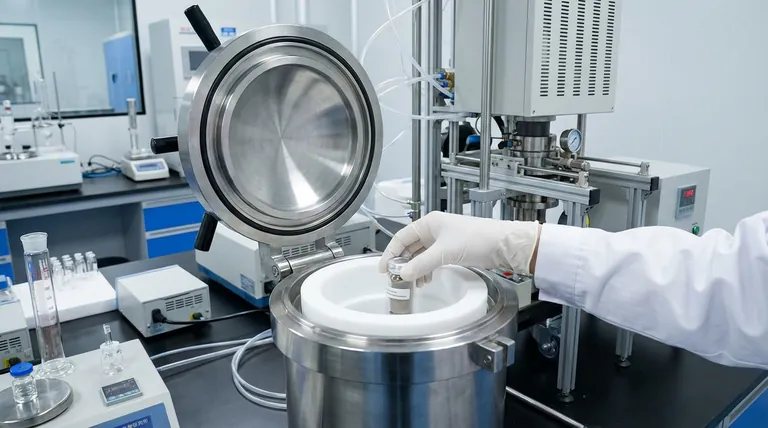
A Teflon lining acts as the critical isolation barrier in high-pressure autoclaves, ensuring both equipment safety and product quality. It is required to physically separate the metal reaction solution from the stainless steel vessel walls, preventing acidic corrosion and ensuring the final high-entropy oxide precursors remain free of metallic contamination.
In large-scale synthesis, the Teflon lining serves a dual function: it protects the autoclave body from corrosive degradation and preserves the strict compositional purity required for high-entropy oxides.
The Mechanics of Contamination Control
Isolating the Reaction Environment
High-pressure synthesis often involves aggressive chemical conditions. The Teflon lining provides a chemically inert shield that effectively isolates the reactive solution from the structural metal body of the autoclave.
Preventing Vessel Erosion
Reaction solutions used for these precursors frequently contain acidic or corrosive ions. Without a protective lining, these ions would directly attack the inner walls of the autoclave. This leads to the erosion of the stainless steel body, compromising the structural integrity of the vessel over time.
Ensuring Material Quality
The Criticality of Compositional Purity
High-entropy oxides rely on precise chemical formulations. If the reaction solution comes into direct contact with the autoclave walls, metallic impurities from the steel can leach into the mixture. The Teflon lining prevents this cross-contamination, ensuring the final product contains only the intended elements.
Maintaining Precursor Integrity
For large-scale preparation, consistency is paramount. By eliminating the variable of wall corrosion, the lining ensures that high-entropy oxide precursors maintain high purity. This results in a stable, reproducible production process free from external pollutants.
Understanding the Operational Trade-offs
Thermal Limits of Polymers
While Teflon offers superior chemical resistance, it has thermal limitations compared to the stainless steel shell. It is generally not suitable for reactions requiring temperatures that exceed the melting point or glass transition temperature of the polymer.
Physical Deformation and Creep
Under high pressure and repeated heating cycles, Teflon linings can experience physical deformation or "creep." This requires regular inspection to ensure the liner retains its shape and continues to provide a perfect seal against the metal body.
Making the Right Choice for Your Goal
To ensure the success of your high-entropy oxide synthesis, consider the following priorities:
- If your primary focus is Material Purity: Prioritize the integrity of the Teflon surface to ensure zero contact between the solution and the steel vessel.
- If your primary focus is Equipment Longevity: Rely on the lining to neutralize the threat of acidic ions, thereby extending the lifespan of your high-pressure autoclave.
The Teflon lining is not merely a safety feature; it is a fundamental requirement for achieving the high-purity standards necessary for advanced material synthesis.
Summary Table:
| Feature | Role of Teflon Lining | Benefit to Precursor Production |
|---|---|---|
| Chemical Resistance | Inert barrier against acidic ions | Prevents autoclave vessel erosion |
| Purity Control | Eliminates metal leaching | Ensures precise high-entropy formulation |
| Consistency | Stable reaction environment | Enables reproducible large-scale results |
| Safety | Structural protection | Extends equipment lifespan under pressure |
Elevate Your Material Synthesis with KINTEK Expertise
Precision in high-entropy oxide preparation demands equipment that guarantees purity and durability. Backed by expert R&D and manufacturing, KINTEK offers high-performance autoclaves and lab high-temp furnaces—including Muffle, Tube, Rotary, Vacuum, and CVD systems—all fully customizable to meet your unique chemical compatibility and thermal requirements.
Don't let contamination compromise your research or production. Contact us today to discuss your custom solution and see how our advanced heating technology can optimize your laboratory's efficiency.
References
- Ayano Taniguchi, Kazuya Kobiro. Low-temperature synthesis of porous high-entropy (CoCrFeMnNi)<sub>3</sub>O<sub>4</sub> spheres and their application to the reverse water–gas shift reaction as catalysts. DOI: 10.1039/d3dt04131j
This article is also based on technical information from Kintek Furnace Knowledge Base .
Related Products
People Also Ask
- Why is controlled heat treatment in a muffle furnace necessary for calcined clay? Achieve Optimal Pozzolanic Activity
- What role does a high-temperature muffle furnace play in STFO synthesis? Achieve Pure Perovskite Results
- What role does a high-temperature muffle furnace play in the multi-stage synthesis of Li0.5MnFe1.5O4? Key to Pure Spinel
- What role does a high-temperature muffle furnace play in the formation of biochar catalysts? Master Catalyst Synthesis
- What is the function of a high-temperature muffle furnace in Belite research? Optimize Polymorphic Phase Transitions
