
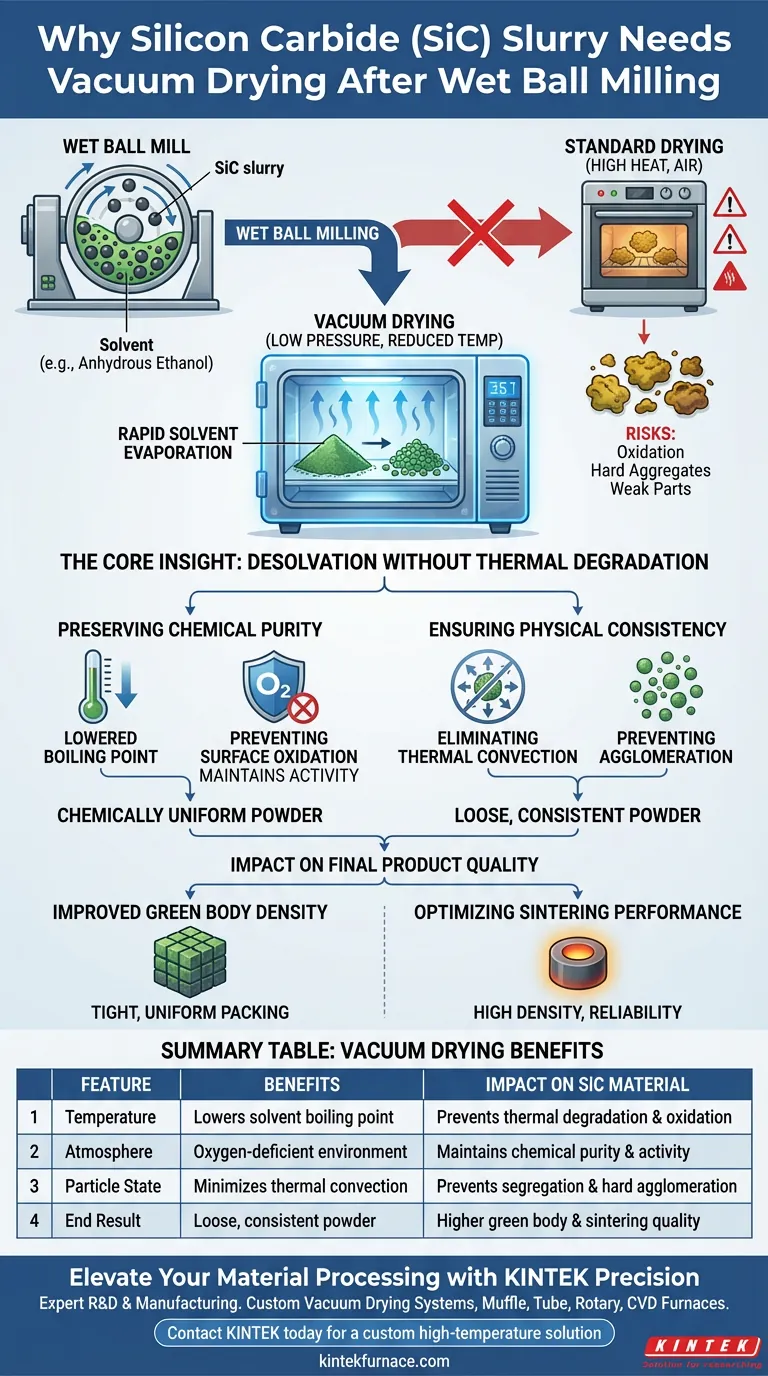
Vacuum drying is the critical process step required to preserve the chemical and physical integrity of Silicon Carbide (SiC) after wet ball milling. By creating a low-pressure environment, the vacuum oven lowers the boiling point of solvents—typically anhydrous ethanol—allowing them to evaporate rapidly at significantly reduced temperatures.
The Core Insight Vacuum drying solves the conflict between needing to remove solvents and needing to protect the material. It enables desolvation without thermal degradation, ensuring the SiC powder remains chemically active, loose, and chemically uniform for subsequent manufacturing stages.
Preserving Chemical Purity
Lowering the Boiling Point
The primary mechanism at work is the relationship between pressure and temperature. By reducing the pressure inside the chamber, the vacuum oven significantly lowers the boiling point of the solvent.
This allows the slurry to dry rapidly without requiring high heat input.
Preventing Surface Oxidation
Silicon Carbide is susceptible to surface oxidation when exposed to high temperatures in the presence of air. Standard drying methods often require heat levels that trigger this reaction.
Because vacuum drying operates at lower temperatures and in an oxygen-deficient environment, it effectively blocks surface oxidation. This maintains the initial activity and purity of the SiC powder.
Ensuring Physical Consistency
Eliminating Thermal Convection
High-temperature drying creates intense thermal convection currents within the slurry. These currents can cause particles to separate based on size or density (segregation).
Vacuum drying minimizes this thermal turbulence. This prevents segregation, ensuring the dried powder maintains consistent compositional integrity throughout the batch.
Preventing Agglomeration
When slurries are dried slowly or at high heat, particles tend to bind together, forming hard "agglomerates" that are difficult to break down later.
The rapid, low-temperature evaporation in a vacuum oven results in loose, dry precursor powders. This loose state is essential for avoiding severe secondary agglomeration.
Impact on Final Product Quality
Improving Green Body Density
The quality of the dried powder directly dictates the quality of the pressed part (the "green body").
By preventing hard agglomerates and oxidation, the vacuum process ensures the powder packs together tightly and uniformly during pressing. This leads to high green density and structural consistency.
Optimizing Sintering Performance
Consistent chemistry in the powder leads to consistent reactions during sintering.
By preserving the original chemical properties of the raw materials, vacuum drying ensures the final sintered body achieves high density and structural reliability.
The Risks of Standard Drying
While vacuum drying requires specialized equipment, attempting to bypass this step using standard thermal drying introduces significant quality risks.
The Cost of Oxidation
If conventional heating is used, the resulting surface oxidation acts as a contaminant. This often degrades the mechanical properties of the final ceramic, leading to weaker parts.
The Problem of Hard Aggregates
Without the gentle environment of the vacuum, powders can form hard clumps. These aggregates create voids or defects in the final product, compromising the structural integrity of the SiC component.
Making the Right Choice for Your Goal
To maximize the effectiveness of your SiC processing, consider your specific manufacturing objectives:
- If your primary focus is Chemical Purity: Ensure your vacuum system is capable of maintaining sufficiently low pressure to keep drying temperatures well below the oxidation threshold of SiC.
- If your primary focus is Mechanical Strength: Prioritize the "looseness" of the powder; a properly vacuum-dried powder should require minimal crushing before pressing to achieve high green density.
Vacuum drying is not just a drying step; it is a preservation step that defines the ultimate quality of your final ceramic product.
Summary Table:
| Feature | Vacuum Drying Benefits | Impact on SiC Material |
|---|---|---|
| Temperature | Lowers solvent boiling point | Prevents thermal degradation and oxidation |
| Atmosphere | Oxygen-deficient environment | Maintains chemical purity and powder activity |
| Particle State | Minimizes thermal convection | Prevents segregation and hard agglomeration |
| End Result | Loose, consistent powder | Higher green body density and sintering quality |
Elevate Your Material Processing with KINTEK Precision
Don’t let surface oxidation or hard agglomerates compromise your Silicon Carbide performance. Backed by expert R&D and manufacturing, KINTEK offers high-performance vacuum drying systems, Muffle, Tube, Rotary, and CVD furnaces, all fully customizable to meet your unique lab requirements.
Ready to achieve superior powder consistency and high-density sintering results?
Contact KINTEK today for a custom high-temperature solution
Visual Guide
References
- Peroxymonosulfate Activation by Sludge-Derived Biochar via One-Step Pyrolysis: Pollutant Degradation Performance and Mechanism. DOI: 10.3390/w17172588
This article is also based on technical information from Kintek Furnace Knowledge Base .
Related Products
- Vacuum Heat Treat Sintering and Brazing Furnace
- Vacuum Heat Treat Sintering Furnace Molybdenum Wire Vacuum Sintering Furnace
- Dental Porcelain Zirconia Sintering Ceramic Vacuum Press Furnace
- Vacuum Hot Press Furnace Machine for Lamination and Heating
- Vacuum Hot Press Furnace Machine Heated Vacuum Press
People Also Ask
- How does vacuum heat treating affect the grain structure of metal alloys? Achieve Precise Microstructure Control
- What are the benefits of using vacuum heat treating furnaces for metal alloys? Achieve Superior Metal Properties and Performance
- What is one of the most important uses of vacuum heat treating furnaces in aerospace? Achieve Superior Strength in Aircraft Alloys
- What is the temperature of a vacuum furnace brazing? Optimize Your Joint Strength and Cleanliness
- What are the steps involved in a typical vacuum brazing treatment? Master the Process for Strong, Clean Joints







