
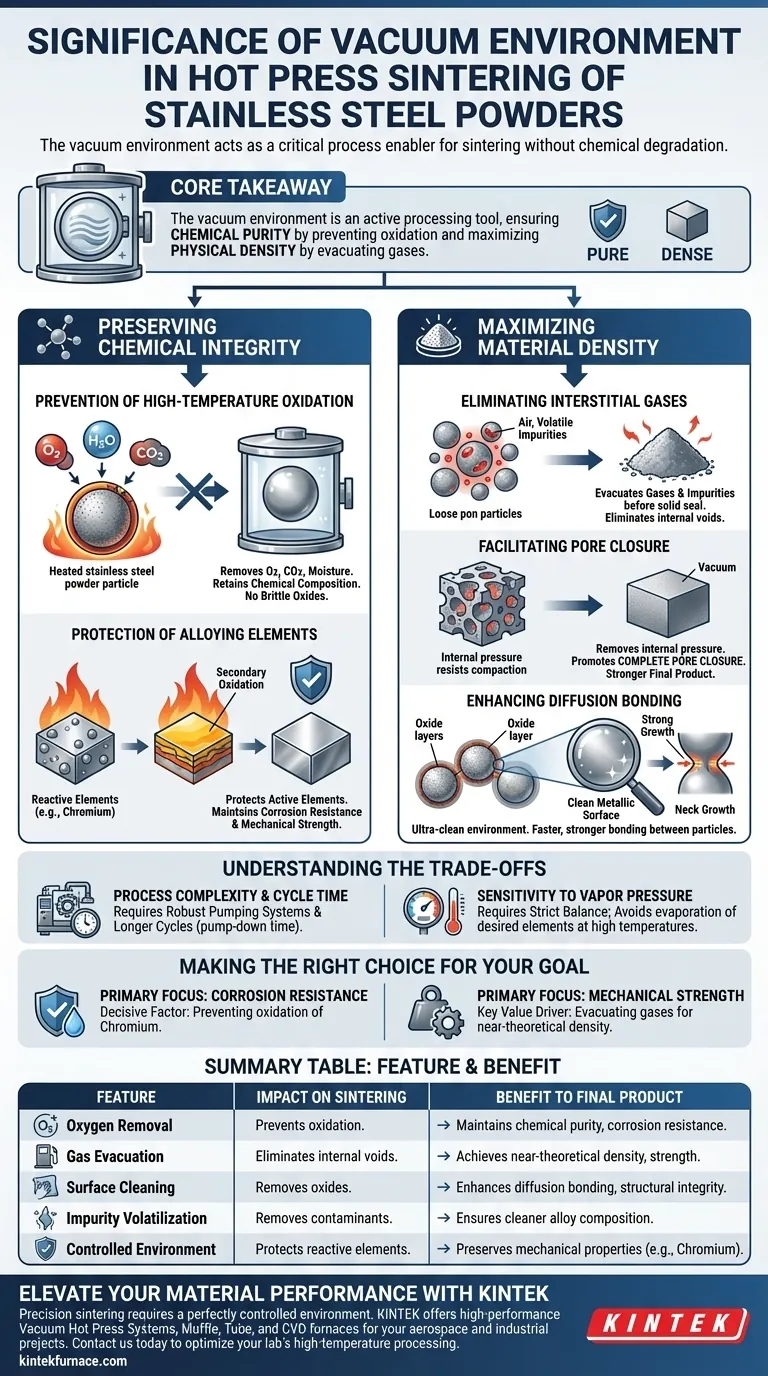
The vacuum environment acts as a critical process enabler that allows stainless steel powders to be sintered without chemical degradation.
In a vacuum hot press furnace, this environment serves two primary functions: it eliminates oxygen to prevent the material from rusting or oxidizing at high temperatures, and it physically removes trapped gases from between powder particles. This dual action is essential for creating stainless steel parts that are chemically pure and structurally dense.
Core Takeaway The vacuum environment is not merely an absence of air; it is an active processing tool that ensures chemical purity by preventing oxidation and maximizes physical density by evacuating gases that would otherwise inhibit pore closure.
Preserving Chemical Integrity
Prevention of High-Temperature Oxidation
High temperatures accelerate chemical reactions between metals and atmospheric gases. Without a vacuum, the heat required for sintering would cause immediate oxidation of the stainless steel powder.
By removing air, the vacuum eliminates oxygen, carbon dioxide, and moisture from the processing chamber. This ensures the material retains its intended chemical composition without forming brittle oxide layers.
Protection of Alloying Elements
Stainless steel relies on specific alloying elements, such as Chromium, to provide corrosion resistance. These elements are often highly reactive (active) and prone to "secondary oxidation" when exposed to heat.
The vacuum environment specifically protects these active elements from reacting with environmental impurities. This preservation is vital for maintaining the alloy's performance characteristics, such as rust resistance and mechanical strength.
Maximizing Material Density
Eliminating Interstitial Gases
Metal powders contain microscopic gaps (interstices) filled with air and volatile impurities. If these gases remain trapped during the pressing and heating process, they create internal voids.
The vacuum state evacuates these gases and volatile impurities before the material creates a solid seal. This allows the powder particles to make physical contact without gas pockets acting as a barrier.
Facilitating Pore Closure
Achieving "near-theoretical density" (a solid block with zero porosity) requires that all internal pores be closed.
By removing the gas from inside the pores, the vacuum removes the internal pressure that would otherwise resist the sintering force. This promotes complete pore closure, leading to a much stronger and denser final product.
Enhancing Diffusion Bonding
Sintering relies on atoms moving across particle boundaries to fuse them together, known as diffusion bonding or "neck growth."
Oxides and impurities on the surface of powder particles act as barriers to this diffusion. Because the vacuum creates an ultra-clean environment, particle surfaces remain metallic and reactive, allowing for faster and stronger bonding between particles.
Understanding the Trade-offs
Process Complexity and Cycle Time
While vacuum sintering yields superior results, it introduces significant complexity compared to atmospheric furnaces.
The equipment requires robust pumping systems to reach high-vacuum levels (e.g., 10^-3 Pa). Furthermore, the processing cycle is often longer because time must be allocated to pump the chamber down to the required vacuum level before heating can begin.
Sensitivity to Vapor Pressure
Operating in a high vacuum at high temperatures can theoretically lead to the vaporization of certain volatile elements within an alloy.
While this is managed through precise temperature control, it requires a strict balance. The operator must ensure the vacuum is strong enough to remove impurities but not so aggressive that it alters the alloy's composition by evaporating desired elements.
Making the Right Choice for Your Goal
While the vacuum hot press offers comprehensive benefits, your specific project goals dictate which aspect of the vacuum is most critical.
- If your primary focus is Corrosion Resistance: The vacuum's ability to prevent the oxidation of Chromium and other active elements is the decisive factor.
- If your primary focus is Mechanical Strength: The vacuum's role in evacuating gases to allow for near-theoretical density and complete pore closure is the key value driver.
The vacuum environment transforms the hot press from a simple heating tool into a precision instrument capable of producing aerospace-grade stainless steel components.
Summary Table:
| Feature | Impact on Sintering | Benefit to Final Product |
|---|---|---|
| Oxygen Removal | Prevents high-temperature oxidation | Maintains chemical purity and corrosion resistance |
| Gas Evacuation | Eliminates internal voids and air pockets | Achieves near-theoretical density and strength |
| Surface Cleaning | Removes oxides from particle surfaces | Enhances diffusion bonding and structural integrity |
| Impurity Volatilization | Removes volatile contaminants | Ensures cleaner alloy composition |
| Controlled Environment | Protects reactive alloying elements | Preserves mechanical properties (e.g., Chromium) |
Elevate Your Material Performance with KINTEK
Precision sintering requires more than just heat—it requires a perfectly controlled environment. Backed by expert R&D and manufacturing, KINTEK offers high-performance Vacuum Hot Press Systems, Muffle, Tube, and CVD furnaces designed to deliver the chemical purity and structural density your aerospace or industrial projects demand.
Whether you need a standard solution or a customizable system tailored to your unique sintering parameters, our team is ready to help you achieve near-theoretical density and superior corrosion resistance.
Ready to optimize your lab's high-temperature processing? Contact us today to discuss your specific needs!
Visual Guide
Related Products
- Vacuum Hot Press Furnace Machine for Lamination and Heating
- Vacuum Hot Press Furnace Machine Heated Vacuum Press Tube Furnace
- 600T Vacuum Induction Hot Press Vacuum Heat Treat and Sintering Furnace
- Vacuum Hot Press Furnace Machine Heated Vacuum Press
- Vacuum Heat Treat Sintering Furnace with Pressure for Vacuum Sintering
People Also Ask
- What are the primary components of a vacuum hot press furnace? Master the Core Systems for Precise Material Processing
- What safety features are incorporated in vacuum hot press furnaces? Ensure Operator and Equipment Protection
- What are the benefits of the vacuum environment system in a vacuum hot press furnace? Unlock High-Density Sintering
- What industries benefit from the use of vacuum hot press furnaces? Unlock High-Performance Materials for Your Industry
- How does the uniaxial pressure applied by a vacuum hot press furnace affect the microstructure of ZrC-SiC materials?



















