
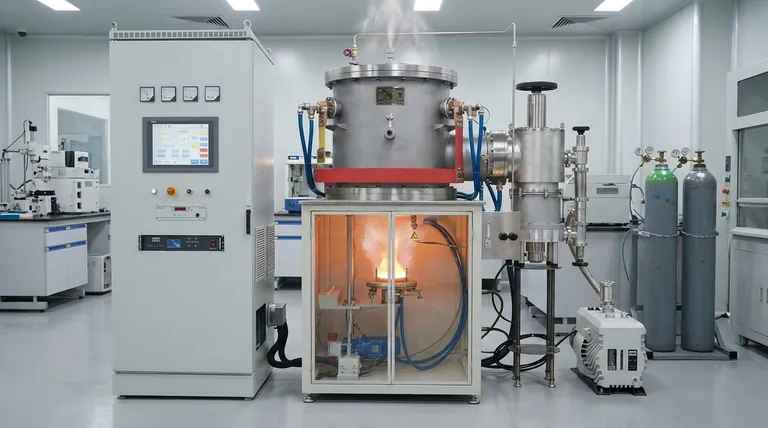
Filling a vacuum induction furnace with high-purity argon acts as a kinetic barrier to evaporation. By introducing argon to regulate the system pressure to approximately 2000 Pa, you fundamentally alter the behavior of aluminum atoms, preventing them from escaping the melt and drastically improving material retention.
By shifting the furnace environment from a high vacuum to a controlled pressure of ~2000 Pa, you transform the aluminum evaporation mode from rapid "boiling" to slow "ordinary" evaporation. This single adjustment reduces aluminum loss from 11.48% down to 0.58%.
The Physics of Vapor Suppression
Changing the Evaporation Mode
In a standard vacuum state, aluminum undergoes molecular or boiling evaporation. This is a rapid, aggressive phase change where atoms escape the surface freely.
By backfilling with argon, you force the system into a state of ordinary evaporation. In this mode, the rate at which aluminum atoms leave the surface is significantly restricted by the presence of the gas atmosphere.
Reducing the Mean Free Path
The core mechanism at work is the reduction of the mean free path of the aluminum molecules.
In a high vacuum, an evaporated aluminum molecule can travel a long distance without hitting anything, eventually condensing on the furnace walls and being lost.
When high-purity argon is present, escaping aluminum molecules collide with argon atoms almost immediately. These collisions bounce the aluminum atoms back toward the melt, effectively trapping them within the liquid phase.
Quantifying the Impact on Yield
The Critical Pressure Point
The effective control of volatilization relies on precise pressure regulation.
The primary reference identifies 2000 Pa as the target pressure for this process. This pressure is sufficient to suppress boiling without completely compromising the vacuum furnace's operational goals.
Drastic Reduction in Material Loss
The difference in metal yield between a vacuum state and an argon-filled state is substantial.
Operating in a vacuum state results in an aluminum evaporation loss of 11.48%.
By implementing the argon backfill to 2000 Pa, this loss is cut to just 0.58%. This represents a near-total mitigation of the volatilization issue.
Understanding the Trade-offs
Balancing Vacuum Needs with Retention
Vacuum induction melting is often used to remove volatile impurities (degassing). However, high-vacuum conditions inherently encourage the evaporation of desirable volatile elements like aluminum.
The trade-off here is between maximum degassing potential and maximum alloy composition control.
Precision vs. Passive Operation
Achieving the specific yield benefits described requires active regulation.
Simply filling the furnace is not enough; the system pressure must be maintained around the 2000 Pa mark. Deviating significantly below this pressure risks reverting to molecular evaporation, while going too high may alter other process dynamics.
Optimizing Your Smelting Strategy
To apply these principles effectively, you must align your pressure settings with your specific yield targets.
- If your primary focus is Maximizing Aluminum Yield: Regulate the furnace pressure to approximately 2000 Pa using high-purity argon to induce ordinary evaporation.
- If your primary focus is Rapid Degassing: Be aware that operating at pressures significantly lower than 2000 Pa will likely result in aluminum losses exceeding 11% due to boiling evaporation.
Controlling the mean free path via pressure regulation is the single most effective variable for preserving aluminum content in vacuum induction smelting.
Summary Table:
| Parameter | Vacuum State | Argon-Filled (2000 Pa) |
|---|---|---|
| Evaporation Mode | Boiling / Molecular | Ordinary Evaporation |
| Mean Free Path | Long (High escape rate) | Short (Frequent collisions) |
| Aluminum Loss (%) | 11.48% | 0.58% |
| Primary Mechanism | Unrestricted atom escape | Kinetic collision back-scattering |
Precision Melting Control with KINTEK
Maximize your material yield and achieve perfect alloy composition with KINTEK’s advanced thermal solutions. Backed by expert R&D and manufacturing, KINTEK offers state-of-the-art Vacuum, Muffle, Tube, Rotary, and CVD systems, all fully customizable for your unique lab and industrial needs.
Stop losing valuable material to volatilization. Our high-performance furnaces provide the precise pressure regulation required to reduce aluminum loss by over 90%.
Ready to optimize your smelting process? Contact KINTEK today for a custom consultation!
References
- Bin Sun, Lanjie Li. Study on Al Evaporation during AlV55 Melting and Alloy Preparation. DOI: 10.3390/met14040466
This article is also based on technical information from Kintek Furnace Knowledge Base .
Related Products
- 600T Vacuum Induction Hot Press Vacuum Heat Treat and Sintering Furnace
- Vacuum Induction Melting Furnace
- Vacuum Hot Press Furnace Machine Heated Vacuum Press Tube Furnace
- Vacuum Heat Treat Sintering and Brazing Furnace
- Vacuum Hot Press Furnace Machine Heated Vacuum Press
People Also Ask
- Why use Vacuum Hot Press (VHP) for ZnS Ceramics? Achieve Superior IR Transparency and Mechanical Strength
- How does a vacuum hot press sintering furnace mitigate copper sintering swelling? Solve Fe-Cu Expansion Issues
- What are the key advantages of vacuum hot press sintering furnaces? Achieve Superior Density and Purity in Materials
- How does the vacuum environment in a vacuum hot press sintering furnace protect chromium-containing ceramics? Find out.
- What is the core function of a vacuum hot press sintering furnace in the preparation of high-density RuTi alloys? Achieve Maximum Density and Purity



















