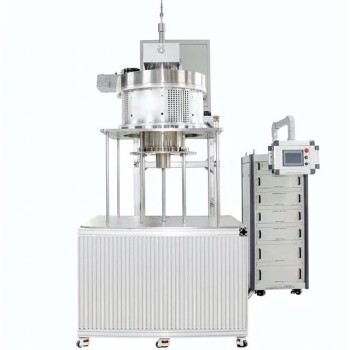
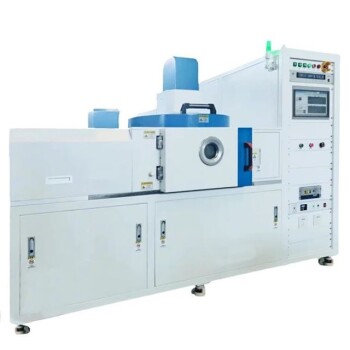
Maintaining a vacuum environment of approximately 6Pa during Spark Plasma Sintering (SPS) is a critical process control requirement for fabricating MoSi2-B4C composites. This low-pressure environment serves two immediate functions: it eliminates residual oxygen to prevent the uncontrolled oxidation of Molybdenum Disilicide (MoSi2) and actively removes volatile gases produced during the chemical reduction of native oxides.
The vacuum system acts as an active purification mechanism during sintering. By preventing the formation of excessive silica and ensuring the evacuation of gaseous byproducts, it facilitates the creation of a denser, tougher ceramic composite.
Preventing Chemical Degradation
Eliminating Residual Oxygen
The high temperatures required for sintering MoSi2 make the material highly susceptible to oxidation. If the furnace chamber contains atmospheric oxygen, it will react aggressively with the raw materials.
Controlling Silicon Dioxide (SiO2) Formation
The primary result of this unwanted oxidation is the formation of excessive Silicon Dioxide (SiO2). While a native oxide layer is expected, uncontrolled SiO2 growth degrades the material's homogeneity. The vacuum system keeps oxygen levels low enough to inhibit this reaction.
Enhancing Microstructural Integrity
Utilizing B4C as a Reducing Agent
Boron Carbide (B4C) is added to the mixture not just as a structural component, but as a chemical agent. It reacts with the native oxide film that naturally exists on the surface of MoSi2 particles.
Managing Volatile Byproducts
This reduction reaction generates gaseous (volatile) byproducts. If these gases are not removed, they can become trapped within the material, creating pores and voids. The 6Pa vacuum environment provides the pressure differential needed to draw these volatiles out of the sintering matrix.
Purifying Grain Boundaries
By removing both the solid oxide film and the resulting gaseous byproducts, the vacuum system "cleans" the interfaces between particles. Purified grain boundaries allow for stronger bonding between the grains during densification.
Understanding the Trade-offs
The Risk of Vacuum Instability
Maintaining 6Pa is a specific operational target; fluctuations in pressure can alter the reaction kinetics. If the pressure rises significantly, the removal of volatiles may stall, leading to trapped gas pockets.
Balancing Reduction and Evaporation
The vacuum must be strong enough to remove byproducts but controlled to avoid evaporating essential elements of the matrix. Operators must ensure the vacuum system is capable of handling the volume of off-gassing without losing suction efficiency.
The Impact on Mechanical Properties
Achieving High Density
The elimination of trapped gases and oxide layers allows the particles to pack together more tightly. This results in a final component with superior density compared to sintering in inert gas or ambient pressure.
Improving Fracture Toughness
A dense material with clean, strong grain boundaries resists cracking more effectively. Consequently, the vacuum-assisted process directly contributes to the enhanced fracture toughness of the MoSi2-B4C composite.
Optimizing Your Sintering Strategy
To maximize the quality of your MoSi2-B4C composite, align your process controls with your specific material goals.
- If your primary focus is Compositional Purity: Prioritize establishing the vacuum well before the heating cycle begins to minimize the initial formation of excess SiO2.
- If your primary focus is Mechanical Performance: Monitor the vacuum gauge closely during the temperature range where B4C reacts with oxides to ensure complete evacuation of volatiles for maximum density.
Control the atmosphere, and you control the structural integrity of the final ceramic.
Summary Table:
| Parameter/Factor | Role in MoSi2-B4C Sintering | Impact on Final Material |
|---|---|---|
| Vacuum Level (6Pa) | Removes residual oxygen and volatile gases | Prevents porosity and grain boundary degradation |
| Oxygen Control | Inhibits excessive SiO2 formation | Ensures chemical homogeneity |
| B4C Reaction | Reduces native oxide films on particles | Purifies grain boundaries for better bonding |
| Gas Evacuation | Draws out reaction byproducts | Increases relative density and fracture toughness |
Elevate Your Material Research with KINTEK Expertise
Precision control over sintering environments is non-negotiable for high-performance ceramics. KINTEK provides state-of-the-art Spark Plasma Sintering (SPS) solutions, Vacuum furnaces, and CVD systems designed to maintain rigorous pressure targets like 6Pa with absolute stability.
Backed by expert R&D and manufacturing, our systems are fully customizable to meet the unique thermal and atmospheric demands of MoSi2, B4C, and other advanced composites. Contact us today to discover how KINTEK’s high-temperature lab equipment can help you achieve superior density and fracture toughness in your next project.
References
- Rodrigo Silva, Carlos Alberto Della Rovere. Mechanisms of intergranular corrosion and self-healing in high temperature aged lean duplex stainless steel 2404. DOI: 10.1038/s41529-024-00541-y
This article is also based on technical information from Kintek Furnace Knowledge Base .
Related Products
- Spark Plasma Sintering SPS Furnace
- Chairside Dental Porcelain Zirconia Sintering Furnace with Transformer for Ceramic Restorations
- Dental Porcelain Zirconia Sintering Ceramic Vacuum Press Furnace
- 600T Vacuum Induction Hot Press Vacuum Heat Treat and Sintering Furnace
- 9MPa Air Pressure Vacuum Heat Treat and Sintering Furnace
People Also Ask
- Why is it necessary to maintain a high vacuum environment during the SPS of SiC? Key to High-Density Ceramics
- How does the heating mechanism of Spark Plasma Sintering (SPS) function? Enhance TiC/SiC Composite Fabrication
- What are the technical advantages of using an SPS sintering furnace? Elevate Al2O3-TiC Material Performance
- What are the steps in the discharge plasma sintering process? Master Fast, High-Density Material Consolidation
- What are the advantages of spark plasma sintering (SPS) over traditional forging? Precision Microstructural Control