
In short, the industries that benefit most from drop-bottom quench furnaces are those requiring the highest level of metallurgical precision and performance, primarily aerospace, automotive, and high-end manufacturing. These furnaces are chosen when the mechanical properties of a metal component, such as strength, hardness, and fatigue resistance, are absolutely critical to its function and safety.
The core value of a drop-bottom quench furnace isn't just heat treating; it's the ability to transfer a part from a high-heat environment to a quenching liquid with extreme speed and uniformity. This capability is essential for developing superior and highly consistent material properties that other methods cannot reliably achieve.
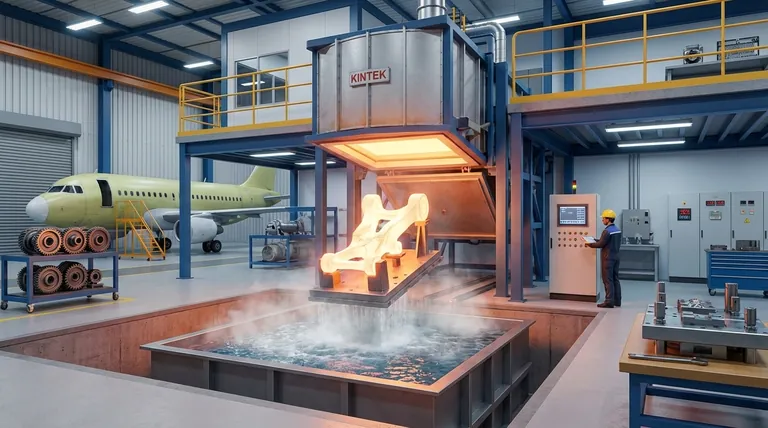
The Core Advantage: Speed and Uniformity
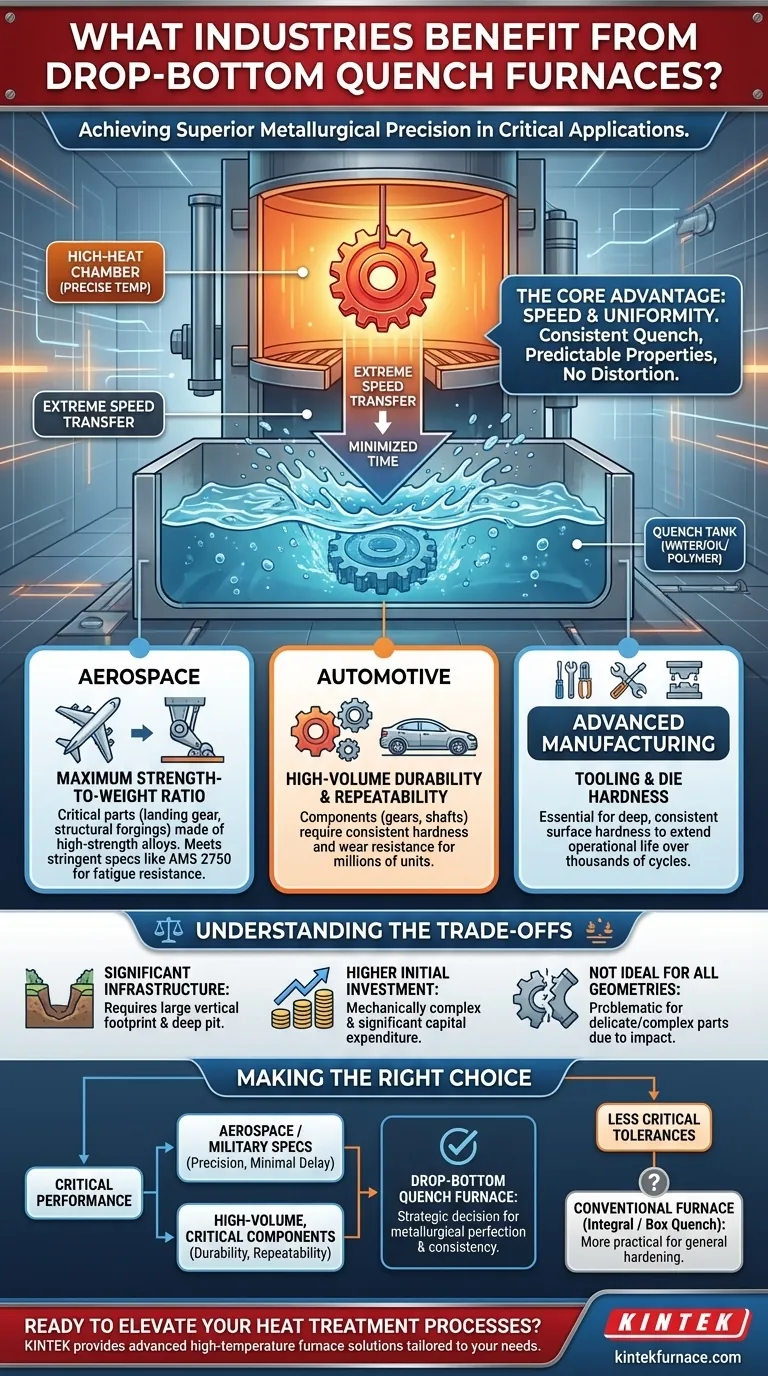
A drop-bottom quench furnace operates on a simple but powerful principle. A part is heated to a precise temperature in an upper chamber, after which the furnace floor, or "bottom," opens, rapidly dropping the part into a quench tank of water, oil, or polymer located directly below. This design delivers two key advantages.
Minimizing Transfer Time
The primary benefit is the extremely short time between the heating and quenching phases. In conventional furnace setups, a part must be manually or robotically moved from the furnace to a separate quench tank, exposing it to cooler air for several seconds.
This exposure causes heat loss and surface oxidation. The drop-bottom design minimizes this transfer time to just a few seconds, ensuring the part enters the quench medium at its optimal temperature.
Achieving a Consistent Quench
Because the entire component is submerged almost instantly and at a uniform temperature, the cooling process is far more consistent across the part's geometry. This prevents internal stresses, distortion, and warping that can occur with a slower, less uniform quench.
The result is a component with predictable, homogenous mechanical properties, which is a non-negotiable requirement for high-performance applications.
Why These Specific Industries Rely on This Technology
The precision offered by drop-bottom furnaces directly addresses the core challenges of industries where component failure is not an option.
Aerospace: Maximum Strength-to-Weight Ratio
Aerospace components, from landing gear to structural forgings, are often made from high-strength aluminum and steel alloys. To achieve their maximum potential strength, these alloys require precise solution heat treating and rapid quenching.
A slow transfer would compromise the final properties, potentially reducing fatigue resistance and overall strength. Drop-bottom furnaces ensure these critical parts meet stringent aerospace specifications (like AMS 2750) every time.
Automotive: High-Volume Durability and Repeatability
In the automotive industry, components like gears, bearings, shafts, and structural frame parts must be durable and perform consistently across millions of units.
Drop-bottom furnaces provide the process control and repeatability needed for mass production. This ensures that every part has the required hardness and wear resistance to withstand the long-term stresses of vehicle operation.
Advanced Manufacturing: Tooling and Die Hardness
For general manufacturing, particularly in the creation of tools, dies, and molds, surface hardness is paramount. These items must resist wear and deformation over thousands of cycles.
The rapid, uniform quench from a drop-bottom furnace is ideal for creating a deep and consistent hardness layer on these critical manufacturing assets, extending their operational life and ensuring product quality.
Understanding the Trade-offs
While powerful, this technology is not the default solution for all heat-treating needs. It involves specific considerations.
Significant Infrastructure Requirements
These furnaces have a large vertical footprint. The design requires a deep pit to be excavated beneath the furnace to house the quench tank, making installation more complex and costly than for a standard box furnace.
Higher Initial Investment
Drop-bottom furnace systems are mechanically complex and represent a significant capital expenditure. Their cost is typically justified only when the metallurgical requirements for the end product are exceptionally demanding.
Not Ideal for All Part Geometries
The "drop" action can be problematic for very delicate or complex parts that could be damaged by the impact with the quenching liquid or for parts that might trap air and cause an uneven quench. Part racking and handling must be carefully engineered.
Making the Right Choice for Your Application
Choosing the right heat treatment process depends entirely on the performance requirements of your component.
- If your primary focus is meeting stringent aerospace or military specifications: The precision and minimal quench delay of a drop-bottom furnace are essential.
- If your primary focus is producing high-volume, critical components with maximum durability and repeatability: The process control of a drop-bottom furnace justifies the investment.
- If your primary focus is general-purpose hardening with less critical tolerances: A more conventional and less expensive integral or box quench furnace is often a more practical solution.
Ultimately, selecting a drop-bottom quench furnace is a strategic decision to prioritize metallurgical perfection and process consistency above all else.
Summary Table:
| Industry | Key Benefits |
|---|---|
| Aerospace | Maximizes strength-to-weight ratio, meets stringent specs (e.g., AMS 2750) |
| Automotive | Ensures high-volume durability, repeatability, and wear resistance |
| Advanced Manufacturing | Extends tool and die life with deep, consistent hardness |
Ready to elevate your heat treatment processes with precision and reliability? At KINTEK, we leverage exceptional R&D and in-house manufacturing to provide advanced high-temperature furnace solutions tailored to your needs. Our product line includes Muffle, Tube, Rotary Furnaces, Vacuum & Atmosphere Furnaces, and CVD/PECVD Systems, all backed by strong deep customization capabilities to meet your unique experimental requirements. Whether you're in aerospace, automotive, or high-end manufacturing, we can help you achieve superior metallurgical outcomes. Contact us today to discuss how our furnaces can benefit your operations!
Visual Guide
Related Products
- Laboratory Muffle Oven Furnace with Bottom Lifting
- 1200℃ Controlled Inert Nitrogen Atmosphere Furnace
People Also Ask
- What function does a muffle furnace perform in Ba0.75Ca0.25TiO3 calcination? Ensure Phase Purity & Synthesis
- What is the importance of the calcination process? Master High-Purity Calcium Phosphate Nanopowder Production
- Why is a high-temperature muffle furnace required for FeOx-MOx/TiO2? Engineering High-Performance Nanocomposites
- Why is a high-temperature laboratory muffle furnace essential for the alkali fusion process in zeolite synthesis?
- What are the primary functions of a high-temperature laboratory muffle furnace in the preparation of biosorbent materials?

