
In essence, a multi-chamber continuous vacuum furnace revolutionizes industrial processing by enabling the mass production of high-quality components with exceptional efficiency. This technology moves beyond the limitations of single-batch systems by creating a seamless, uninterrupted workflow, which expands production scale, improves product quality, and increases overall work efficiency.
The core advantage of a multi-chamber continuous design is its ability to transform inefficient, start-and-stop batch processing into a seamless, uninterrupted production flow. This dramatically increases throughput while maintaining the pristine, controlled environment of a vacuum for superior material quality.
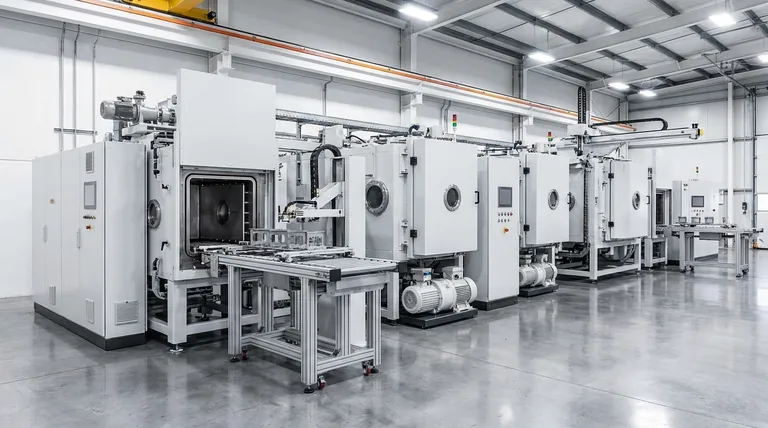
The Core Advantage: Moving Beyond Batch Processing
Traditional vacuum furnaces operate in batches, creating a significant bottleneck in production. A continuous furnace solves this by segmenting the process into a series of connected chambers.
The Inefficiency of Batch Production
A single-chamber furnace requires a slow, sequential process: load parts, pump the chamber down to a vacuum, run the heating and cooling cycle, vent the chamber back to atmospheric pressure, and finally unload the parts. The entire system must start and stop for every single batch.
The Continuous Flow Principle
A multi-chamber system consists of several specialized zones—typically for loading, pre-heating, high-temperature processing, cooling or quenching, and unloading. Parts move automatically from one chamber to the next without breaking the vacuum in the critical central heating chamber.
Dramatically Increased Throughput
By eliminating the need to pump down and vent the main chamber for each load, the furnace can process a continuous stream of material. This directly translates to a massive increase in work efficiency and supports a much larger production scale, making it ideal for high-volume manufacturing.
Achieving Superior Material Quality and Consistency
The benefits of a continuous furnace extend beyond speed. The design inherently produces higher quality and more consistent parts by perfecting the processing environment.
Preventing Oxidation and Contamination
Operating in a vacuum environment is the primary reason for its high-quality output. It prevents materials from reacting with atmospheric gases like oxygen during high-temperature treatment, which eliminates oxidation and ensures material integrity.
Ensuring Uniform Heating and Cooling
Each chamber is optimized for a specific task. This allows for extremely precise temperature control and uniform heating throughout the workload. The result is consistent metallurgical properties across every part in every batch.
Advanced Process Control
These furnaces support a range of sophisticated thermal processes, including annealing, brazing, sintering, and vacuum carburizing. The ability to use partial pressure control also allows engineers to manage specific metallurgical effects, such as preventing the vaporization of chromium on steel surfaces.
Repeatability Through Automation
Modern continuous furnaces are managed by computer-controlled systems. This automation ensures every component is subjected to the exact same thermal cycle, guaranteeing process repeatability and consistency that is difficult to achieve with manual or semi-automated batch systems.
Understanding the Trade-offs
While powerful, a multi-chamber continuous furnace is not a universal solution. Understanding its limitations is critical for making an informed decision.
Higher Initial Investment
The complexity of a multi-chamber system, with its multiple vacuum pumps and automated transfer mechanisms, results in a significantly higher initial capital cost compared to a standard single-chamber batch furnace.
Increased Maintenance Complexity
More chambers and moving parts mean a more complex maintenance schedule. Keeping the entire line operational requires a dedicated and skilled maintenance effort to manage seals, pumps, and transfer systems.
Best Suited for High-Volume Production
This technology delivers the best return on investment in high-throughput environments running large quantities of the same or very similar parts. It is less flexible for a high-mix, low-volume job shop where process parameters and part sizes change frequently.
Making the Right Choice for Your Operation
The decision to invest in a multi-chamber continuous furnace depends entirely on your primary production goals.
- If your primary focus is maximizing throughput for a consistent product: A multi-chamber continuous furnace is the definitive solution for scaling up production and reducing per-unit costs.
- If your primary focus is achieving the highest material purity and process control: The vacuum environment is non-negotiable, and the continuous model ensures this quality is applied consistently at an industrial scale.
- If your primary focus is operational flexibility for diverse, small-batch jobs: A traditional single-chamber batch vacuum furnace may offer a more cost-effective and adaptable solution despite its lower throughput.
Ultimately, adopting this technology is a strategic decision to prioritize industrial-scale efficiency and quality over small-batch flexibility.
Summary Table:
| Aspect | Impact |
|---|---|
| Throughput | Dramatically increases production scale by eliminating batch processing bottlenecks |
| Material Quality | Prevents oxidation and ensures uniform heating for superior material integrity |
| Process Control | Enables precise temperature control and supports annealing, brazing, and sintering |
| Automation | Guarantees repeatability and consistency in high-volume operations |
| Trade-offs | Higher initial cost and maintenance complexity, best for consistent high-volume use |
Ready to revolutionize your industrial processes with advanced furnace solutions? At KINTEK, we leverage exceptional R&D and in-house manufacturing to provide diverse laboratories with cutting-edge high-temperature furnace systems. Our product line includes Muffle, Tube, Rotary Furnaces, Vacuum & Atmosphere Furnaces, and CVD/PECVD Systems, all backed by strong deep customization capabilities to precisely meet your unique experimental requirements. Whether you need to boost throughput, enhance material quality, or achieve superior process control, our solutions are tailored for your success. Contact us today to discuss how we can optimize your production efficiency and quality!
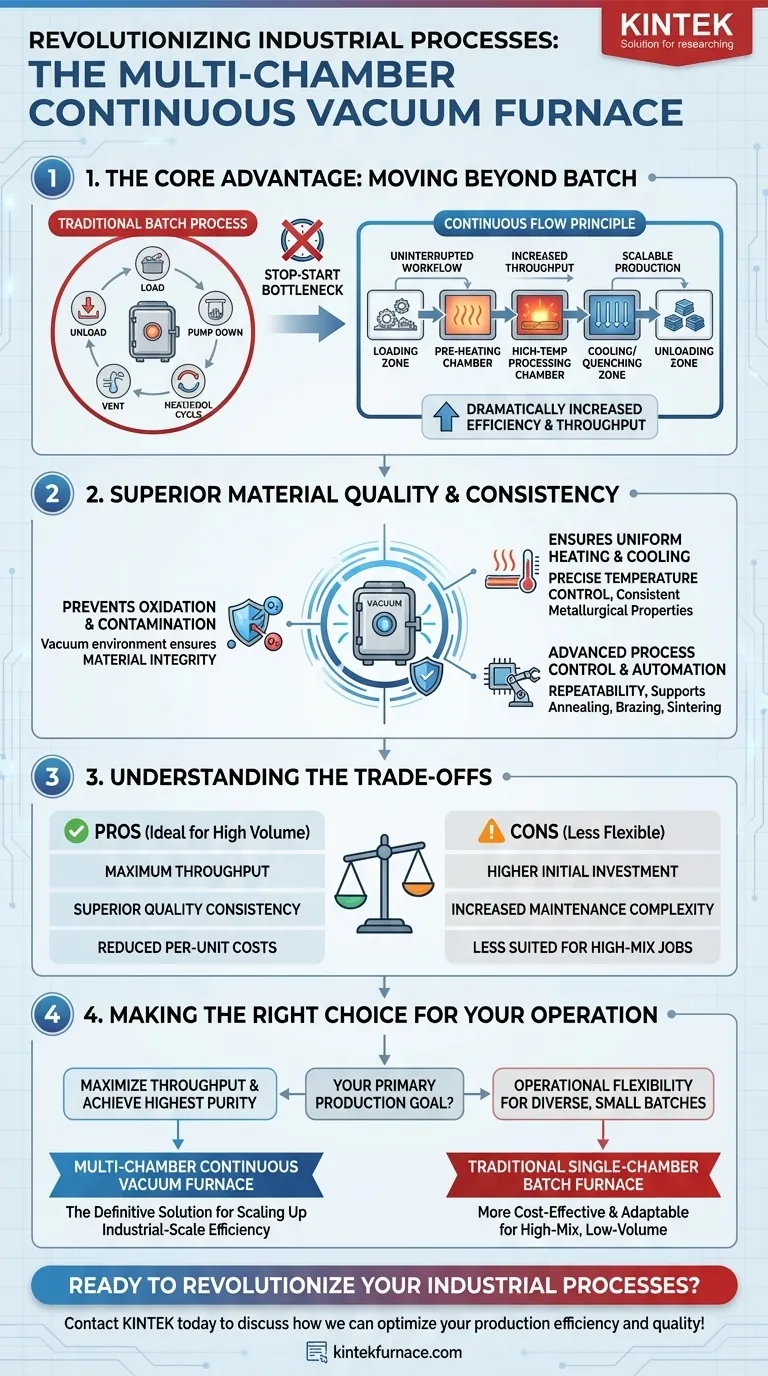
Visual Guide
Related Products
- Split Chamber CVD Tube Furnace with Vacuum Station CVD Machine
- Vacuum Sealed Continuous Working Rotary Tube Furnace Rotating Tube Furnace
- Vacuum Heat Treat Sintering Furnace with Pressure for Vacuum Sintering
- Multi Heating Zones CVD Tube Furnace Machine for Chemical Vapor Deposition Equipment
- Custom Made Versatile CVD Tube Furnace Chemical Vapor Deposition CVD Equipment Machine
People Also Ask
- What role does a Tube Furnace play in the CVD growth of carbon nanotubes? Achieve High-Purity CNT Synthesis
- How does a CVD tube furnace achieve high purity in gate media preparation? Master Precision Control for Flawless Films
- What are the advantages of using a CVD tube furnace for preparing gate dielectrics? Achieve High-Quality Thin Films for Transistors
- What are the operational and maintenance requirements for a CVD tube furnace? Ensure Precision for Thin Film Deposition
- What are the benefits of developing new precursor materials for CVD tube furnaces? Unlock Advanced Thin-Film Synthesis



















