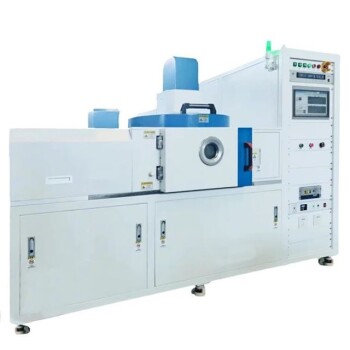
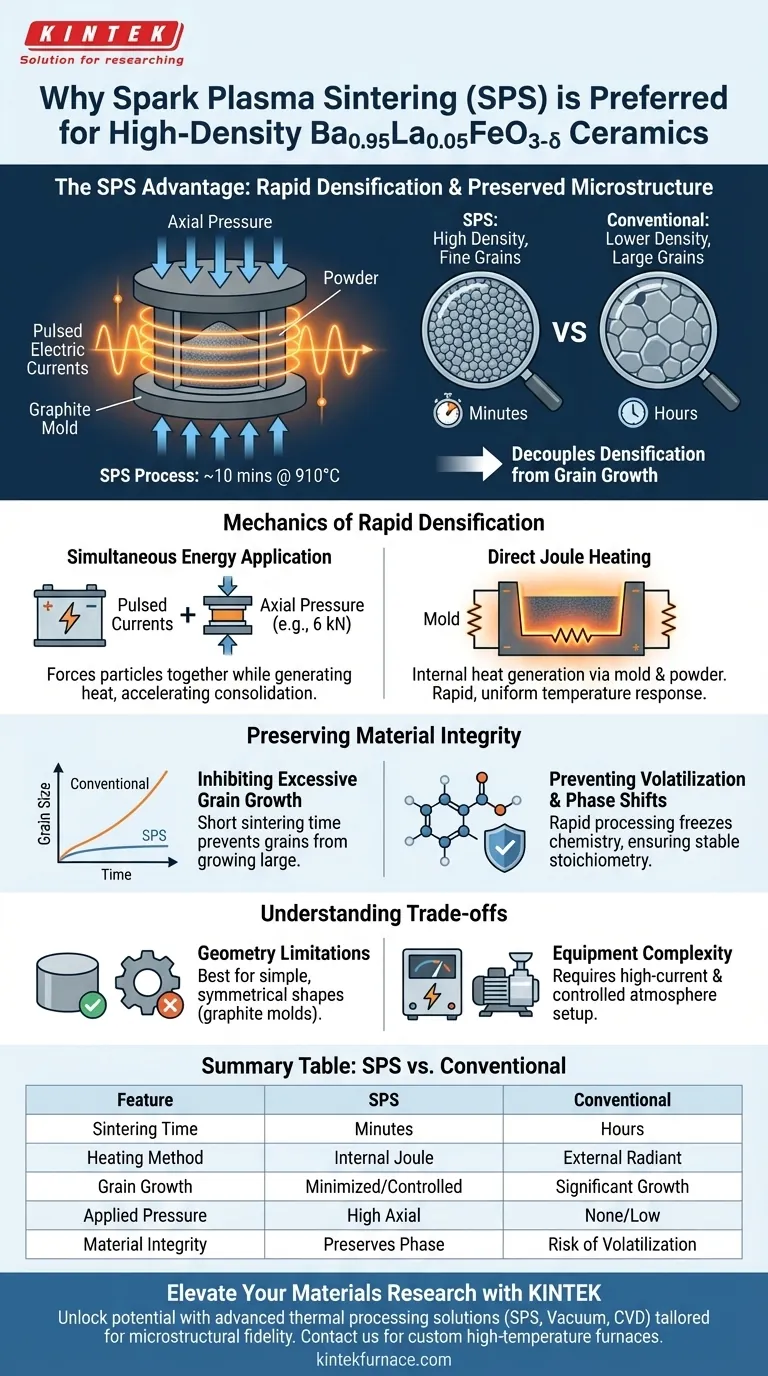
Spark Plasma Sintering (SPS) is the preferred method for producing Ba0.95La0.05FeO3-δ ceramics because it achieves high density while preserving the material's delicate microstructure. By utilizing pulsed electric currents to heat the sample directly while simultaneously applying axial pressure, the system enables rapid densification. This allows the material to reach full density at 910°C in as little as 10 minutes, a timeframe significantly shorter than conventional methods.
The core advantage of SPS lies in its ability to decouple densification from grain growth. By delivering thermal and mechanical energy efficiently, it prevents the component volatilization and phase transformations that plague long-term, high-temperature sintering processes.
The Mechanics of Rapid Densification
Simultaneous Thermal and Mechanical Energy
The SPS process is distinct because it does not rely on passive heating. Instead, it applies pulsed electric currents directly to the mold and the sample.
Simultaneously, the system applies significant axial pressure (often around 6 kN) to the powder compact. This combination forces particles together physically while the current generates heat, accelerating the consolidation process.
Direct Joule Heating
Unlike conventional furnaces that heat from the outside in, SPS utilizes Joule heating. The pulsed current passes through the high-purity graphite mold and the powder itself.
This internal heat generation results in extremely fast heating rates. Because the mold acts as both the container and the resistive heating element, the temperature response is rapid and uniform throughout the sintering cycle.
Preserving Material Integrity
Inhibiting Excessive Grain Growth
One of the most critical challenges in ceramic processing is preventing grains from growing too large, which degrades mechanical properties.
SPS addresses this through speed. Because the sintering time is reduced to minutes rather than hours, there is insufficient time for excessive grain growth to occur. This results in a fine-grain structure that retains superior material properties.
Preventing Volatilization and Phase Shifts
Complex oxides like Ba0.95La0.05FeO3-δ are sensitive to prolonged exposure to high heat. Conventional sintering can lead to the evaporation of volatile components or unwanted phase transformations.
The rapid processing window of SPS effectively freezes the material's chemistry in its desired state. This ensures that the stoichiometry remains stable and the final ceramic matches the theoretical design.
Understanding the Trade-offs
Geometry and Scale Limitations
While SPS is excellent for material quality, it is generally limited by the graphite molds. Producing complex, non-symmetrical shapes or very large components is often more difficult compared to pressureless sintering methods.
Equipment Complexity
SPS systems require high-current power supplies and vacuum or controlled atmosphere environments. This makes the operational setup more complex and capital-intensive than standard muffle furnaces.
Making the Right Choice for Your Goal
To determine if SPS is the right tool for your specific application of Ba0.95La0.05FeO3-δ, consider your performance priorities:
- If your primary focus is microstructural fidelity: Rely on SPS to achieve high density while strictly suppressing grain growth and maintaining phase purity.
- If your primary focus is processing efficiency: Use SPS to dramatically reduce cycle times, achieving results in minutes (e.g., 10 minutes at 910°C) rather than hours.
By leveraging the coupling of electrical and mechanical forces, SPS offers a unique pathway to producing high-performance ceramics that conventional heating cannot match.
Summary Table:
| Feature | Spark Plasma Sintering (SPS) | Conventional Sintering |
|---|---|---|
| Sintering Time | Minutes (e.g., 10 mins) | Hours |
| Heating Method | Internal Joule Heating | External Radiant Heating |
| Grain Growth | Minimized/Controlled | Significant Growth |
| Applied Pressure | High Axial Pressure | None to Low |
| Material Integrity | Preserves Phase & Stoichiometry | Risk of Volatilization |
Elevate Your Materials Research with KINTEK
Unlock the full potential of your high-performance ceramics with KINTEK’s advanced thermal processing solutions. Backed by expert R&D and precision manufacturing, we provide high-quality SPS, Vacuum, and CVD systems tailored for researchers and manufacturers who demand microstructural fidelity and phase purity.
Whether you are producing complex oxides or specialized lab-scale components, our customizable high-temperature furnaces ensure rapid densification without compromising material integrity. Contact KINTEK today to discuss your unique project needs and discover how our equipment can accelerate your innovation.
Visual Guide
References
- Christian Berger, Rotraut Merkle. Ion transport in dry and hydrated Ba<sub>0.95</sub>La<sub>0.05</sub>(Fe<sub>1−<i>x</i></sub>Y<sub><i>x</i></sub>)O<sub>3−<i>δ</i></sub> and implications for oxygen electrode kinetics of protonic ceramic cells. DOI: 10.1039/d5ta03014e
This article is also based on technical information from Kintek Furnace Knowledge Base .
Related Products
- Spark Plasma Sintering SPS Furnace
- Chairside Dental Porcelain Zirconia Sintering Furnace with Transformer for Ceramic Restorations
- 600T Vacuum Induction Hot Press Vacuum Heat Treat and Sintering Furnace
- 9MPa Air Pressure Vacuum Heat Treat and Sintering Furnace
- Dental Porcelain Zirconia Sintering Ceramic Vacuum Press Furnace
People Also Ask
- How does the heating mechanism of Spark Plasma Sintering (SPS) function? Enhance TiC/SiC Composite Fabrication
- Why is it necessary to maintain a high vacuum environment during the SPS of SiC? Key to High-Density Ceramics
- What are the technical advantages of using an SPS sintering furnace? Elevate Al2O3-TiC Material Performance
- What are the steps in the discharge plasma sintering process? Master Fast, High-Density Material Consolidation
- What are the advantages of spark plasma sintering (SPS) over traditional forging? Precision Microstructural Control