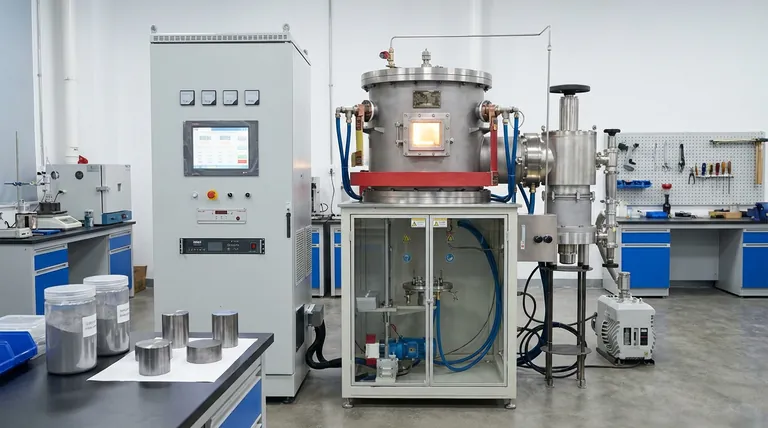
A vacuum hot press acts as a precision consolidation tool that transforms loose metallic glass powders into dense bulk materials by applying heat and pressure simultaneously. By operating specifically within the material's superplastic region—just above the glass transition temperature (Tg)—it forces the powders to bond via viscous flow while preventing the amorphous structure from reverting to a standard crystalline state.
Core Takeaway: By utilizing the synergy of uniaxial pressure and controlled heat in a vacuum, this process lowers the required sintering temperature and shortens holding times. This allows for the rapid creation of high-density bulk metallic glass (BMG) composites while actively suppressing excessive grain growth and preserving essential nanostructural characteristics.
Navigating the Superplastic Region
Targeting the Glass Transition Temperature (Tg)
The vacuum hot press is designed to operate in a specific thermal window known as the superplastic region. This region exists above the glass transition temperature (Tg) but below the crystallization temperature.
Promoting Viscous Flow
In this state, the metallic glass powder softens but does not melt in the traditional sense. The equipment applies significant axial pressure to induce viscous flow, causing the amorphous particles to deform and merge without requiring the extreme heat that would destroy their unique properties.
Densification and Structural Integrity
Achieving High Relative Density
The simultaneous application of high temperature (e.g., 1200°C in specific contexts) and high pressure (e.g., 25 MPa) creates a synergistic effect. This mechanism drives rapid densification, allowing the material to reach high relative densities (often exceeding 96%) through plastic flow and diffusion mechanisms.
Inhibiting Large-Scale Crystallization
A major challenge in processing metallic glasses is their tendency to crystallize and become brittle when heated. The vacuum hot press mitigates this by allowing for consolidation at lower sintering temperatures and shorter durations. This suppresses large-scale crystallization reactions, ensuring the bulk material retains its desirable amorphous qualities.
Creating Nanocrystal-Reinforced Composites
While preventing unwanted grain growth, the process can be tuned to allow for controlled, limited phase transformations. This capability enables the formation of nanocrystal-reinforced BMG composites, where the amorphous matrix is strengthened by a dispersion of nanocrystals or microcrystals.
Understanding the Trade-offs
The Thermal Window Risk
Operating a vacuum hot press requires precise thermal management. If the temperature exceeds the superplastic window or if the holding time is too long, the material will undergo excessive grain growth, losing the nanostructural advantages of the metallic glass.
Uniaxial Pressure Limitations
Because the pressure is applied axially (uniaxially), the densification is highly effective in one direction. However, this method is generally best suited for simple geometries (like pucks or cylinders) rather than complex, net-shape parts, which might require different consolidation techniques.
Making the Right Choice for Your Goal
When employing a vacuum hot press for metallic glass consolidation, your operational parameters must align with your specific material objectives:
- If your primary focus is Maximum Density: Prioritize high axial pressure levels to maximize plastic flow and diffusion, aiming for relative density above 96%.
- If your primary focus is Microstructural Preservation: Prioritize precise temperature control just above Tg and shorter holding times to inhibit crystallization and maintain the amorphous or nanocrystalline state.
Ultimately, the vacuum hot press bridges the gap between unstable powders and robust bulk materials by exploiting the unique flow characteristics of the superplastic state.
Summary Table:
| Feature | Function in Metallic Glass Consolidation | Key Benefit |
|---|---|---|
| Thermal Control | Operates in the superplastic region (above Tg) | Prevents unwanted crystallization |
| Uniaxial Pressure | Drives viscous flow and particle deformation | Achieves >96% relative density |
| Vacuum Environment | Removes atmospheric contaminants | Ensures high purity and structural integrity |
| Short Holding Time | Minimizes thermal exposure | Preserves nanostructural characteristics |
Elevate Your Material Research with KINTEK
Unlock the full potential of your metallic glass and advanced material projects with KINTEK’s precision vacuum hot press systems. Backed by expert R&D and world-class manufacturing, we provide customizable solutions for Muffle, Tube, Rotary, Vacuum, and CVD systems tailored to your unique laboratory requirements.
Whether you are aiming for maximum densification or microstructural preservation, our high-performance furnaces ensure you maintain the critical balance of temperature and pressure. Contact KINTEK today to discuss your specific application and discover how our customizable high-temperature solutions can transform your powder consolidation process.
References
- Pee‐Yew Lee, Chung‐Kwei Lin. Synthesis of Nanocrystal-Embedded Bulk Metallic Glass Composites by a Combination of Mechanical Alloying and Vacuum Hot Pressing. DOI: 10.3390/ma18020360
This article is also based on technical information from Kintek Furnace Knowledge Base .
Related Products
- Vacuum Hot Press Furnace Machine for Lamination and Heating
- Vacuum Hot Press Furnace Machine Heated Vacuum Press
- Vacuum Hot Press Furnace Machine Heated Vacuum Press Tube Furnace
- 600T Vacuum Induction Hot Press Vacuum Heat Treat and Sintering Furnace
- Vacuum Heat Treat Sintering Furnace with Pressure for Vacuum Sintering
People Also Ask
- What are the primary components of a vacuum hot press furnace? Master the Core Systems for Precise Material Processing
- What safety features are incorporated in vacuum hot press furnaces? Ensure Operator and Equipment Protection
- What are the benefits of the vacuum environment system in a vacuum hot press furnace? Unlock High-Density Sintering
- What industries benefit from the use of vacuum hot press furnaces? Unlock High-Performance Materials for Your Industry
- How does the uniaxial pressure applied by a vacuum hot press furnace affect the microstructure of ZrC-SiC materials?