
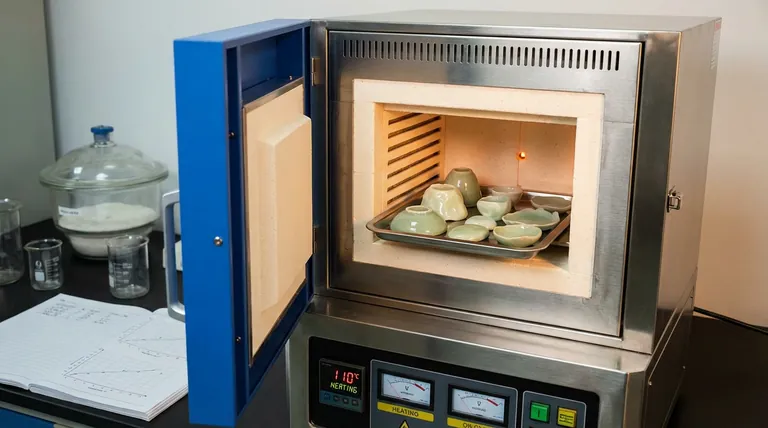
The primary purpose of using a laboratory oven in this context is to establish a standardized, moisture-free baseline for the material. By subjecting celadon samples to a constant temperature of 110°C for approximately two hours, researchers completely eliminate residual moisture trapped within the material's pores.
Core Takeaway Moisture acts as a hidden variable that distorts physical measurements. Standardized oven drying ensures that every test begins from a consistent "dry state," isolating the true properties of the celadon from the fluctuations of environmental humidity.
The Mechanics of Sample Preparation
Targeting Pore Moisture
Celadon, like many ceramics, contains microscopic pores. These pores naturally trap moisture from the surrounding environment.
The 110°C Standard
The specific temperature of 110°C is chosen because it is slightly above the boiling point of water. This ensures that any liquid water within the sample transitions to vapor and evaporates.
Duration for Core Consistency
The two-hour duration is critical for thermal equilibrium. It ensures the heat penetrates the center of the sample, guaranteeing that the core is just as dry as the surface.
Impact on Physical Measurements
Water Absorption Accuracy
To measure how much water a material can absorb, it must start completely empty. If the pores are already partially filled with atmospheric moisture, your final absorption data will be artificially low.
Density and Mass Precision
Physical property calculations often rely on the sample's mass. Any unevaporated water adds "false weight" to the sample, which leads to incorrect density calculations.
Microhardness Reliability
The presence of moisture can subtly affect how a material responds to physical stress. Drying the sample ensures that microhardness testing measures the ceramic structure itself, not the influence of water content.
Common Pitfalls to Avoid
The Risk of Environmental Interference
Without this drying step, your data becomes dependent on the weather. A sample tested on a humid day would yield different results than one tested on a dry day, destroying the reproducibility of the experiment.
Incomplete Drying
Reducing the time or temperature (e.g., drying at 90°C) may leave residual moisture deep in the pores. This introduces "noise" into your data set, making it impossible to compare samples accurately.
Making the Right Choice for Your Goal
To ensure your experimental data is valid and comparable, adhere to the following principles:
- If your primary focus is Accuracy: Ensure the oven is pre-heated to 110°C before inserting samples to guarantee the evaporation threshold is met immediately.
- If your primary focus is Reproducibility: Apply the two-hour drying window strictly to every batch of samples to eliminate humidity as a variable.
Consistent drying is not merely a cleaning step; it is the calibration of your material to ensure the data you record reflects reality.
Summary Table:
| Parameter | Standard Value | Scientific Purpose |
|---|---|---|
| Target Temperature | 110°C | Exceeds water boiling point to ensure complete evaporation |
| Treatment Duration | 2 Hours | Achieves thermal equilibrium and core-to-surface dryness |
| Primary Goal | Dry State Baseline | Eliminates environmental humidity as a variable |
| Impacted Metrics | Absorption, Density | Prevents 'false weight' and ensures pore availability |
Elevate Your Material Testing Precision with KINTEK
Don't let environmental variables compromise your research data. KINTEK provides high-performance laboratory ovens designed for the rigorous thermal equilibrium required in ceramic and material science. Backed by expert R&D and manufacturing, we offer a comprehensive range of Muffle, Tube, Rotary, Vacuum, and CVD systems, all fully customizable to meet your specific temperature treatment needs.
Ready to achieve absolute consistency in your lab? Contact our experts today to find your custom solution
References
- Qijiang Li, Jinwei Li. Transparent Celadon with Phase-Separated Structure: Study on the Technological Characteristics and Coloring Mechanism of Celadons from the Lieshan Kiln. DOI: 10.3390/cryst15010095
This article is also based on technical information from Kintek Furnace Knowledge Base .
Related Products
- Laboratory Muffle Oven Furnace with Bottom Lifting
- 1200℃ Muffle Oven Furnace for Laboratory
- 1400℃ Muffle Oven Furnace for Laboratory
- 1800℃ High Temperature Muffle Oven Furnace for Laboratory
- 1700℃ High Temperature Muffle Oven Furnace for Laboratory
People Also Ask
- What is the importance of the calcination process? Master High-Purity Calcium Phosphate Nanopowder Production
- Why is a high-temperature laboratory muffle furnace essential for the alkali fusion process in zeolite synthesis?
- What function does a muffle furnace perform in Ba0.75Ca0.25TiO3 calcination? Ensure Phase Purity & Synthesis
- Why is a high-temperature muffle furnace required for FeOx-MOx/TiO2? Engineering High-Performance Nanocomposites
- What are the primary functions of a high-temperature laboratory muffle furnace in the preparation of biosorbent materials?



















