
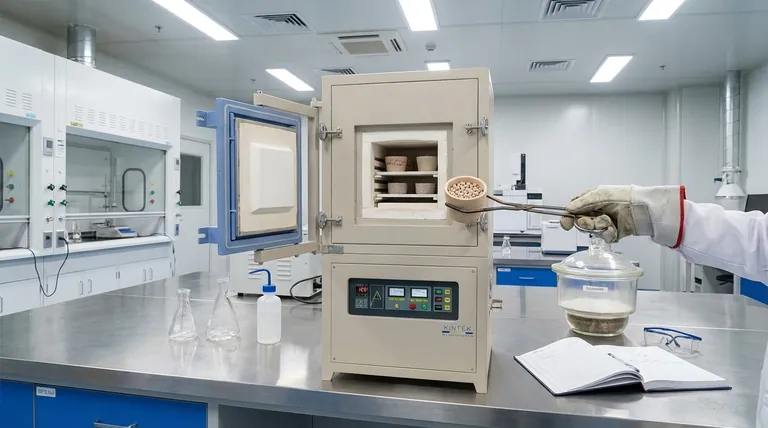
The primary purpose of using a laboratory drying oven in catalyst recycling is to restore the material's reactive potential by eliminating residual contaminants. Specifically, it removes water and organic solvents trapped within the catalyst's pores after washing, ensuring the material returns to a stable physical state before the next cycle of use.
Crucial Insight: Drying is not merely a cleaning step; it is a structural "reset" that ensures the validity of your data. Without this controlled thermal treatment, residual solvents can block active sites or induce chemical instability, rendering recyclability metrics inaccurate.
Restoring Catalytic Performance
To accurately evaluate how well a catalyst can be reused, you must ensure that any drop in performance is due to actual degradation, not improper preparation. The drying oven plays a vital role in establishing this baseline.
Reactivating Surface Sites
Recovered catalysts are typically saturated with washing fluids. The drying process evaporates these fluids from deep within the material's micropores. This effectively "unclogs" the active sites, making them accessible for reactants in the subsequent cycle.
Stabilizing Chemical Structure
Residual moisture is rarely benign. If left in the catalyst, water or solvents can trigger unwanted side reactions or accelerate structural degradation during storage. By removing these volatile components, the oven locks in the material’s chemical stability, preventing artificial aging of the sample between tests.
Ensuring Data Consistency
The goal of a recyclability study is to prove that a material performs consistently over time. The drying oven is the control mechanism that makes this comparison possible.
Standardization of Conditions
For data to be comparable, every cycle must begin with the catalyst in the exact same state. The drying oven provides a controlled thermal environment, ensuring that the catalyst entering Cycle 5 is as dry and solvent-free as the catalyst that entered Cycle 1.
Preventing False Negatives
If a catalyst appears to lose activity, it might simply be "wet" rather than "dead." Proper drying eliminates the variable of solvent interference, giving you confidence that measured performance declines are genuine indicators of material fatigue, not preparation errors.
Understanding the Trade-offs
While drying is essential, the method of drying introduces specific risks that must be managed to maintain material integrity.
The Risk of Thermal Collapse
Applying heat indiscriminately can backfire. High temperatures can cause the delicate porous structure of certain catalysts to collapse or "sinter." This permanently reduces the surface area, destroying the very activity you are trying to measure.
Vacuum vs. Standard Drying
Standard ovens rely on heat alone, which may need to be higher to be effective. Vacuum drying ovens operate at reduced pressures, allowing solvents to evaporate at much lower temperatures (e.g., 60°C). This approach is critical for preserving heat-sensitive surface functional groups that might otherwise deactivate.
Making the Right Choice for Your Goal
To maximize the accuracy of your recyclability evaluation, align your drying protocol with the physical properties of your catalyst.
- If your primary focus is preserving delicate morphology: Prioritize vacuum drying at lower temperatures to remove moisture without collapsing pores or deactivating surface groups.
- If your primary focus is removing heavy organic solvents: Ensure your temperature settings are sufficient to fully evaporate the specific solvents used in washing, preventing active site blockage.
The drying oven serves as the critical bridge between operational cycles, ensuring that your research is built on reproducible, high-integrity data.
Summary Table:
| Function | Key Benefit | Impact on Catalyst Study |
|---|---|---|
| Solvent Removal | Evaporates washing fluids from micropores | Reactivates surface sites for the next cycle |
| Structural Reset | Stabilizes chemical structure | Prevents artificial aging and side reactions |
| Standardization | Uniform thermal environment | Ensures cycle-to-cycle data reproducibility |
| Vacuum Drying | Low-temperature evaporation | Preserves heat-sensitive morphology and functional groups |
Maximize Your Research Precision with KINTEK
Don't let residual solvents compromise your catalyst performance data. KINTEK provides high-precision drying solutions, including standard and vacuum laboratory ovens, designed to protect delicate material structures while ensuring complete decontamination.
Backed by expert R&D and manufacturing, KINTEK offers Muffle, Tube, Rotary, Vacuum, and CVD systems, all fully customizable to meet the unique thermal processing needs of your lab. Whether you are evaluating catalyst durability or developing advanced materials, our equipment delivers the stability and control you require.
Ready to elevate your lab's efficiency? Contact KINTEK today to find the perfect high-temperature furnace solution for your application.
References
- Zi‐Qing Liu, Bao‐Li Fei. Mixed Metal Oxide Derived from Polyoxometalate-Based Metal–Organic Framework as a Bi-Functional Heterogeneous Catalyst for Wastewater Treatment. DOI: 10.3390/catal15010076
This article is also based on technical information from Kintek Furnace Knowledge Base .
Related Products
- 1200℃ Muffle Oven Furnace for Laboratory
- 1800℃ High Temperature Muffle Oven Furnace for Laboratory
- High Temperature Muffle Oven Furnace for Laboratory Debinding and Pre Sintering
- 1400℃ Muffle Oven Furnace for Laboratory
- Laboratory Muffle Oven Furnace with Bottom Lifting
People Also Ask
- How does a high-temperature laboratory muffle furnace affect material properties? Transform Anodic Oxide Films Fast
- What is the primary function of a high-temperature laboratory muffle furnace in chemical synthesis? Achieve Precision.
- How is a laboratory muffle furnace used in 3D-printed PP-CF cross-linking? Achieve Thermal Stability at 150 °C
- Why is a laboratory high-temperature muffle furnace used for BaTiO3? Achieve Optimal Tetragonal Crystalline Phases
- What is the critical role of a laboratory high-temperature muffle furnace in TiO2/LDH? Unlock Superior Crystallization












