
Graphite is the material of choice for melting Ti50Ni47Fe3 alloys primarily because of its superior thermal conductivity and exceptional high-temperature resistance. It serves as a robust and economical container capable of withstanding the intense heat required to melt this specific alloy, making it the standard solution for large-scale industrial preparation.
Core Takeaway While the vacuum environment is what chemically protects the reactive elements (Titanium and Nickel), the graphite crucible provides the necessary physical durability and thermal efficiency to make the manufacturing process scalable and cost-effective.
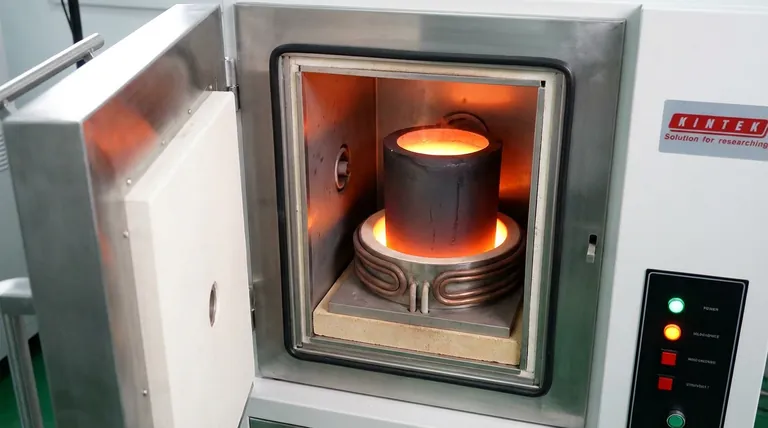
The Physical Advantages of Graphite
Withstanding Extreme Heat
The melting process for Ti50Ni47Fe3 requires temperatures that would degrade lesser materials. Graphite possesses excellent high-temperature resistance, allowing it to remain structurally stable well above the melting point of the alloy. This ensures the crucible does not fail or deform during the melt.
Efficient Thermal Transfer
Graphite is characterized by superior thermal conductivity. This property allows for rapid and even heat distribution from the induction source to the metal charge. This efficiency is critical for maintaining process speed and reducing energy consumption in an industrial setting.
Economic Scalability
For large-scale production, cost becomes a significant factor. The primary reference highlights that graphite serves as an economical and effective container. It balances the need for high performance with the financial constraints of industrial manufacturing.
The Critical Role of the Vacuum Environment
Preventing Oxidation
While the graphite crucible holds the metal, the vacuum induction furnace preserves its chemistry. Titanium and Nickel are highly reactive elements. Without a protective environment, they would react instantly with oxygen and nitrogen in the air. The furnace maintains a high vacuum (typically around 1x10^-3 Pa) to guarantee the purity of the alloy.
Ensuring Uniformity
The vacuum induction process utilizes electromagnetic induction stirring. This mechanism creates movement within the molten pool, ensuring the Titanium, Nickel, and Iron mix perfectly. This results in high compositional uniformity, which is essential for achieving the precise mechanical and thermal performance required in aerospace and power generation applications.
Understanding the System Dependencies
The Crucible-Vacuum Synergy
It is a common pitfall to view the crucible choice in isolation. Using a graphite crucible without the accompanying high-vacuum environment would be disastrous for TiNiFe alloys. The vacuum is the critical control that allows the graphite to function without the atmosphere contaminating the reactive metal.
Precision vs. Cost
While graphite is effective for industrial scales, it is chosen specifically for its balance of durability and economy. In high-stakes manufacturing, the goal is consistent integrity. The combination of graphite's robustness and the vacuum's purity control ensures the alloy meets strict chemical composition ratios without incurring prohibitive costs.
Making the Right Choice for Your Goal
To ensure the successful preparation of Ti50Ni47Fe3 alloys, consider your specific production objectives:
- If your primary focus is Cost-Effective Scalability: Prioritize the use of graphite crucibles, as they offer the best balance of thermal performance and economic viability for large batches.
- If your primary focus is Material Purity: strictly maintain a high-vacuum environment (1x10^-3 Pa) to prevent reactive elements like Titanium from oxidizing and compromising the alloy's integrity.
- If your primary focus is Compositional Consistency: Rely on the electromagnetic stirring inherent in vacuum induction melting to ensure the reactive elements are uniformly distributed throughout the alloy.
By pairing the thermal resilience of graphite with the protective atmosphere of a vacuum furnace, you ensure a manufacturing process that is both efficient and chemically precise.
Summary Table:
| Feature | Benefit for Ti50Ni47Fe3 Melting |
|---|---|
| High-Temp Resistance | Maintains structural stability above alloy melting points. |
| Thermal Conductivity | Ensures rapid, even heat distribution and energy efficiency. |
| Economic Viability | Cost-effective solution for large-scale industrial production. |
| Vacuum Synergy | Works with 1x10^-3 Pa vacuum to prevent Titanium oxidation. |
| Induction Stirring | Promotes perfect mixing of Ti, Ni, and Fe for uniformity. |
Elevate Your Material Purity with KINTEK
Precise alloy preparation demands the perfect balance of thermal resilience and environmental control. KINTEK provides industry-leading vacuum induction furnace solutions designed to optimize your melting processes.
Backed by expert R&D and world-class manufacturing, we offer a comprehensive range of Muffle, Tube, Rotary, Vacuum, and CVD systems. Whether you are melting reactive Ti-Ni-Fe alloys or developing specialized ceramics, our high-temp furnaces are fully customizable to meet your unique laboratory or industrial needs.
Ready to achieve superior compositional uniformity?
Contact KINTEK experts today to find the ideal thermal solution for your application.
References
- Shuwei Liu, Songxiao Hui. Effect of Annealing on the Microstructure, Texture, and Properties of Cold-Rolled Ti50Ni47Fe3 Shape Memory Alloy Sheets. DOI: 10.3390/cryst14040360
This article is also based on technical information from Kintek Furnace Knowledge Base .
Related Products
People Also Ask
- Why are vacuum heat treating furnaces essential for aerospace? Ensure Superior Material Integrity for High-Stakes Applications
- What is the primary application of vacuum heat treating furnaces in aerospace? Enhance Component Performance with Precision
- How does a vacuum heat treating furnace improve the condition of metal alloys? Achieve Superior Metal Performance
- How does vacuum heat treating work in terms of temperature and time control? Master Precise Material Transformations
- What is the process of vacuum heat treating? Achieve Superior Metallurgical Properties
