
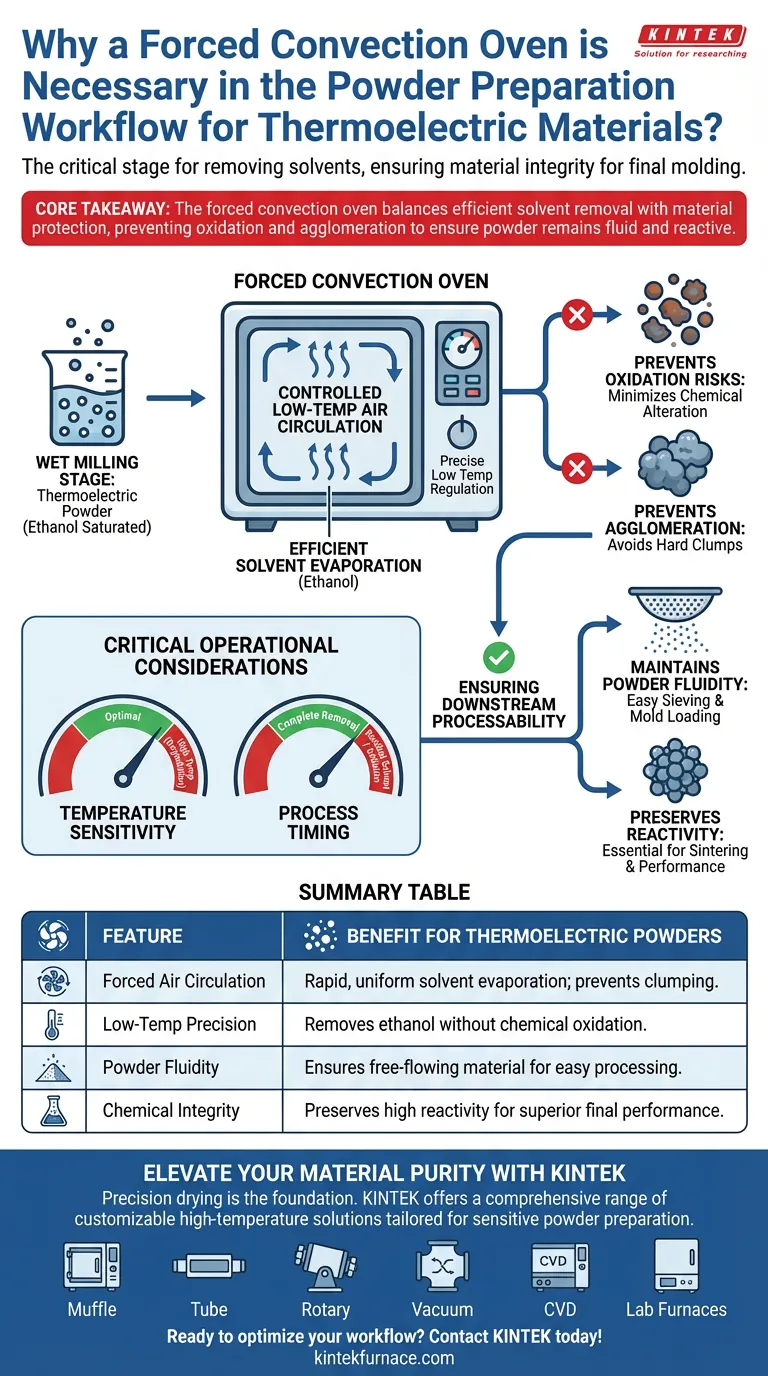
A forced convection oven is the critical mechanism for removing solvents, such as ethanol, following the wet milling stage of thermoelectric powder preparation. By utilizing controlled, low-temperature air circulation, it ensures the complete evaporation of liquids without compromising the powder's chemical integrity or physical consistency.
Core Takeaway: The forced convection oven balances efficient solvent removal with material protection. It prevents the two biggest risks during drying—oxidation and agglomeration—ensuring the powder remains fluid and reactive for the final molding process.
The Role of Controlled Drying in Processing
Efficient Solvent Removal
After wet milling, thermoelectric powders are saturated with solvents like ethanol. You cannot proceed to molding until this liquid is entirely removed.
A forced convection oven circulates hot air to accelerate evaporation. This ensures the drying process is both rapid and uniform throughout the batch.
Controlled Low Temperatures
Speed cannot come at the cost of material degradation. These ovens allow for precise temperature regulation.
By operating at low temperatures, the oven removes the solvent without subjecting the material to excessive heat. This protects the fundamental properties of the thermoelectric compound.
Preventing Material Degradation
Minimizing Oxidation Risks
Thermoelectric materials can be highly sensitive to environmental factors. Exposure to high heat in an uncontrolled environment often leads to oxidation.
Oxidation alters the chemical reactivity of the powder. The forced convection oven mitigates this risk by drying the powder gently, preserving its chemical purity for the next stages of fabrication.
Preventing Agglomeration
When powders dry unevenly or slowly, particles tend to stick together. This creates hard clumps, or agglomerates, which are difficult to process.
The constant circulation of air prevents moisture pockets from lingering. This ensures the particles dry individually rather than fusing into a solid cake.
Ensuring Downstream Processability
Maintaining Powder Fluidity
The steps following drying are sieving and mold loading. Both require the material to behave like a fluid.
Because the oven prevents clumping, the resulting powder remains free-flowing. This "fluidity" allows the powder to pass easily through sieves and fill molds evenly.
Preserving Reactivity
The physical state of the powder dictates how well it sinters or forms during molding.
By avoiding oxidation and agglomeration, the oven ensures the powder maintains high chemical reactivity. This is essential for achieving the desired thermoelectric performance in the final solid component.
Critical Operational Considerations
Temperature Sensitivity
While the oven is designed to prevent oxidation, operator settings are crucial. Even with forced convection, setting the temperature too high can negate the protective benefits and degrade the material.
Process Timing
The goal is to remove ethanol completely. Removing the powder too early leaves residual solvent, which can cause defects during molding. Leaving it too long at temperature may eventually introduce oxidation risks.
Making the Right Choice for Your Goal
To maximize the quality of your thermoelectric materials, align your drying parameters with your specific processing needs.
- If your primary focus is material purity: Keep the oven temperature low to ensure the ethanol evaporates without triggering chemical oxidation.
- If your primary focus is handling efficiency: rely on the uniform air circulation to prevent agglomeration, ensuring the powder is immediately ready for sieving without additional grinding.
The forced convection oven is not just a drying tool; it is a preservation stage that bridges wet processing and final consolidation.
Summary Table:
| Feature | Benefit for Thermoelectric Powders |
|---|---|
| Forced Air Circulation | Rapid, uniform solvent evaporation and prevention of particle clumping (agglomeration). |
| Low-Temp Precision | Removes ethanol/solvents without reaching temperatures that cause chemical oxidation. |
| Powder Fluidity | Ensures dried material remains free-flowing for easy sieving and mold loading. |
| Chemical Integrity | Preserves high chemical reactivity for superior sintering and final performance. |
Elevate Your Material Purity with KINTEK
Precision drying is the foundation of high-performance thermoelectric materials. Backed by expert R&D and manufacturing, KINTEK offers a comprehensive range of Muffle, Tube, Rotary, Vacuum, and CVD systems, along with specialized lab furnaces tailored for sensitive powder preparation.
Whether you need to eliminate oxidation or ensure uniform particle consistency, our customizable high-temperature solutions provide the control your research demands.
Ready to optimize your workflow? Contact KINTEK today to find the perfect furnace for your unique needs!
Visual Guide
References
- Effect of Sb Doping on the Thermoelectric Properties of MNiSn (M=Ti, Zr, Hf) Half-Heusler Alloys Fabricated by a Rapid Solidification Process. DOI: 10.3365/kjmm.2025.63.4.243
This article is also based on technical information from Kintek Furnace Knowledge Base .
Related Products
- Multi Heating Zones CVD Tube Furnace Machine for Chemical Vapor Deposition Equipment
- High Temperature Muffle Oven Furnace for Laboratory Debinding and Pre Sintering
- 1400℃ Muffle Oven Furnace for Laboratory
- Laboratory Muffle Oven Furnace with Bottom Lifting
- 1700℃ High Temperature Muffle Oven Furnace for Laboratory
People Also Ask
- What is the function of a multi-zone tube furnace in CVD synthesis? Master 2D In2Se3 Nanosheet Precision
- What role do multi zone tube furnaces play in new energy research? Unlock Precise Thermal Control for Innovation
- What environmental protection applications utilize multi zone tube furnaces? Unlock Precision in Waste Treatment and Green Tech
- What temperature-related capabilities make multi zone tube furnaces valuable for research? Unlock Precision Thermal Control
- Why are multi zone tube furnaces particularly useful for nanomaterial research? Unlock Precise Thermal Control for Advanced Synthesis






