
The introduction of argon (Ar) and sulfur hexafluoride (SF6) into a vacuum shaft furnace serves a dual purpose: stabilizing the volatile melt and physically shielding it from reaction. This gas mixture creates a dense protective film on the surface of the molten magnesium alloy while simultaneously maintaining an inert pressure environment. This combination prevents the catastrophic oxidation and spontaneous combustion typical of liquid magnesium, ensuring both operational safety and high-purity alloy ingots.
The Core Insight: Liquid magnesium is chemically aggressive and highly volatile. The Ar/SF6 mixture addresses this by forming a "chemical lid" (via SF6) to stop burning and a "physical buffer" (via Ar) to stop evaporation, preserving the alloy's exact chemical composition.
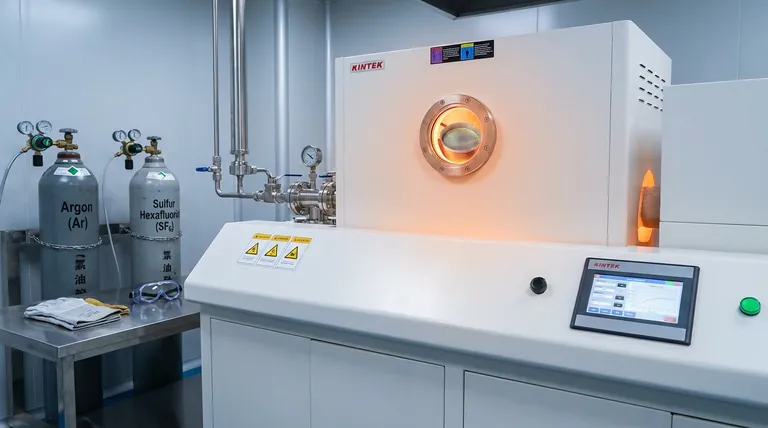
The Mechanics of Protection
The Role of Sulfur Hexafluoride (SF6)
SF6 is the active protective agent in this mixture. Unlike inert gases that simply displace air, SF6 chemically interacts with the surface of the melt.
It reacts to form a dense, coherent protective film directly on the liquid magnesium. This film acts as a physical barrier, effectively isolating the active metal from any residual oxygen in the furnace atmosphere.
The Role of Argon (Ar)
Argon acts as the inert carrier and pressure stabilizer. In high-vacuum environments (such as $10^{-5}$ mbar), volatile elements like magnesium can evaporate or "burn off" rapidly due to their high vapor pressure.
By introducing high-purity argon to maintain atmospheric pressure, you inhibit this volatilization. This ensures the alloy retains its designed stoichiometry and prevents phase structure changes caused by the loss of magnesium.
Why This Specific Mixture is Critical
Preventing Spontaneous Combustion
Magnesium is highly reactive at melting temperatures. Without a protective atmosphere, it reacts violently with oxygen, leading to spontaneous combustion.
The film created by the Ar/SF6 mixture suppresses this reactivity. This is the primary mechanism for experimental safety, converting a hazardous process into a controlled operation.
Minimizing Impurities and Slag
Oxidation doesn't just cause fire; it creates slag. When magnesium reacts with oxygen, it forms oxides that act as impurities within the ingot.
By preventing the oxidation reaction, the gas mixture minimizes slag production. This results in a cleaner melt and a high-quality final ingot with low impurity levels.
Understanding the Risks of Improper Control
While this gas mixture is effective, the precision of the application is paramount. The references highlight that the absence or failure of this system leads to specific deficits:
Compositional Deviation
If the argon pressure is insufficient or the seal is broken, the burn-off of elements with high vapor pressure occurs. This alters the chemical makeup of your alloy, meaning the final product will not match the design specifications.
Structural Phase Changes
Alloy properties depend on exact ratios. If magnesium volatilizes due to a lack of protective pressure, the phase structure of the alloy shifts. This can render the material mechanically inferior or unsuitable for its intended application.
Making the Right Choice for Your Goal
To optimize your melting process, ensure your gas strategy aligns with your specific quality metrics:
- If your primary focus is Safety: Prioritize the flow and concentration of SF6 to ensure the protective surface film is dense and unbroken, preventing combustion.
- If your primary focus is Composition Accuracy: Monitor the Argon partial pressure to suppress the volatilization of high-vapor-pressure elements like magnesium.
Ultimately, the Ar/SF6 mixture is not just about preventing fire; it is a precision tool for locking in the chemical identity of your alloy.
Summary Table:
| Gas Component | Primary Function | Protective Mechanism |
|---|---|---|
| Sulfur Hexafluoride (SF6) | Chemical Shielding | Forms a dense, coherent surface film to prevent combustion |
| Argon (Ar) | Physical Buffer | Maintains pressure to inhibit magnesium volatilization/burn-off |
| Combined Mixture | Process Control | Minimizes slag, prevents phase shifts, and ensures safety |
Optimize Your Magnesium Alloying with KINTEK Precision
Maintaining the exact stoichiometry and safety of reactive metal melts requires specialized equipment. KINTEK provides industry-leading high-temperature systems—including Vacuum, CVD, and customizable Lab Furnaces—backed by expert R&D and manufacturing. Our systems are designed to handle precise gas atmospheres like Ar/SF6, ensuring your alloys remain pure and your processes secure.
Ready to elevate your material research or production? Contact KINTEK today to discuss how our customizable vacuum shaft furnaces can meet your unique melting requirements.
References
- Hongxuan Liu, Jingzhong Xu. Discharge Properties and Electrochemical Behaviors of Mg-Zn-xSr Magnesium Anodes for Mg–Air Batteries. DOI: 10.3390/ma17174179
This article is also based on technical information from Kintek Furnace Knowledge Base .
Related Products
- Vacuum Sealed Continuous Working Rotary Tube Furnace Rotating Tube Furnace
- Vacuum Heat Treat Sintering Furnace with Pressure for Vacuum Sintering
- Small Vacuum Heat Treat and Tungsten Wire Sintering Furnace
- Vacuum Hot Press Furnace Machine Heated Vacuum Press Tube Furnace
- Vacuum Heat Treat Sintering Furnace Molybdenum Wire Vacuum Sintering Furnace
People Also Ask
- What is the purpose of rotary tube furnaces? Achieve Uniform Heat Treatment for Powders and Granules
- What are the key advantages of using a rotary tube furnace? Achieve Dynamic, Uniform Heating for Powders
- How does the amount of material processed vary between batch and continuous rotary tube furnaces? Scale Your Production Efficiently
- What are the advantages of rotary tube furnaces in fuel compatibility? Boost Efficiency and Cut Costs
- What is the temperature range of some rotary tube furnaces? Achieve Uniform Heating Up to 1200°C



















