
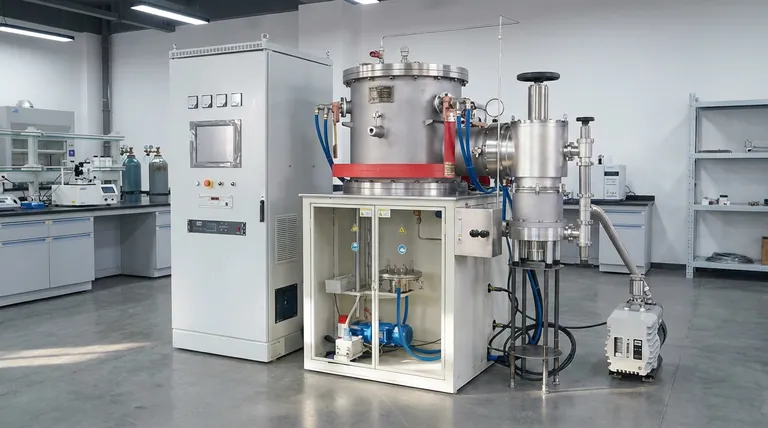
The critical function of a vacuum induction furnace in preparing Fe-Cu-Nb-Mo-Si-B master alloys is to provide a controlled environment that simultaneously melts high-melting-point elements and protects reactive components.
It achieves this by generating intense heat through electromagnetic induction to fully melt refractory metals like Molybdenum and Niobium. Crucially, the vacuum atmosphere prevents the oxidation of active elements (specifically Niobium), while the inherent electromagnetic stirring ensures the complex multi-component mixture is chemically uniform.
The vacuum induction furnace solves the dual challenge of processing refractory metals and reactive elements simultaneously. It creates a high-purity, homogeneous master alloy by preventing oxidative loss and mechanically forcing the integration of elements with vastly different densities and melting points.
Mastering High-Melting-Point Raw Materials
Generating Extreme Heat via Induction
The Fe-Cu-Nb-Mo-Si-B alloy system contains refractory metals, specifically Molybdenum (Mo) and Niobium (Nb), which have exceptionally high melting points. Standard heating methods often struggle to reach the temperatures required to fully fuse these materials into a liquid state without contaminating them.
Electromagnetic induction generates heat directly within the metal charge. This allows the furnace to rapidly achieve and maintain the extreme temperatures necessary to fully melt the Molybdenum and Niobium components, ensuring they are completely integrated into the iron matrix.
Eliminating Unmelted Inclusions
In multi-component alloys, incomplete melting is a common failure point. If the high-melting-point elements do not dissolve completely, the resulting master alloy will contain unmelted particles.
The induction furnace ensures a complete melt, providing a defect-free liquid phase that serves as the foundation for the alloy's final properties.
Preserving Alloy Composition
Protection from Oxidation
The "active" elements in this alloy system, particularly Niobium (Nb), are highly susceptible to oxidation when exposed to air at melting temperatures. Silicon (Si) and Boron (B) can also react adversely with oxygen.
The vacuum environment is the primary defense mechanism. By removing air from the melting chamber, the furnace prevents oxygen from contacting the molten pool. This ensures that these expensive and critical alloying elements are retained in the metal rather than being lost as oxide slag.
Degassing for Purity
Beyond preventing oxidation, the vacuum aids in degassing. As the metal melts, dissolved gases and volatile impurities are drawn out of the liquid and evacuated by the vacuum system.
This results in a master alloy with significantly reduced porosity and lower levels of harmful impurities like nitrogen or oxygen, which is essential for high-performance research applications.
Ensuring Compositional Uniformity
The Mechanism of Electromagnetic Stirring
A major challenge in multi-component alloys is segregation. Elements with different densities (like Copper vs. Molybdenum) naturally tend to separate, leading to an inconsistent chemical composition across the ingot.
The induction current that heats the metal also generates a magnetic field that exerts a physical force on the molten pool. This creates a vigorous electromagnetic stirring effect.
Homogenizing the Master Alloy
This continuous stirring motion forces the heavy elements and lighter elements to mix thoroughly. It prevents gravity-based segregation and ensures that the Fe-Cu-Nb-Mo-Si-B composition is chemically homogeneous throughout the entire batch.
For a master alloy—which is intended to be a standard reference for performance research—this uniformity is non-negotiable. It guarantees that any sample taken from the alloy is representative of the whole.
Understanding the Trade-offs
Crucible Reactivity
While vacuum induction melting (VIM) is excellent for purity, it is not without limitations. The intense stirring and high heat can sometimes cause the molten metal to react with the ceramic crucible lining.
This can introduce trace amounts of refractory material (ceramic inclusions) into the melt. Operators must carefully select crucible materials that are chemically compatible with the specific alloy system to minimize this contamination.
Volatilization of High-Vapor-Pressure Elements
The vacuum environment protects against oxidation, but it can also induce the evaporation of elements with high vapor pressures (such as Manganese or Copper) if the pressure is too low or the temperature too high.
In the case of Fe-Cu-Nb-Mo-Si-B, the Copper (Cu) content must be monitored. Precise control of the vacuum level and partial pressure (backfilling with inert gas like argon) is often required to balance degassing against the evaporation of volatile components.
Making the Right Choice for Your Goal
When utilizing vacuum induction melting for complex alloys, tailor your process parameters to your specific research or production needs:
- If your primary focus is Chemical Accuracy: Prioritize precise vacuum levels and potential argon backfilling to prevent the evaporative loss of Copper while protecting Niobium from oxidation.
- If your primary focus is Microstructural Consistency: Maximize the duration and intensity of the electromagnetic stirring phase to ensure Molybdenum and Niobium are perfectly distributed before casting.
- If your primary focus is Material Purity: Ensure a deep vacuum is held for a sufficient period during the molten stage to allow for complete degassing of volatile impurities.
By leveraging the induction furnace's ability to stir and protect the melt simultaneously, you transform a mix of difficult raw materials into a pristine, high-performance master alloy.
Summary Table:
| Feature | Benefit for Fe-Cu-Nb-Mo-Si-B Alloy Preparation |
|---|---|
| Induction Heating | Reaches extreme temperatures to melt refractory Mo and Nb. |
| Vacuum Atmosphere | Prevents oxidation of active Niobium and enables degassing of impurities. |
| Magnetic Stirring | Prevents density-based segregation for total chemical homogeneity. |
| Refined Process Control | Balances vacuum levels to minimize the evaporation of volatile Copper. |
Elevate Your Material Research with KINTEK
Precise alloy preparation demands specialized equipment that can handle refractory metals and prevent reactive oxidation. KINTEK provides industry-leading Vacuum, CVD, and high-temperature furnace systems backed by expert R&D and manufacturing. Whether you are developing Fe-based master alloys or specialized nanomaterials, our customizable solutions ensure chemical uniformity and purity for your most demanding lab applications.
Ready to optimize your melting process? Contact KINTEK today to discuss your custom furnace needs.
Visual Guide

References
- Yuri N. Starodubtsev, Nadezhda P. Tsepeleva. Melting, Solidification, and Viscosity Properties of Multicomponent Fe-Cu-Nb-Mo-Si-B Alloys with Low Aluminum Addition. DOI: 10.3390/ma17020474
This article is also based on technical information from Kintek Furnace Knowledge Base .
Related Products
- 600T Vacuum Induction Hot Press Vacuum Heat Treat and Sintering Furnace
- Vacuum Induction Melting Furnace
- Small Vacuum Heat Treat and Tungsten Wire Sintering Furnace
- High Pressure Laboratory Vacuum Tube Furnace
- Vacuum Hot Press Furnace Machine Heated Vacuum Press Tube Furnace
People Also Ask
- Why use Vacuum Hot Press (VHP) for ZnS Ceramics? Achieve Superior IR Transparency and Mechanical Strength
- How does a vacuum hot press sintering furnace mitigate copper sintering swelling? Solve Fe-Cu Expansion Issues
- What are the benefits of using a vacuum hot press sintering furnace for the preparation of SiCw/2024 aluminum matrix composites? Achieve High-Performance Aerospace Materials
- How does the vacuum environment in a vacuum hot press sintering furnace protect chromium-containing ceramics? Find out.
- What are the key advantages of vacuum hot press sintering furnaces? Achieve Superior Density and Purity in Materials



















