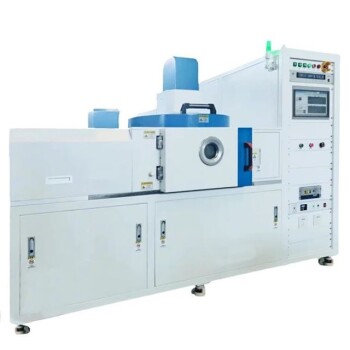
Medium-frequency induction heating provides a high-efficiency solution for Ir/HfO2 deposition by directly heating the substrate through electromagnetic induction. This method enables the substrate to rapidly reach critical reaction temperatures exceeding 1400°C while keeping the chamber walls relatively cool. Consequently, this "cold-wall" setup minimizes side reactions and prevents material contamination, ensuring the structural integrity and purity of the resulting composite coatings.
By decoupling the substrate temperature from the environment, medium-frequency induction heating optimizes thermal efficiency and chemical purity, which are essential for high-performance Ir/HfO2 composite materials.
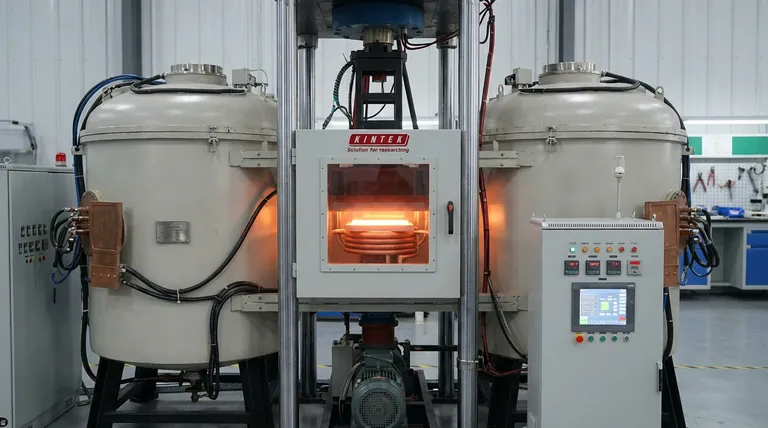
Precision Thermal Management through Induction
Direct Electromagnetic Coupling
Unlike traditional resistive heating, medium-frequency induction targets the substrate itself using electromagnetic fields.
This mechanism eliminates the need for heat to travel through space or air, resulting in an exceptionally rapid temperature rise.
Achieving High-Temperature Thresholds
The deposition of HfO2 requires extreme thermal environments to ensure proper chemical bonding and crystallization.
Medium-frequency systems easily push substrate temperatures above 1400°C, satisfying the rigorous energy demands of the iridium and hafnium oxide composite process.
The Strategic Advantage of Cold-Wall Environments
Minimizing Deleterious Side Reactions
In a standard hot-wall furnace, gas precursors often react prematurely with the heated chamber surfaces.
By keeping the chamber walls at a lower temperature, induction heating ensures that the chemical reaction is localized strictly to the substrate surface.
Eliminating Material Contamination
High temperatures can cause furnace linings and equipment components to outgas or shed particulates.
The cold-wall environment prevents the degradation of equipment materials, ensuring that the Ir/HfO2 coating remains free of impurities from the deposition system.
Understanding the Trade-offs
Equipment Complexity and Geometry
Induction heating requires precise coil designs that are specifically tailored to the shape of the substrate.
If the substrate geometry is highly irregular, achieving uniform heating across the entire surface can be technically challenging compared to radiant heating.
Material Conductivity Requirements
The efficiency of induction heating depends heavily on the electromagnetic properties of the substrate.
Non-conductive materials may require a susceptor (a secondary heated element), which can slightly complicate the system design and reintroduce thermal lag.
How to Apply This to Your Project
Making the Right Choice for Your Goal
To maximize the benefits of medium-frequency induction heating, align your process parameters with your specific material requirements:
- If your primary focus is Maximum Purity: Leverage the cold-wall effect to eliminate precursor interaction with the chamber walls and prevent equipment-sourced contamination.
- If your primary focus is Process Throughput: Utilize the rapid heating cycles of induction to reduce "ramp-up" time and increase the number of deposition cycles per shift.
- If your primary focus is High-Temperature Stability: Use this method to reach the 1400°C+ threshold required for the phase stability of HfO2 without overstressing the entire vacuum system.
Selecting medium-frequency induction heating allows you to transform the deposition chamber into a high-precision chemical reactor that prioritizes coating integrity.
Summary Table:
| Feature | Advantage in Ir/HfO2 Deposition | Benefit to Coating Quality |
|---|---|---|
| Direct Induction | Rapid substrate heating exceeding 1400°C | Enhanced crystallization and bonding |
| Cold-Wall Setup | Localized reaction on substrate only | Minimizes side reactions and impurities |
| Thermal Efficiency | Direct electromagnetic coupling | Reduced cycle times and energy waste |
| Process Control | Decoupled substrate/environment temperature | High-performance material integrity |
Elevate Your Material Research with KINTEK Precision
Are you looking to achieve superior purity and thermal stability in your composite coatings? Backed by expert R&D and manufacturing, KINTEK offers high-performance Muffle, Tube, Rotary, Vacuum, and CVD systems tailored for the most demanding laboratory environments.
Whether you need to reach 1400°C+ for Ir/HfO2 deposition or require a customized heating solution for unique substrate geometries, our team provides the technical expertise to optimize your workflow. Contact us today to discover how our customizable high-temperature furnaces can transform your deposition process and deliver the chemical purity your project demands.
References
- Junyu Zhu, Xuxiang Zhang. Oxidation Resistance of Ir/HfO2 Composite Coating Prepared by Chemical Vapor Deposition: Microstructure and Elemental Migration. DOI: 10.3390/coatings14060695
This article is also based on technical information from Kintek Furnace Knowledge Base .
Related Products
- Multi Heating Zones CVD Tube Furnace Machine for Chemical Vapor Deposition Equipment
- Custom Made Versatile CVD Tube Furnace Chemical Vapor Deposition CVD Equipment Machine
- 915MHz MPCVD Diamond Machine Microwave Plasma Chemical Vapor Deposition System Reactor
- MPCVD Machine System Reactor Bell-jar Resonator for Lab and Diamond Growth
- Split Chamber CVD Tube Furnace with Vacuum Station CVD Machine
People Also Ask
- What is the function of a multi-zone tube furnace in CVD synthesis? Master 2D In2Se3 Nanosheet Precision
- What role do multi zone tube furnaces play in new energy research? Unlock Precise Thermal Control for Innovation
- What environmental protection applications utilize multi zone tube furnaces? Unlock Precision in Waste Treatment and Green Tech
- Why are multi zone tube furnaces particularly useful for nanomaterial research? Unlock Precise Thermal Control for Advanced Synthesis
- What temperature-related capabilities make multi zone tube furnaces valuable for research? Unlock Precision Thermal Control