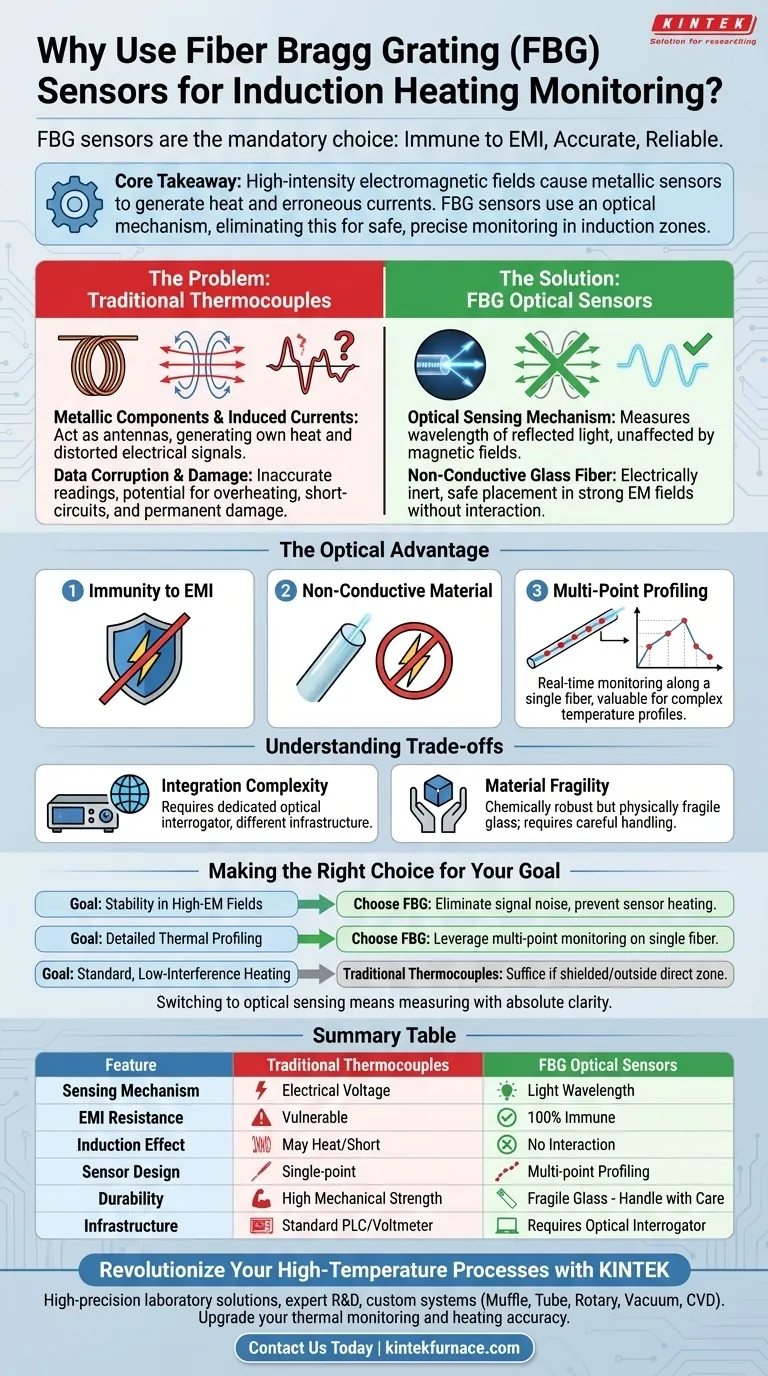
Fiber Bragg Grating (FBG) sensors are the mandatory choice for induction heating environments because they are completely immune to electromagnetic interference (EMI). While traditional thermocouples rely on metal components that react to magnetic fields, FBG sensors utilize light traveling through non-conductive glass fibers to provide accurate temperature data without signal distortion or physical failure.
Core Takeaway High-intensity alternating electromagnetic fields cause metallic sensors to generate their own heat and erroneous electrical currents. FBG sensors eliminate this failure mode by using an optical sensing mechanism, allowing for safe, precise monitoring directly inside the induction zone.

The Problem with Traditional Thermocouples
The Physics of Interference
Induction heating operates by generating high-intensity alternating electromagnetic fields. Traditional thermocouples are constructed from metal wires designed to generate a small voltage based on temperature.
Induced Currents
Because they are metallic, thermocouples essentially act as antennas within the induction coil. The alternating magnetic field creates induced currents directly within the thermocouple wires.
Data Corruption and Damage
These induced currents distort the voltage signal, leading to wildly inaccurate temperature readings. In severe scenarios, the induced current can cause the sensor itself to overheat or short-circuit, resulting in permanent sensor damage.
The Optical Advantage of FBG Sensors
Immunity to EMI
FBG sensors operate on an optical sensing mechanism, measuring changes in the wavelength of reflected light rather than changes in voltage. Light is unaffected by magnetic fields, rendering FBG sensors completely immune to the interference that cripples electronic sensors.
Non-Conductive Material
These sensors are constructed from glass fiber, which is an electrically non-conductive material. This allows the sensor to be placed safely in the center of strong magnetic fields without interacting with the energy source or altering the heating profile.
Multi-Point Profiling
Beyond simple durability, FBG technology allows for real-time, multi-point monitoring along a single fiber. This is particularly valuable in complex applications, such as ammonia decomposition reactors, where understanding the full temperature profile is critical for process control.
Understanding the Trade-offs
Integration Complexity
While FBG sensors solve the interference problem, they require an optical interrogator to interpret the light signals. This is a different infrastructure requirement compared to the standard voltmeters or PLCs used with thermocouples.
Material Fragility
While chemically robust, the glass fiber construction is physically different from metal wire. Proper handling and installation techniques are required to ensure the fiber is not snapped or stressed mechanically during setup in the reactor.
Making the Right Choice for Your Goal
- If your primary focus is stability in high-EM fields: Choose FBG sensors to eliminate signal noise and prevent the sensor from becoming a heating element itself.
- If your primary focus is detailed thermal profiling: Choose FBG sensors to leverage their ability to measure multiple points along a single fiber without complex wiring harnesses.
- If your primary focus is standard, low-interference heating: Traditional thermocouples may suffice, provided they are shielded or located outside the direct induction zone.
By switching to optical sensing, you move from inferring temperature through noise to measuring it with absolute clarity.
Summary Table:
| Feature | Traditional Thermocouples | FBG Optical Sensors |
|---|---|---|
| Sensing Mechanism | Electrical Voltage (Metallic) | Light Wavelength (Glass) |
| EMI Resistance | Vulnerable to signal distortion | 100% Immune to interference |
| Induction Effect | May heat up or short-circuit | No interaction with magnetic fields |
| Sensor Design | Single-point monitoring | Real-time, multi-point profiling |
| Durability | High mechanical strength | Fragile glass (requires careful handling) |
| Infrastructure | Standard PLC/Voltmeter | Requires Optical Interrogator |
Revolutionize Your High-Temperature Processes with KINTEK
Don't let signal noise compromise your critical thermal data. KINTEK provides high-precision laboratory solutions backed by expert R&D and manufacturing. Whether you require Muffle, Tube, Rotary, Vacuum, or CVD systems, our lab high-temp furnaces are fully customizable to meet your unique induction or thermal processing needs.
Ready to upgrade your thermal monitoring and heating accuracy? Contact us today to discover how our advanced systems and optical sensing expertise can optimize your research and production outcomes.
Visual Guide
References
- Débora de Figueiredo Luiz, Jurriaan Boon. Use of a 3D Workpiece to Inductively Heat an Ammonia Cracking Reactor. DOI: 10.3390/suschem6040043
This article is also based on technical information from Kintek Furnace Knowledge Base .
Related Products
- High Temperature Muffle Oven Furnace for Laboratory Debinding and Pre Sintering
- Vertical Laboratory Quartz Tube Furnace Tubular Furnace
- Multi Zone Laboratory Quartz Tube Furnace Tubular Furnace
- Multi Heating Zones CVD Tube Furnace Machine for Chemical Vapor Deposition Equipment
- Ultra High Vacuum Observation Window Stainless Steel Flange Sapphire Glass Sight Glass for KF
People Also Ask
- What thermal phenomena occur during polymer binder burnout in ceramic green bodies? Lab Furnace Guide
- Why is controlled heat treatment in a muffle furnace necessary for calcined clay? Achieve Optimal Pozzolanic Activity
- What role does a high-temperature muffle furnace play in STFO synthesis? Achieve Pure Perovskite Results
- How does a high-temperature muffle furnace facilitate the formation of LaNbxAl1−xO3+δ perovskite structures? Key Roles
- What role does a high-temperature muffle furnace play in the formation of biochar catalysts? Master Catalyst Synthesis