
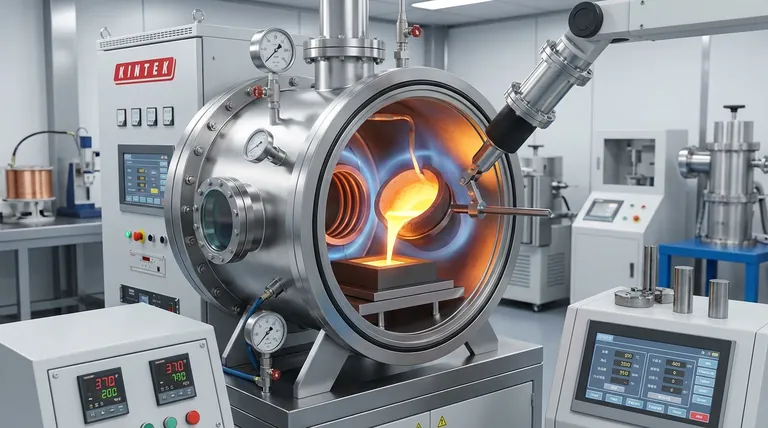
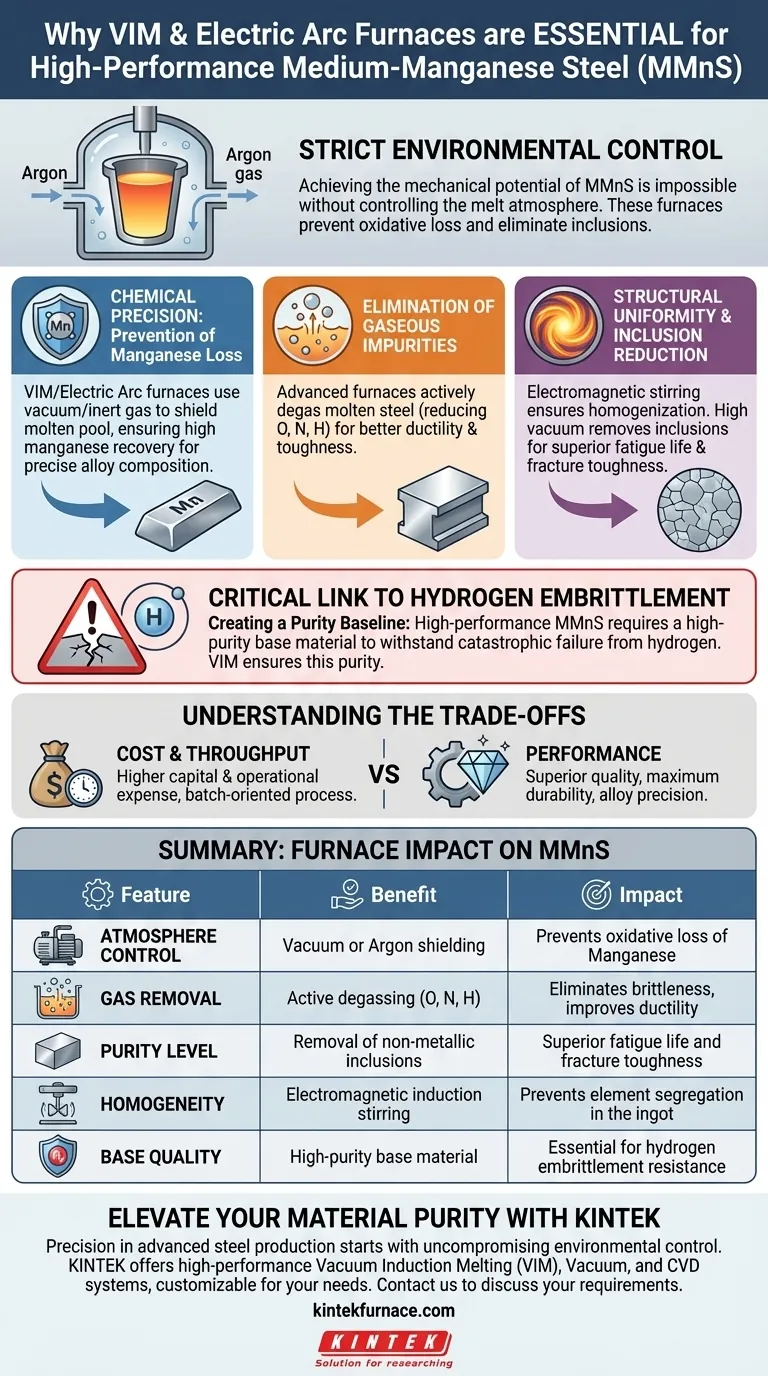
The production of high-performance Medium-Manganese Steel (MMnS) relies entirely on strict environmental control during the melting phase. Industrial-grade Vacuum Induction Melting (VIM) furnaces or electric arc furnaces are essential because they provide the precise regulation of gas content—specifically oxygen, nitrogen, and hydrogen—required to remove harmful impurities. This high-vacuum or argon-protected environment ensures the maximum recovery of manganese and creates the high-purity base material needed to resist hydrogen embrittlement.
Core Takeaway Achieving the mechanical potential of Medium-Manganese Steel is impossible without controlling the melt atmosphere. These furnaces prevent the oxidative loss of manganese and eliminate microscopic inclusions, ensuring the material is pure enough to withstand critical failure modes like hydrogen embrittlement.
The Imperative of Chemical Precision
Prevention of Manganese Loss
Manganese is a reactive element that is prone to significant oxidative loss when exposed to air at melting temperatures.
VIM and electric arc furnaces utilize vacuum or inert gas (argon) environments to shield the molten pool. This ensures a high recovery rate of manganese, maintaining the precise alloy composition required for the steel's intended mechanical properties.
Elimination of Gaseous Impurities
Standard melting processes often trap gases that degrade steel performance.
Advanced furnaces equipped with vacuum decarburization units or argon protection actively degas the molten steel. This significantly reduces the content of oxygen, nitrogen, and hydrogen, which are detrimental to the material's ductility and toughness.
Achieving Structural Uniformity
Reduction of Harmful Inclusions
Impurities in the melt eventually solidify into inclusions, which act as stress concentrators within the finished steel.
By operating in a high-vacuum environment, these furnaces facilitate the removal of these non-metallic inclusions. The result is a cleaner microstructure that exhibits superior fatigue life and fracture toughness.
Homogenization via Electromagnetic Stirring
A distinct advantage of VIM furnaces is the use of electromagnetic induction.
This mechanism naturally stirs the molten metal, ensuring a high degree of compositional homogenization. It guarantees that alloying elements like iron, manganese, and carbon are evenly distributed throughout the ingot, preventing segregation.
The Critical Link to Hydrogen Embrittlement
Creating a Purity Baseline
Hydrogen embrittlement is a catastrophic failure mode where metal becomes brittle and fractures due to the introduction of hydrogen.
High-performance MMnS requires a high-purity base material to properly evaluate and achieve resistance to this phenomenon. If the base material is already compromised by hydrogen or inclusions during melting, its resistance to environmental hydrogen embrittlement cannot be accurately assessed or guaranteed.
Understanding the Trade-offs
Cost vs. Performance
While VIM and specialized electric arc furnaces offer superior quality, they represent a significant capital and operational expense compared to standard induction melting.
Throughput Limitations
Vacuum processes are inherently batch-oriented and time-consuming due to the need for pumping down creates and backfilling with argon. This can act as a bottleneck in high-volume production environments, forcing manufacturers to balance purity requirements with production speed.
Making the Right Choice for Your Goal
When selecting a production route for Medium-Manganese Steel, consider your end-use requirements:
- If your primary focus is Maximum Durability: Prioritize VIM processing to minimize inclusions and maximize hydrogen embrittlement resistance.
- If your primary focus is Alloy Precision: Use vacuum or argon-protected environments to ensure the final manganese content matches your exact specifications without oxidative loss.
Ultimate reliability in advanced steels is not just about the recipe; it is about the purity of the kitchen.
Summary Table:
| Feature | VIM / Electric Arc Furnace Benefit | Impact on Medium-Mn Steel |
|---|---|---|
| Atmosphere Control | Vacuum or Argon shielding | Prevents oxidative loss of Manganese |
| Gas Removal | Active degassing (O, N, H) | Eliminates brittleness and improves ductility |
| Purity Level | Removal of non-metallic inclusions | Superior fatigue life and fracture toughness |
| Homogeneity | Electromagnetic induction stirring | Prevents element segregation in the ingot |
| Base Quality | High-purity base material | Essential for hydrogen embrittlement resistance |
Elevate Your Material Purity with KINTEK
Precision in advanced steel production starts with uncompromising environmental control. Backed by expert R&D and manufacturing, KINTEK offers high-performance Vacuum Induction Melting (VIM), Vacuum, and CVD systems, along with other specialized lab high-temp furnaces. Our systems are fully customizable to meet your unique metallurgical needs, ensuring maximum manganese recovery and the elimination of harmful impurities.
Ready to achieve the ultimate reliability in your alloy development?
Contact KINTEK Experts Today to discuss your custom furnace requirements.
Visual Guide
References
- Mahmoud Elaraby, Vahid Javaheri. Computational Designing Approach for Medium Manganese Steels with Potential Better Hydrogen Embrittlement Resistance. DOI: 10.3384/ecp212.032
This article is also based on technical information from Kintek Furnace Knowledge Base .
Related Products
- Vacuum Induction Melting Furnace
- 600T Vacuum Induction Hot Press Vacuum Heat Treat and Sintering Furnace
- Small Vacuum Heat Treat and Tungsten Wire Sintering Furnace
- Vacuum Heat Treat Sintering and Brazing Furnace
- Vacuum Heat Treat Sintering Furnace Molybdenum Wire Vacuum Sintering Furnace
People Also Ask
- What are the core functions of the High Vacuum Induction Melting (VIM) furnace? Optimize DD5 Superalloy Purification
- What are the advantages of using a VIM furnace to control residual oxygen pressure? Achieve Superior Metal Uniformity
- What are the technical advantages of using a Vacuum Induction Melting furnace in the development of advanced packaging steel?
- What is the role of VIM and directional solidification in aero-engine blade substrates? Engineering Extreme Durability
- Why is a Vacuum Induction Melting furnace (VIM) used for Cu-Zn-Al-Sn alloys? Achieve Precision Composition Control



















