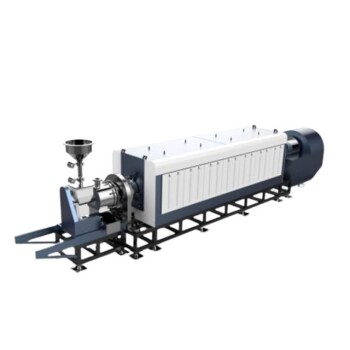
A crucible melting furnace establishes a strictly controlled high-temperature environment designed to elevate Aluminum-Silicon (Al-Si) alloys well above their melting point. Specifically, it targets temperatures around 750°C, ensuring the raw materials transition completely from solid to liquid to achieve the necessary fluidity for casting.
The crucible furnace acts as the foundational hardware for casting integrity. Its primary function is not just to melt metal, but to provide uniform heat transfer and thermal stability, which are critical for achieving a homogenized chemical composition before pouring.
Establishing the Thermal Foundation
Precise Temperature Control
The furnace must generate a stable heat source capable of reaching and maintaining specific targets, typically 750°C for Al-Si alloys.
This temperature is strategically chosen to be sufficiently above the alloy's melting point. This ensures the material does not just melt, but achieves the low viscosity required for complex mold filling.
Sustained Insulation and Holding
Beyond simply hitting a peak temperature, the furnace provides a strictly maintained insulation period.
Supplementary data suggests maintaining this heat for extended periods, such as 2 hours, is often necessary. This "holding time" ensures that even dense master alloys and pure aluminum blocks are fully fused into the melt.
Ensuring Material Consistency
Uniform Heat Transfer
A critical condition provided by the crucible furnace is the even distribution of heat throughout the raw material.
Uniform heat transfer prevents localized "hot spots" (which can burn off elements) or "cold spots" (which leave unmelted solids). This uniformity is the key driver for achieving consistent pouring fluidity.
Preliminary Homogenization
The furnace environment serves as the physical foundation for the alloy's chemistry.
By fully melting the base components (pure aluminum and silicon master alloys), the furnace facilitates preliminary homogenization. This ensures the chemical composition is uniform throughout the melt, creating a stable base for any subsequent alloying elements that need to be added.
Understanding the Risks of Inadequate Control
The Danger of Thermal Instability
If the furnace fails to provide a stable temperature, the alloy's fluidity becomes unpredictable.
Fluctuating temperatures can lead to defects such as misruns (where the metal freezes before filling the mold) or excessive gas absorption if the melt overheats.
Incomplete Phase Transition
Without sufficient holding time and uniform heat, the melt may contain semi-solid inclusions.
These unmelted particles compromise the mechanical properties of the final cast, leading to structural weaknesses in the Aluminum-Silicon component.
Ensuring Process Success
To leverage the crucible furnace effectively for your casting goals:
- If your primary focus is Casting Fluidity: Ensure the furnace is calibrated to maintain a steady temperature of 750°C to prevent premature solidification during pouring.
- If your primary focus is Material Quality: Prioritize the insulation and holding time (e.g., 2 hours) to guarantee full melting and chemical homogenization of the master alloys.
The crucible furnace is not merely a heater; it is the stabilization chamber that dictates the consistency and quality of your final Al-Si alloy product.
Summary Table:
| Key Condition | Requirement for Al-Si Alloys | Impact on Casting Quality |
|---|---|---|
| Target Temperature | ~750°C | Ensures low viscosity and high fluidity for mold filling |
| Holding Time | ~2 Hours | Guarantees complete fusion of dense master alloys |
| Heat Distribution | Uniform Transfer | Prevents element burnout and unmelted solid inclusions |
| Thermal Stability | Constant Insulation | Eliminates misruns and structural weaknesses |
Elevate Your Melting Process with KINTEK
Don't let thermal instability compromise your casting integrity. Backed by expert R&D and manufacturing, KINTEK offers high-performance Muffle, Tube, Rotary, Vacuum, and CVD systems, along with customizable lab high-temp furnaces tailored to your metallurgical needs. Whether you require precise Al-Si alloy homogenization or specialized heat treatment, our solutions ensure consistent fluidity and material purity.
Ready to optimize your lab's thermal performance? Contact us today to find your custom furnace solution!
Visual Guide

References
- Dewi Izzatus Tsamroh, Didin Zakariya Lubis. Hardness enhancement of Al-Si alloys from sand casting with runner variations. DOI: 10.23960/mech.v15i2.5280
This article is also based on technical information from Kintek Furnace Knowledge Base .
Related Products
- Vacuum Induction Melting Furnace
- High Temperature Muffle Oven Furnace for Laboratory Debinding and Pre Sintering
- Small Vacuum Heat Treat and Tungsten Wire Sintering Furnace
- Vacuum Heat Treat Sintering Furnace with Pressure for Vacuum Sintering
- Laboratory Muffle Oven Furnace with Bottom Lifting
People Also Ask
- What are the core functions of the High Vacuum Induction Melting (VIM) furnace? Optimize DD5 Superalloy Purification
- What are the advantages of using a VIM furnace to control residual oxygen pressure? Achieve Superior Metal Uniformity
- What is the role of VIM and directional solidification in aero-engine blade substrates? Engineering Extreme Durability
- What are the technical advantages of using a Vacuum Induction Melting furnace in the development of advanced packaging steel?
- Why is a Vacuum Induction Melting furnace (VIM) used for Cu-Zn-Al-Sn alloys? Achieve Precision Composition Control