
Vacuum-arc melting ensures compositional uniformity primarily through an iterative process of flipping and remelting the ingot. By melting the Ti–Mo–Fe alloy a minimum of three times and utilizing the electromagnetic stirring generated by the high-temperature arc, the furnace eliminates elemental segregation to create a homogeneous matrix.
Achieving atomic-level consistency in Ti–Mo–Fe alloys is not a single-step event but a cycle of melting and agitation. The combination of multiple remelting cycles and inherent electromagnetic stirring overcomes the density and melting point differences of the constituent metals to ensure a defect-free, uniform ingot.
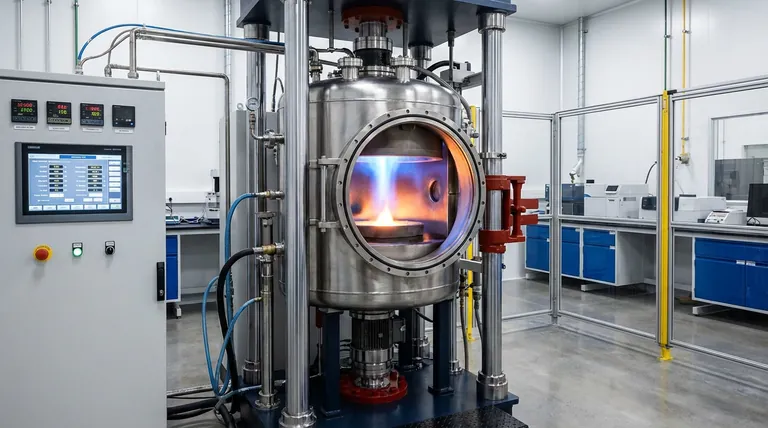
The Mechanics of Homogeneity
The Necessity of Repetitive Melting
Creating a uniform alloy from metals with different melting points, such as Titanium (Ti) and Molybdenum (Mo), requires more than a single pass.
The primary reference dictates that ingots must be flipped and remelted multiple times, typically a minimum of three.
This repetition physically redistributes the elements, ensuring that areas which may have been metal-rich or metal-poor in the first pass are homogenized in subsequent melts.
Electromagnetic Stirring
Beyond simple heat, the vacuum-arc process introduces kinetic energy into the melt pool.
The electric arc generates a powerful electromagnetic stirring effect.
This force actively agitates the molten liquid, preventing heavier elements like Iron (Fe) or Molybdenum from settling at the bottom, thereby ensuring distribution at an atomic level.
Atmosphere and Purity Control
While mechanical mixing ensures distribution, the atmosphere ensures the chemical composition remains accurate.
The furnace operates under a vacuum or a protective argon atmosphere to prevent the titanium from reacting with oxygen or nitrogen.
By eliminating these atmospheric contaminants, the furnace maintains the purity of the alloy and prevents the formation of unwanted brittle phases that could disrupt uniformity.
Understanding the Trade-offs
The Risk of Insufficient Cycles
The most common pitfall in this process is underestimating the number of melt cycles required.
Failing to remelt the ingot at least three times often results in macroscopic segregation, where distinct regions of unmixed Molybdenum or Iron remain within the Titanium matrix.
Thermal Gradients and Solidification
While the arc melts the material effectively, the cooling process poses its own challenges.
If the cooling system integrated into the equipment is not strictly controlled, the solidification rate may vary across the ingot.
Uncontrolled cooling can re-introduce segregation even after a successful melt, as elements with different freezing points may separate out of the solution if the liquid solidifies too slowly or unevenly.
Ensuring Quality in Alloy Synthesis
To guarantee the performance of Ti–Mo–Fe alloys, you must align your processing parameters with your specific material goals.
- If your primary focus is Chemical Homogeneity: strictly enforce the protocol of flipping and remelting the ingot a minimum of three times to leverage electromagnetic stirring.
- If your primary focus is Material Purity: Prioritize the integrity of the vacuum or argon environment to prevent the degradation of Titanium by oxygen or nitrogen.
The ultimate quality of a Ti–Mo–Fe ingot is determined not just by the heat applied, but by the rigor of the remelting strategy and the precision of the atmospheric control.
Summary Table:
| Feature | Mechanism for Uniformity | Benefit |
|---|---|---|
| Iterative Remelting | Minimum 3 cycles of flipping & melting | Physically redistributes elements to eliminate macro-segregation |
| Electromagnetic Stirring | Arc-induced kinetic agitation | Prevents heavy elements like Mo/Fe from settling; ensures atomic-level mixing |
| Atmospheric Control | Vacuum or high-purity Argon gas | Prevents Ti oxidation and maintains chemical purity of the alloy |
| Cooling Systems | Controlled solidification rates | Prevents secondary segregation during the transition from liquid to solid |
Elevate Your Material Purity with KINTEK Expertise
Achieving perfect homogeneity in complex alloys like Ti-Mo-Fe requires more than just heat; it requires precision engineering. KINTEK provides industry-leading thermal solutions, including Vacuum-arc, Tube, and CVD systems, specifically designed to handle the rigorous demands of advanced metallurgy.
Backed by expert R&D and manufacturing, our systems are fully customizable to your unique research or production needs, ensuring your ingots are defect-free and chemically uniform every time. Contact KINTEK today to discover how our specialized high-temperature lab furnaces can optimize your alloying process.
References
- Nthabiseng Moshokoa, Maje Phasha. Influence of intermetallic phase (TiFe) on the microstructural evolution and mechanical properties of as-cast and quenched Ti–Mo–Fe alloys. DOI: 10.1038/s41598-024-60894-x
This article is also based on technical information from Kintek Furnace Knowledge Base .
Related Products
- Vacuum Induction Melting Furnace
- Vacuum Heat Treat Sintering and Brazing Furnace
- Vacuum Heat Treat Sintering Furnace Molybdenum Wire Vacuum Sintering Furnace
- Vacuum Heat Treat Sintering Furnace with Pressure for Vacuum Sintering
- Small Vacuum Heat Treat and Tungsten Wire Sintering Furnace
People Also Ask
- What are the core functions of the High Vacuum Induction Melting (VIM) furnace? Optimize DD5 Superalloy Purification
- What are the advantages of using a VIM furnace to control residual oxygen pressure? Achieve Superior Metal Uniformity
- What are the technical advantages of using a Vacuum Induction Melting furnace in the development of advanced packaging steel?
- What is the role of VIM and directional solidification in aero-engine blade substrates? Engineering Extreme Durability
- What role does a Vacuum Induction Melting furnace play in the production of high-aluminum nickel-based superalloys?



















