
At its core, an induction-heated vacuum furnace offers a combination of superior material purity, unmatched process control, and high operational efficiency. It achieves this by integrating two powerful technologies: electromagnetic induction for rapid, targeted heating, and a high-vacuum chamber to create an ultra-clean processing environment free from atmospheric contamination.
The fundamental advantage is not just one feature, but the synergy between induction heating and a vacuum environment. This combination allows you to achieve metallurgical results—in terms of purity, strength, and consistency—that are simply unattainable with conventional atmospheric furnaces.
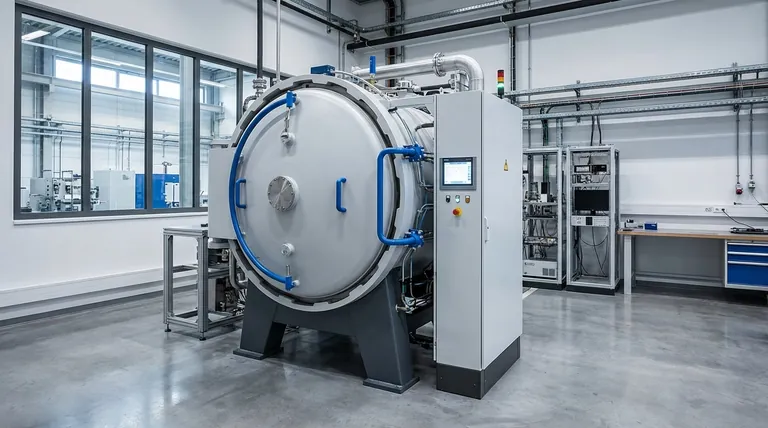
The Core Advantages: Purity, Precision, and Performance
The decision to use an induction vacuum furnace centers on achieving specific material properties that depend on an exceptionally controlled environment.
A Contamination-Free Processing Environment
The vacuum is the first pillar of the furnace's power. By removing the atmosphere, you eliminate the root cause of many metallurgical defects.
This prevents unwanted chemical reactions like oxidation, nitridation, and hydrogenation. The result is a final product with higher purity, greater stability, and more predictable properties.
Furthermore, the vacuum actively helps degas the molten metal, pulling out dissolved gases like hydrogen and oxygen. This significantly reduces porosity and improves the mechanical integrity of the final casting.
Unmatched Temperature Precision and Speed
The second pillar is induction heating. Unlike a conventional furnace that heats the chamber walls, induction uses a magnetic field to generate heat directly inside the conductive material.
This method is incredibly fast and responsive. It allows for rapid heating to very high temperatures, making it ideal for melting refractory metals and high-performance alloys that are beyond the scope of other furnaces.
Temperature control is exceptionally precise. Heat is generated in a targeted area, and modern control systems can maintain temperature stability with extreme accuracy, ensuring metallurgical repeatability from one batch to the next.
Superior Operational and Energy Efficiency
This technology is not just about quality; it's also about intelligent resource use. Because heat is generated directly in the material, very little energy is wasted heating the furnace body.
The vacuum itself acts as a perfect insulator, dramatically minimizing heat loss to the outside environment. This leads to significantly lower energy consumption compared to traditional furnaces.
This process also reduces metal loss. In an atmospheric furnace, a portion of the metal is lost to oxidation (scale). In a vacuum, this loss is virtually eliminated, improving yield and reducing cost.
Understanding the Trade-offs
No technology is a universal solution. An objective evaluation requires acknowledging the limitations and associated costs.
High Initial Capital Investment
Induction vacuum furnaces are complex systems. The combination of high-power electrical supplies, robust vacuum pumps, and sophisticated control systems results in a significant upfront cost compared to simpler atmospheric furnaces.
Operational Complexity and Maintenance
While modern systems are highly automated, they require specialized knowledge for proper operation and maintenance. The vacuum system, power supply, and water-cooling circuits are critical components that demand regular, expert attention.
Batch Processing Limitations
Most induction vacuum furnaces operate on a batch basis. This provides excellent flexibility for research, development, and low-volume production of specialized parts.
However, this batch nature can be a bottleneck for high-volume, continuous manufacturing, where other types of furnaces may offer better throughput.
Crucible and Refractory Constraints
The crucible, which holds the molten metal, is a critical consumable. It must be made of a refractory material (like graphite, alumina, or zirconia) compatible with the metal being melted and the extreme temperatures. Crucible life and cost are significant operational factors.
Making the Right Choice for Your Application
Selecting this technology depends entirely on your end goal. The value of an induction vacuum furnace is directly proportional to how critical process control and material purity are to your final product.
- If your primary focus is maximum material purity and performance: This furnace is essential for reactive metals (like titanium) or superalloys used in aerospace, medical, and electronics, where even trace contamination can cause failure.
- If your primary focus is processing refractory or high-temperature alloys: The rapid, direct heating of induction is one of the few viable methods for efficiently melting materials like tungsten, molybdenum, and advanced ceramics.
- If your primary focus is research, development, or creating new alloys: The furnace’s precise control over temperature and chemistry, combined with its batch flexibility, makes it an unparalleled tool for metallurgical innovation.
Ultimately, an induction vacuum furnace is an investment in absolute process control, enabling the creation of advanced materials that meet the most demanding specifications.
Summary Table:
| Advantage | Description |
|---|---|
| Contamination-Free Processing | Prevents oxidation, nitridation, and hydrogenation; degasses molten metal for higher purity and reduced porosity. |
| Unmatched Temperature Precision | Rapid, targeted heating with extreme accuracy for metallurgical repeatability and handling refractory metals. |
| Superior Operational Efficiency | Minimizes energy waste and metal loss, lowering costs and improving yield in batch processing. |
| High Initial Investment | Significant upfront cost due to complex systems like vacuum pumps and power supplies. |
| Operational Complexity | Requires specialized knowledge for maintenance of vacuum, power, and cooling components. |
Ready to elevate your material processing with precision and purity? At KINTEK, we leverage exceptional R&D and in-house manufacturing to provide advanced high-temperature furnace solutions tailored for industries like aerospace, medical, and electronics. Our product line, including Muffle, Tube, Rotary Furnaces, Vacuum & Atmosphere Furnaces, and CVD/PECVD Systems, is complemented by strong deep customization capabilities to meet your unique experimental needs. Contact us today to discuss how our induction-heated vacuum furnaces can enhance your lab's efficiency and deliver superior results!
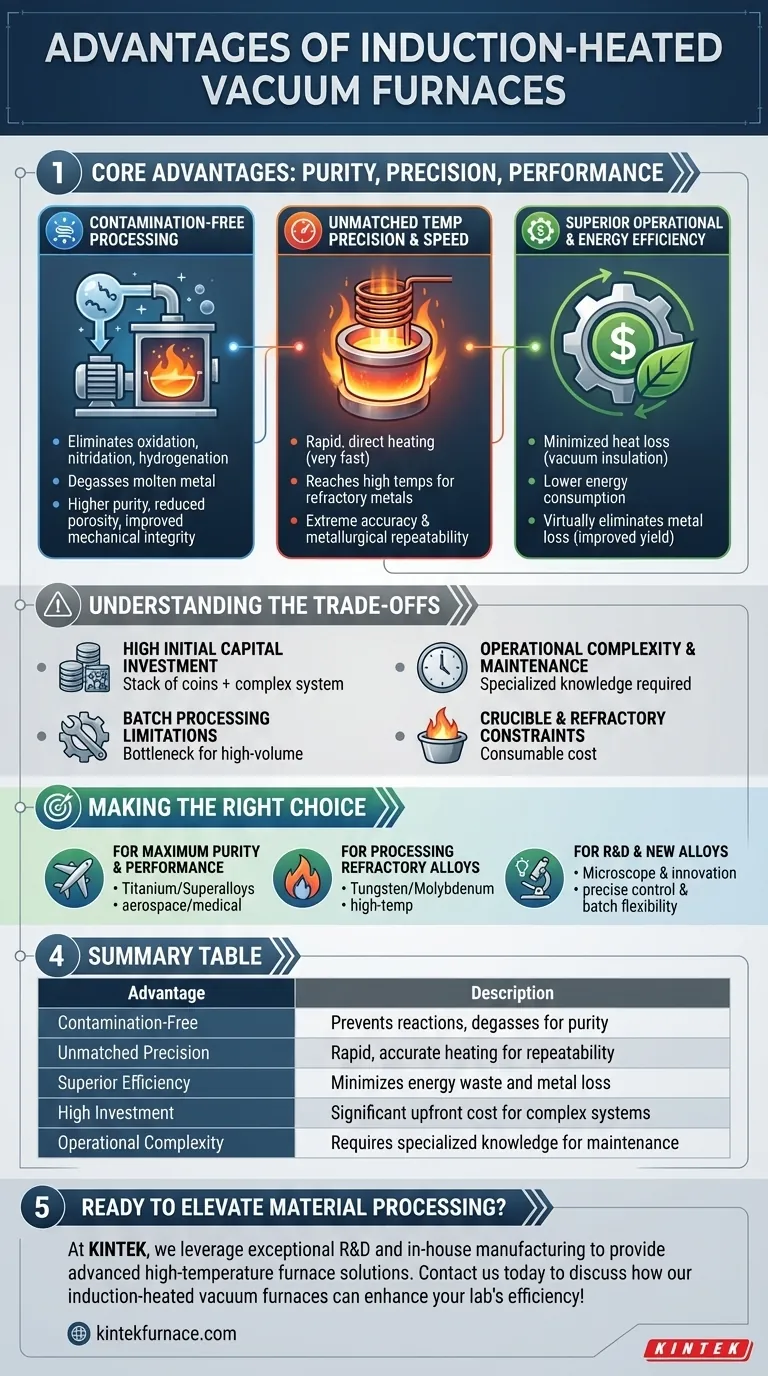
Visual Guide
Related Products
- 600T Vacuum Induction Hot Press Vacuum Heat Treat and Sintering Furnace
- Vacuum Induction Melting Furnace
- Vacuum Hot Press Furnace Machine Heated Vacuum Press Tube Furnace
- Vacuum Hot Press Furnace Machine Heated Vacuum Press
- 2200 ℃ Graphite Vacuum Heat Treat Furnace
People Also Ask
- Why use Vacuum Hot Press (VHP) for ZnS Ceramics? Achieve Superior IR Transparency and Mechanical Strength
- How does a vacuum hot press sintering furnace mitigate copper sintering swelling? Solve Fe-Cu Expansion Issues
- How does the vacuum environment in a vacuum hot press sintering furnace protect chromium-containing ceramics? Find out.
- What is the core function of a vacuum hot press sintering furnace in the preparation of high-density RuTi alloys? Achieve Maximum Density and Purity
- What are the key advantages of vacuum hot press sintering furnaces? Achieve Superior Density and Purity in Materials



















