
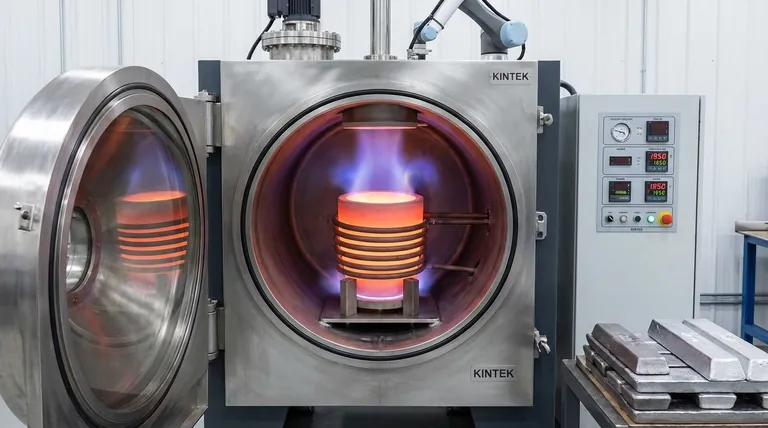
The critical role of a Vacuum Induction Melting (VIM) furnace is to melt high-purity elements into metal ingots while maintaining a strictly controlled, inert environment. By operating under vacuum or an argon-protected atmosphere, the furnace prevents the oxidation of highly reactive iron and aluminum, ensuring the final FeAl alloy achieves exact chemical specifications and exceptional purity.
The Core Insight Producing Iron-Aluminum (FeAl) alloys requires battling the natural reactivity of aluminum at high temperatures. The VIM furnace solves this by isolating the melt from atmospheric oxygen, serving as the definitive tool for guaranteeing the chemical uniformity and structural integrity of the base material.
The Mechanics of Purity in FeAl Preparation
Preventing Elemental Oxidation
The most immediate challenge in preparing FeAl alloys is the high reactivity of the raw materials, particularly aluminum and iron.
When exposed to the extreme heat required for melting (often reaching 1900 to 2000 °C), these elements will instantly react with oxygen if exposed to air.
The VIM furnace mitigates this by creating an absolute barrier against the atmosphere. By utilizing a vacuum or backfilling with inert argon gas, it stops oxides from forming and contaminating the melt.
Ensuring Precise Chemical Composition
Beyond simple protection, the VIM process ensures that the ratio of iron to aluminum remains consistent with the intended design.
In open-air melting, the loss of elements due to oxidation or evaporation acts as a variable that ruins consistency.
The controlled environment of a VIM furnace inhibits the loss of these alloying elements. This stability ensures that the chemical composition of the final ingot matches the original base material formulas precisely.
Elimination of Gaseous Impurities
A crucial advantage of the VIM furnace is its ability to refine the material at a molecular level.
The vacuum environment does not just exclude outside air; it actively facilitates the removal of dissolved gases already present in the raw materials.
Impurities such as oxygen, nitrogen, and hydrogen are drawn out of the molten metal. Removing these gases is essential for preventing porosity and ensuring the high-quality foundation needed for subsequent processing, such as gas atomization.
Operational Considerations and Trade-offs
Balancing Vacuum and Volatility
While high vacuum is excellent for removing impurities, it introduces a specific trade-off regarding element retention.
Under extreme vacuum conditions, certain volatile elements may evaporate from the melt, potentially altering the alloy's composition.
To counter this, operators must utilize inert gas backfilling (typically high-purity argon). This creates a protective pressure that suppresses the evaporation of volatile components while still preventing oxidation, striking a critical balance between purity and composition stability.
Making the Right Choice for Your Goal
When integrating VIM technology into your material preparation workflow, consider your specific objectives:
- If your primary focus is material purity: Prioritize the furnace's vacuum capabilities to maximize the removal of dissolved gases like nitrogen and hydrogen from the molten matrix.
- If your primary focus is compositional accuracy: Rely on the argon-backfill features to prevent the evaporation loss of volatile alloying elements during the high-temperature melt.
Ultimately, the Vacuum Induction Melting furnace is not just a heating vessel; it is a precision instrument that locks in the quality of your FeAl alloy from the very first step.
Summary Table:
| Feature | Impact on FeAl Alloy Preparation | Benefit to Material Quality |
|---|---|---|
| Vacuum Environment | Removes dissolved gases (H, O, N) | Prevents porosity and internal defects |
| Argon Protection | Inhibits oxidation and evaporation | Ensures exact stoichiometric composition |
| Induction Heating | Reaches 1900°C - 2000°C | Rapid, uniform melting of iron and aluminum |
| Inert Barrier | Blocks atmospheric oxygen | Maintains high chemical purity levels |
Elevate Your Material Purity with KINTEK Precision Solutions
Achieving the perfect FeAl alloy requires the absolute control that only a specialized furnace can provide. Backed by expert R&D and manufacturing, KINTEK offers high-performance Vacuum, Muffle, Tube, Rotary, and CVD systems designed to meet the rigorous demands of advanced metallurgy. Our customizable lab high-temperature furnaces empower researchers and manufacturers to lock in chemical uniformity and eliminate impurities from the start.
Ready to refine your melting process? Contact us today to discuss your unique project needs and see how KINTEK can deliver the tailored equipment your laboratory deserves.
References
- Rubén del Olmo, Marta Michalska-Domańska. Anodization of FeAl Alloy in Boric-Sulfuric Acid: Band Gap Tuning Via Copper Doping and Annealing. DOI: 10.1007/s11661-025-07914-1
This article is also based on technical information from Kintek Furnace Knowledge Base .
Related Products
- Vacuum Induction Melting Furnace
- 600T Vacuum Induction Hot Press Vacuum Heat Treat and Sintering Furnace
- Vacuum Heat Treat Sintering and Brazing Furnace
- Small Vacuum Heat Treat and Tungsten Wire Sintering Furnace
- Vacuum Heat Treat Sintering Furnace Molybdenum Wire Vacuum Sintering Furnace
People Also Ask
- What are the core functions of the High Vacuum Induction Melting (VIM) furnace? Optimize DD5 Superalloy Purification
- What are the technical advantages of using a Vacuum Induction Melting furnace in the development of advanced packaging steel?
- Why is a Vacuum Induction Melting furnace (VIM) used for Cu-Zn-Al-Sn alloys? Achieve Precision Composition Control
- What role does a Vacuum Induction Melting furnace play in the production of high-aluminum nickel-based superalloys?
- What are the advantages of using a VIM furnace to control residual oxygen pressure? Achieve Superior Metal Uniformity



















