
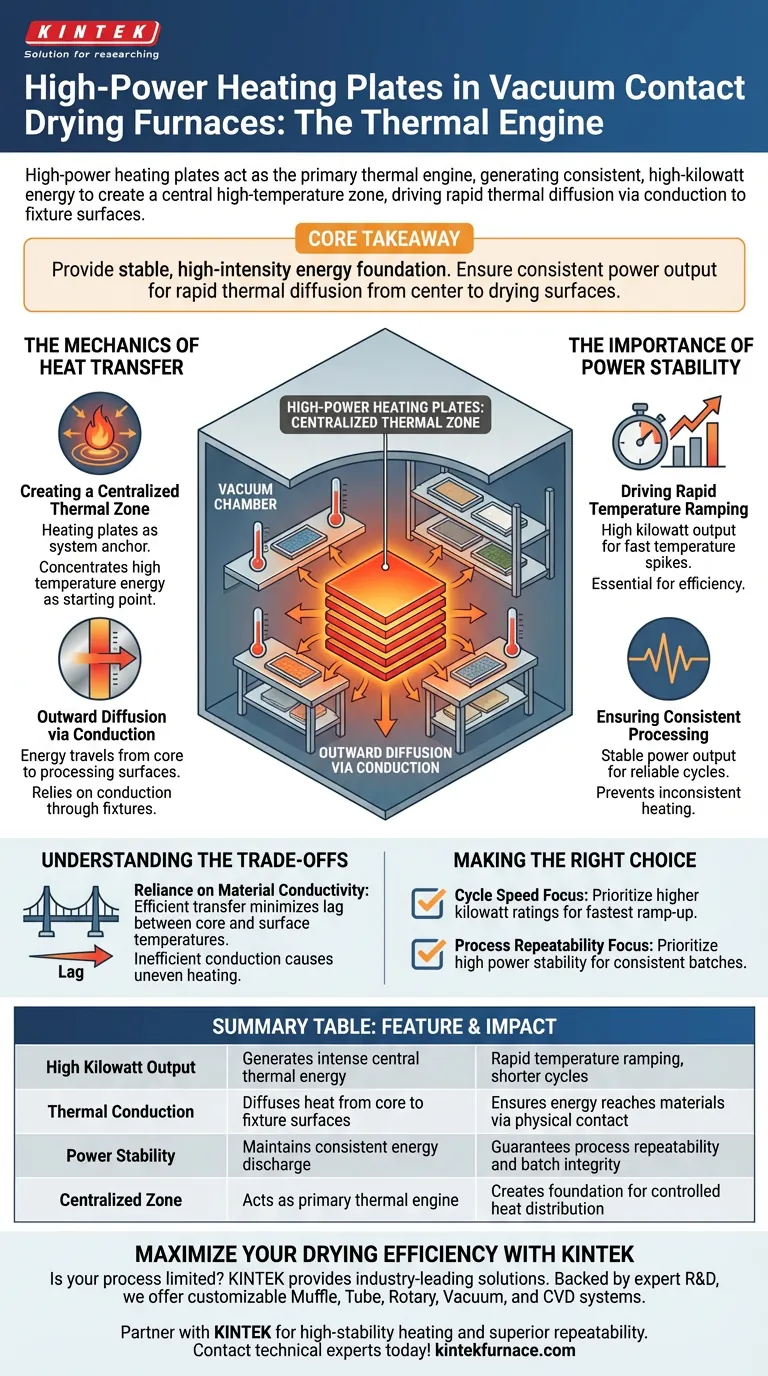
High-power heating plates function as the primary thermal engine within vacuum contact drying furnaces. They serve as the central heat source, generating consistent thermal energy—often in the range of several kilowatts—to establish a high-temperature zone at the core of the system's fixtures. This intense heat is then transferred outward via conduction to rapidly raise fixture surface temperatures to the required processing levels.
Core Takeaway: These plates provide the stable, high-intensity energy foundation required to drive the drying process. Their role is not just generating heat, but ensuring consistent power output to enable rapid thermal diffusion from the center of the fixture to the drying surfaces.
The Mechanics of Heat Transfer
Creating a Centralized Thermal Zone
The heating plate acts as the anchor for the system's thermal dynamics.
By positioning the heat source centrally, the system creates a focused zone of high temperature. This concentration of energy is the starting point for the entire drying operation.
Outward Diffusion via Conduction
Once the central zone is heated, the energy must travel to the actual processing surfaces.
The system relies on conduction to move this heat. The thermal energy diffuses outward from the high-power plates, spreading across the fixtures to reach the materials being dried.
The Importance of Power Stability
Driving Rapid Temperature Ramping
Efficiency in vacuum drying often depends on how quickly you can reach the target temperature.
High-power plates are essential here because they provide the sheer volume of energy needed to spike the temperature of the fixture surfaces rapidly. Without high kilowatt output, the ramp-up time would be significantly slower.
Ensuring Consistent Processing
The drying process requires reliability.
The heating plates must deliver stable power output. Fluctuations in power would lead to inconsistent heating, potentially compromising the integrity of the drying cycle.
Understanding the Trade-offs
Reliance on Material Conductivity
Because the heat is generated centrally and diffuses outward, the system is heavily dependent on the conductive properties of the fixture materials.
If the thermal transfer is inefficient, you may experience a lag between the core temperature and the surface temperature. The high power at the center must be effectively managed to ensure it reaches the edges uniformly.
Making the Right Choice for Your Process
When evaluating vacuum contact drying furnaces, the specifications of the heating plates directly impact performance.
- If your primary focus is Cycle Speed: Prioritize plates with higher kilowatt ratings to ensure the fastest possible temperature ramp-up times.
- If your primary focus is Process Repeatability: Ensure the plates are rated for high stability in power output to guarantee consistent thermal diffusion across every batch.
High-power heating plates are the critical component that transforms electrical energy into the kinetic thermal force required for efficient vacuum drying.
Summary Table:
| Feature | Function in Vacuum Drying | Impact on Performance |
|---|---|---|
| High Kilowatt Output | Generates intense central thermal energy | Enables rapid temperature ramping and shorter cycles |
| Thermal Conduction | Diffuses heat from core to fixture surfaces | Ensures energy reaches materials via physical contact |
| Power Stability | Maintains consistent energy discharge | Guarantees process repeatability and batch integrity |
| Centralized Zone | Acts as the primary thermal engine | Creates the foundation for controlled heat distribution |
Maximize Your Drying Efficiency with KINTEK
Is your process limited by slow heating cycles or inconsistent thermal distribution? KINTEK provides industry-leading vacuum drying solutions engineered for precision. Backed by expert R&D and manufacturing, we offer a comprehensive range of Muffle, Tube, Rotary, Vacuum, and CVD systems, as well as other lab high-temp furnaces—all fully customizable to meet your unique processing needs.
Partner with KINTEK to leverage high-stability heating technology that ensures rapid temperature ramping and superior repeatability. Contact our technical experts today to design the perfect thermal solution for your laboratory or industrial application!
Visual Guide
References
- Lili Zhao, Bo Qi. Research on Temperature Field Characteristics of Lithium Battery Vacuum Drying Furnace. DOI: 10.56028/aetr.11.1.63.2024
This article is also based on technical information from Kintek Furnace Knowledge Base .
Related Products
- 2200 ℃ Tungsten Vacuum Heat Treat and Sintering Furnace
- 9MPa Air Pressure Vacuum Heat Treat and Sintering Furnace
- 2200 ℃ Graphite Vacuum Heat Treat Furnace
- Molybdenum Vacuum Heat Treat Furnace
- Vacuum Heat Treat Furnace with Ceramic Fiber Liner
People Also Ask
- How does a tungsten-heated vacuum sintering furnace prepare (TbxY1-x)2O3 ceramics? Achieve 99%+ Density & Purity
- How do compaction pressure and vacuum sintering optimize porous ceramics? Maximize Density & Toughness
- What wear-resistance enhancements are achieved by powder coating? The Role of Vacuum Sintering Furnaces
- What role does a high-temperature vacuum sintering furnace play in the densification of WC-10(Ni, Ni/Co) alloys?
- How does high-temp vacuum sintering influence Y-TZP mechanical properties? Achieve Max Toughness



















