
A vacuum annealing furnace is a critical requirement for post-processing titanium alloys produced via Laser Powder Bed Fusion (PBF-LB/M) because it addresses the structural instabilities created by the printing process.
The rapid heating and cooling cycles inherent to PBF-LB/M lock in severe residual stresses and brittle microstructures that must be corrected to prevent part failure. The vacuum environment is specifically required to perform this high-temperature correction without allowing the highly reactive titanium to oxidize and degrade.
By combining high heat with an oxygen-free environment, vacuum annealing simultaneously relieves manufacturing stresses, transforms brittle internal structures into tough, medical-grade material, and preserves the alloy's surface integrity.
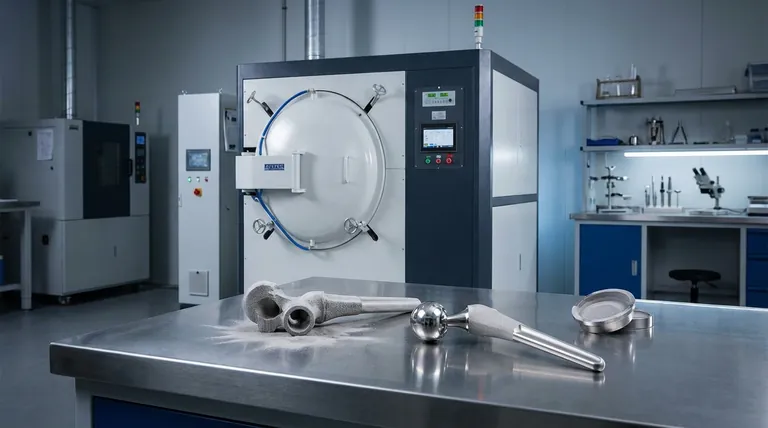
Resolving the Thermal History of PBF-LB/M
The additive manufacturing process creates a unique thermal history that dictates the need for post-processing.
Counteracting Rapid Cooling Rates
PBF-LB/M involves melting metal powder with a laser, which then solidifies almost instantly.
This extreme cooling rate traps significant tension within the material. Without relief, these internal forces can cause the part to distort or crack prematurely.
Eliminating Residual Stress
The vacuum annealing furnace heats the material to allow relaxation.
This process effectively eliminates the residual stresses accumulated during the layer-by-layer construction. It stabilizes the part's geometry, ensuring it maintains its shape during use.
Optimizing Microstructure for Performance
Beyond simple stress relief, the furnace fundamentally alters the metal's internal grain structure to meet engineering standards.
Transforming Brittle Phases
As printed, titanium alloys often exhibit a martensitic microstructure.
This structure is hard but inherently brittle, making it unsuitable for high-load applications. It lacks the ductility required for dynamic environments.
Achieving Alpha+Beta Equilibrium
Annealing at temperatures around 1,050°C facilitates a phase transformation.
The heat converts the brittle martensite into a tougher alpha+beta mixed-phase structure. This specific microstructure is often a requirement for meeting rigorous medical implant standards.
The Critical Role of the Vacuum Environment
You cannot simply heat titanium in a standard industrial oven; the atmosphere must be strictly controlled.
Preventing High-Temperature Oxidation
Titanium is highly reactive to oxygen, especially at annealing temperatures like 1,050°C.
In a standard atmosphere, the alloy would oxidize rapidly, compromising its mechanical properties. The vacuum environment creates a protective shield, preventing this chemical reaction entirely.
Ensuring Uniform Heating
Vacuum furnaces provide a distinct advantage regarding thermal consistency.
They deliver uniform heating across the entire component. This ensures that the stress relief and ductility enhancements are consistent throughout the part, rather than just on the surface.
Understanding the Operational Trade-offs
While necessary, vacuum annealing introduces specific constraints that must be managed.
Equipment Complexity and Cost
Vacuum furnaces are significantly more complex than standard atmospheric ovens.
They require robust pumping systems and precise leak control to maintain the vacuum. This increases both the initial capital investment and ongoing maintenance requirements.
Process Cycle Time
The process is not instantaneous.
To achieve the full transformation from martensitic to alpha+beta phases, the material must be held at heat for a specific duration. This adds time to the overall manufacturing workflow compared to using as-printed parts.
Making the Right Choice for Your Goal
The necessity of this process depends on the specific failure modes you are trying to prevent in your final application.
- If your primary focus is mechanical toughness: You need vacuum annealing to transform the brittle martensitic structure into the ductile alpha+beta phase required for load-bearing or medical applications.
- If your primary focus is geometric stability: You must use this process to relieve the residual stresses from rapid cooling, preventing the part from warping after it is removed from the build plate.
- If your primary focus is surface integrity: You rely on the vacuum environment to prevent the formation of a brittle oxide layer (alpha-case) that would otherwise form at high temperatures.
Vacuum annealing is the bridge that turns a printed titanium shape into a reliable, engineering-grade component.
Summary Table:
| Feature | PBF-LB/M As-Printed Condition | Post-Vacuum Annealing Result |
|---|---|---|
| Microstructure | Brittle Martensitic Phase | Tough Alpha+Beta Mixed Phase |
| Internal Stress | High Residual Stress (Risk of Cracking) | Relieved Stress (Geometric Stability) |
| Surface Quality | High Oxidation Risk at Temperature | Oxidation-Free / Preserved Integrity |
| Ductility | Low (Brittle) | High (Medical/Engineering Grade) |
| Thermal Uniformity | N/A | High Consistency via Vacuum Heating |
Elevate Your Additive Manufacturing with KINTEK
Don't let residual stress or oxidation compromise your titanium components. Backed by expert R&D and precision manufacturing, KINTEK offers specialized Vacuum, Muffle, and CVD furnace systems tailored for the rigorous demands of PBF-LB/M post-processing. Whether you need standard thermal treatment or fully customizable high-temp solutions, our equipment ensures your titanium alloys reach medical-grade excellence with uniform heating and reliable phase transformation.
Ready to optimize your post-processing workflow? Contact our experts today to find the perfect furnace solution for your laboratory or production line.
References
- Mirko Teschke, Frank Walther. Microstructural, Electrochemical, and Mechanical Assessment of Additive Manufactured Titanium Grade 23 for Dental Implants Application. DOI: 10.21873/invivo.13978
This article is also based on technical information from Kintek Furnace Knowledge Base .
Related Products
- Vacuum Heat Treat Sintering Furnace with Pressure for Vacuum Sintering
- 2200 ℃ Tungsten Vacuum Heat Treat and Sintering Furnace
- Small Vacuum Heat Treat and Tungsten Wire Sintering Furnace
- Vacuum Heat Treat Sintering Furnace Molybdenum Wire Vacuum Sintering Furnace
- Molybdenum Vacuum Heat Treat Furnace
People Also Ask
- How does vacuum heat treating affect the grain structure of metal alloys? Achieve Precise Microstructure Control
- What is one of the most important uses of vacuum heat treating furnaces in aerospace? Achieve Superior Strength in Aircraft Alloys
- What are the benefits of using vacuum heat treating furnaces for metal alloys? Achieve Superior Metal Properties and Performance
- What is the purpose of setting a mid-temperature dwell stage? Eliminate Defects in Vacuum Sintering
- What are the key components of a vacuum sintering furnace? Essential Parts for Precision Material Processing



















